GuidePeople5 min
Breathing exercises for teens and students
Exams, group chats, scrolling at 1am, the corridor before a presentation: some days your breathing goes quick and high before you’ve noticed anything’s wrong. These breathing exercises for teens take a minute or two, and nobody needs to know you’re doing them. Start with this one.

Which breathing exercises for teens help with anxiety?
Slow ones, with a longer breath out. When you’re stressed, your breathing speeds up and moves into your chest, which makes your heart race more and the feeling louder. Slowing the out-breath works the other way: your heart slows slightly each time you breathe out, so a longer out-breath gives it more time to settle. Practise one with  Breathform on an ordinary evening, and it’s already familiar on the day it counts.
Heart racing right now? The physiological sigh.
The fastest one: 10 rounds take 90 seconds, and it looks like ordinary breathing.
- Breathe in through your nose for 2 seconds.
- Take a second, shorter sniff on top, 1 second, to fill right up.
- Breathe out slowly through your mouth for 6 seconds.
- Do it 5 to 10 times. If you feel light-headed, breathe normally for a moment.
In a month-long trial with 108 adults, 5 minutes a day of cyclic sighing lifted mood more than mindfulness meditation (Balban et al. 2023).
Full guide: physiological sigh
About to walk into an exam? Box breathing.
Even and steady, for staying composed before something.
- Breathe in through your nose for 4 seconds.
- Hold for 4, keeping your jaw and shoulders loose.
- Breathe out for 4, then rest for 4.
- Repeat for 2 minutes. If 4 feels long, use 3.
In one trial of 66 adults, people who did 5 minutes of box breathing before a stressful test had smaller rises in heart rate and anxiety than people who breathed normally (McAllister et al. 2026).
Full guide: box breathing · and the corridor routine in breathing exercises for public speaking and exams
Can’t switch off at 1am? 4-7-8, four rounds.
A long hold and a longer out-breath, to put the day down. If it’s the scroll that keeps you up, start with how to stop doomscrolling.
- Phone face-down, out of reach. Lie on your back or side.
- Breathe in through your nose for 4 seconds, hold for 7, breathe out through your mouth for 8.
- Do 4 rounds, just over a minute. If the hold feels like too much, shorten it.
Popular, with limited research: in one lab comparison, plain slow breathing raised heart rate variability more (Marchant et al. 2025).
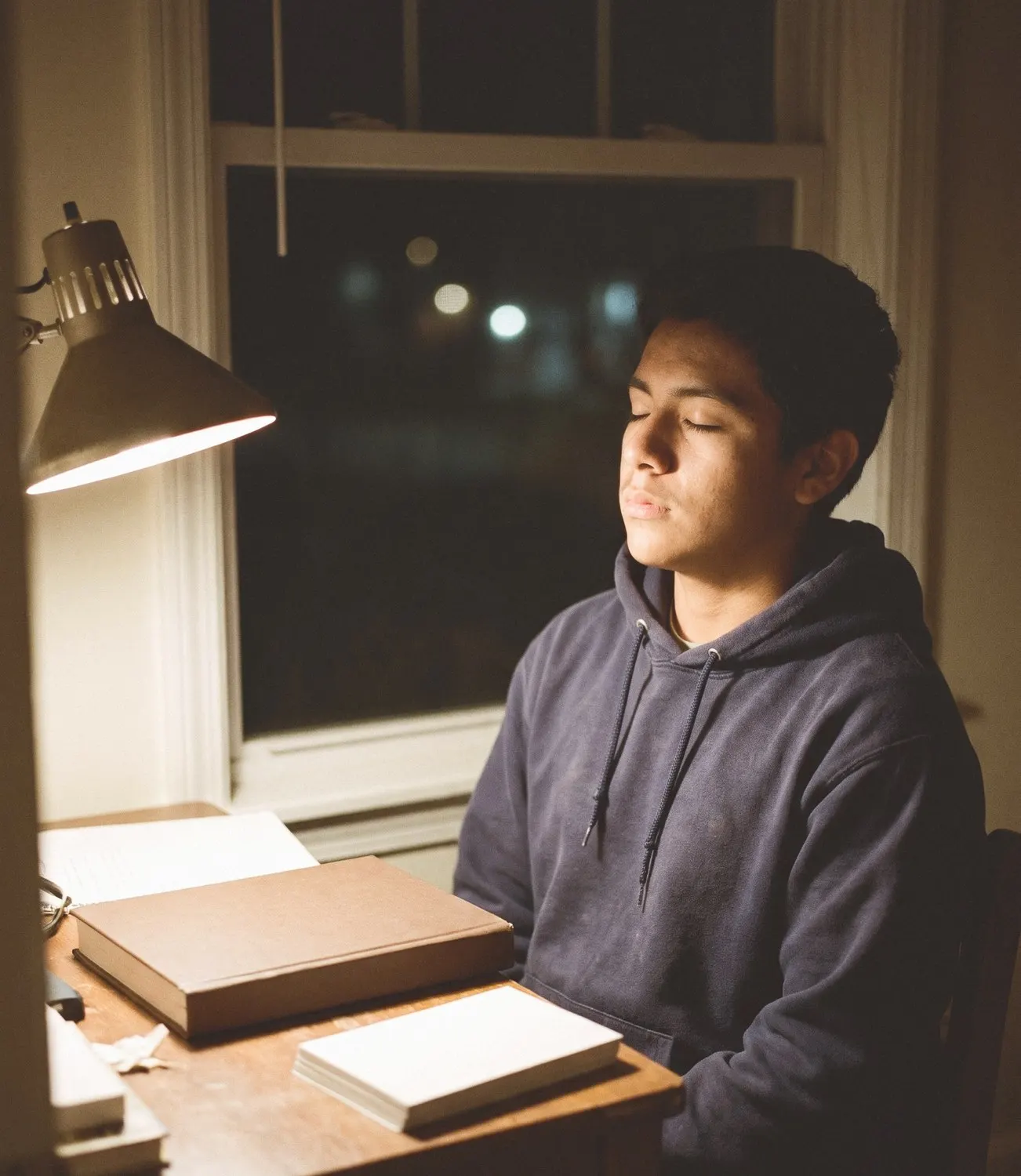
What’s a good breathing exercise before an exam?
Box breathing, or a few sighs, then a couple of easy breaths. Do it outside the room, or at your desk before you turn the paper over.
Routine · 2 minutes
The 2-minute exam routine
- 5 physiological sighs, about 45 seconds, to take the edge off.
- 4 rounds of box breathing, about a minute, to steady your focus.
- One ordinary breath, then turn the paper over and read the first question twice.
Run through it once or twice at home first, so on the day it feels automatic.
How can students calm down quickly in class?
Use a version nobody will notice. Keep your mouth closed and breathe in through your nose for 4, out for 6. Press your feet into the floor as you breathe out. Or trace up and down the fingers of one hand under the desk, one breath per finger. If your class does breathing breaks together, breathing exercises for the classroom is the version your teacher might use.
Do breathing exercises help with school stress?
In one study, 139 university students did a short session of slow breathing with a longer out-breath, or let their minds wander. The breathers did better on a memory test straight afterwards, and felt less stressed for a while (Pilcher et al. 2025). In younger students, a few deep breaths before a timed maths test lowered anxiety and lifted scores (Khng 2017).
Over weeks, it’s less clear. In a pilot with 43 final-year students, a 5-week slow-breathing course didn’t change anxiety scores, and practice dropped off over the weeks (Bentley et al. 2022).
So: a quick tool for a hard moment, not a fix for a hard term. If things feel like a lot most of the time, talk to someone you trust: a friend, a parent, a teacher or your GP.
How well each breath is studied
- Physiological sighSome evidence
- Box breathingSome evidence
- 4-7-8 breathingEarly research or tradition
Every study on this page (6)
- Balban et al., 2023: Five minutes a day of cyclic sighing lifted mood a little more than mindfulness meditation, in 108 adults.
- McAllister et al., 2026: In 66 adults facing a stress test, box breathing or a long out-breath beforehand softened the rise in heart rate and anxiety.
- Marchant et al., 2025: In 84 students, six breaths a minute raised heart-rhythm signs of calm modestly more than box or 4-7-8 breathing; none changed mood.
- Pilcher et al., 2025: 139 undergraduates randomised to one brief session of slow-paced breathing with a longer out-breath, or mind-wandering: the breathing group did better on a working-memory test, and their mood and stress improved for a while.
- Khng, 2017: 122 Primary 5 students (about age 11): taking deep breaths before a timed maths test reduced self-reported anxiety and improved test performance compared with a control group.
- Bentley et al., 2022: Pilot with 43 final-year high school students: a 5-week slow diaphragmatic breathing curriculum was feasible and well tolerated, but practice dropped off over the weeks and anxiety scores did not change significantly.
Questions people ask
Is box breathing good for teens?
Yes. It’s simple, silent and easy to do in an exam hall: in for 4, hold for 4, out for 4, rest for 4. If the holds feel tight, make every side 3 seconds, or shorten just the holds. It’s best before something, like a test, a match or a presentation. For calming down after something, a longer out-breath usually works better.
Can breathing help teens sleep?
It can help you wind down, which is half the battle. Put your phone face-down out of reach first, then try 4-7-8 or a simple 4 in, 6 out for a few minutes. Breathing won’t knock you out, but it gives a busy head something calmer to do than replaying the day. Breathing exercises for sleep has more.
Is there a breathing exercises PDF for teens?
You don’t really need one: the timers on this page work in your phone’s browser and keep the count for you. If you’d like something to stick inside a folder or on a wall, printable breathing exercises has cards for box breathing, the sigh and more.
What if breathing exercises make me feel worse?
That happens to some people, especially if focusing on your body makes you more aware of a racing heart. Keep your eyes open, count in your head and make only the out-breath longer. If you feel light-headed, take a few normal breaths. Or try tracing your hand instead: five-finger breathing gives your eyes and hands something to do.
Practices in this guide
Read next
In the moment · 5 min
Breathing exercises for public speakingKids · 5 min
Breathing exercises for the classroomTechnique · 8 min
Box breathing (square breathing)Technique · 6 min
Physiological sigh (cyclic sighing)Long read · 9 min
Breathing exercises for sleepGuide · 5 min
How to stop doomscrolling
More in People
Long read · 8 min
Breathing exercises for pregnancyGuide · 6 min
Breathing techniques for labourTechnique · 6 min
Lamaze breathing (patterned breathing)Technique · 6 min
Hypnobirthing breathing (up and down breathing)Guide · 5 min
Postpartum breathing exercisesGuide · 5 min
Breathing exercises for seniors and older adultsGuide · 6 min
How to breathe while running
Breathe gently, never strain, and stop if you feel dizzy, light-headed or short of breath.