GuideEveryday5 min
How to stop doomscrolling
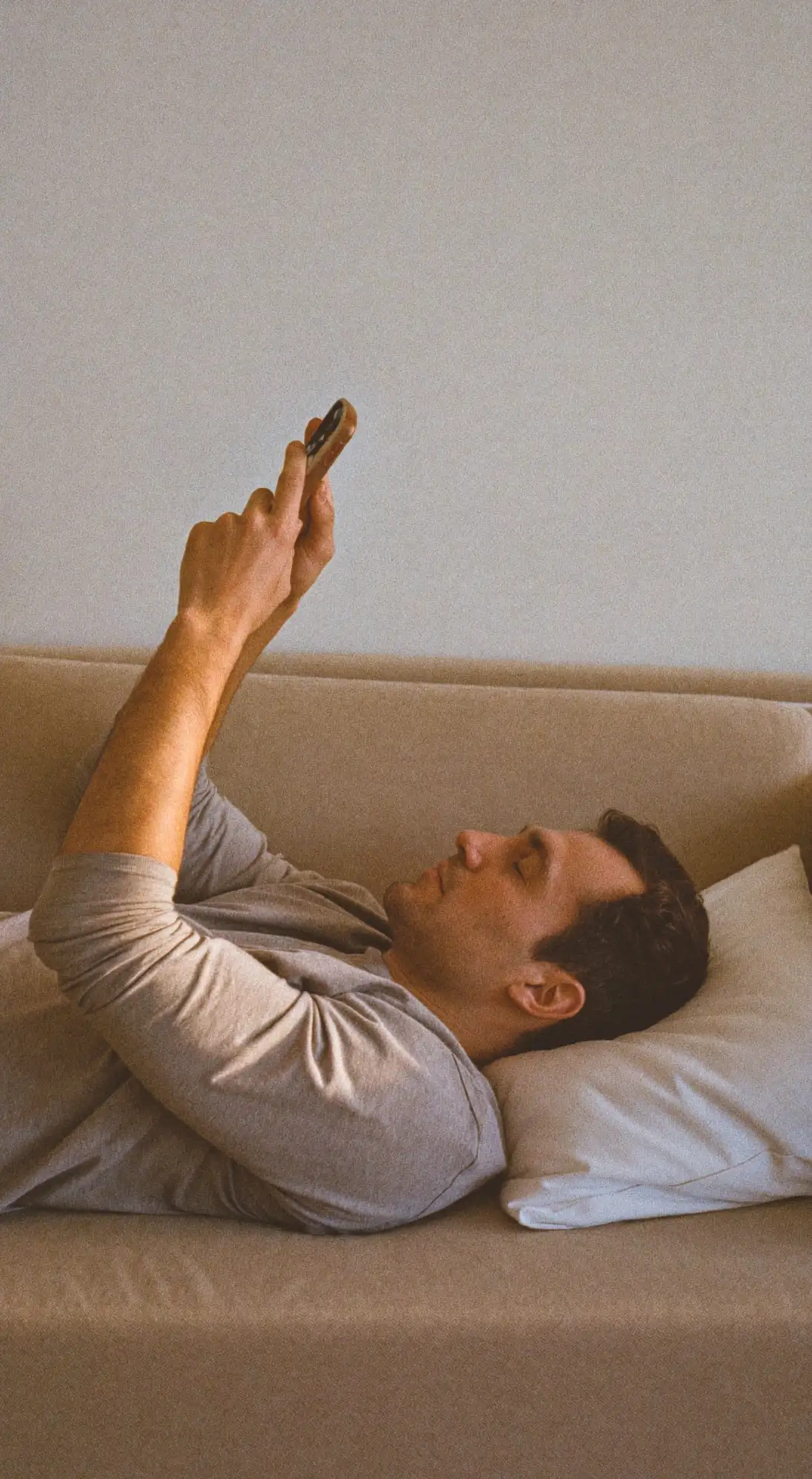
You picked the phone up to check one thing. Twenty minutes later you’re still going, and you feel worse. The feed has no bottom, so there’s never a natural place to stop. The way out is the second before you start.
Why can’t I stop doomscrolling?
Because it runs on habit, not on choice. In a study that filmed people’s days with small wearable cameras, 89% of their phone interactions were started by the person, not by a notification, and they followed routines that had built up over time (Heitmayer and Lahlou 2021).
That’s good news, in a way. A habit has a cue, and a cue is something you can catch: the hand going to your pocket, the lift doors closing, the kettle starting to boil. Change what happens in that second and the rest gets easier.
How do you stop doomscrolling?
Use the reach as the signal for a breath. Here’s the one-minute version.
- Catch the reach. The moment your hand goes for the phone, that’s the cue.
- Put the phone face down, or keep it in your hand with the screen dark.
- Look up and find three things around you: a window, a colour, a sound.
- Breathe in for 4 seconds and out for 5, five times, eyes open.
- Then choose. If there’s something you need, unlock and do it. If not, leave it where it is.
The looking-up part is borrowed from grounding: it moves your attention out of your head and into the room. The full breath, with more ways to use it, is in grounding breathing.
A few things make the reach rarer in the first place: notifications off for anything that isn’t a person, the feed apps off your Home Screen, and the phone in another room when you’re working or eating.
How to stop doomscrolling at night
Take the phone out of the bedroom, or at least out of reach, and put a slow breath where the scroll used to be.
There’s a small trial on exactly this swap. Young adults who spent 15 minutes each evening on app-guided slow breathing, about 6 breaths a minute, rated their sleep better after 30 days than a group who spent the same 15 minutes on social media (Laborde et al. 2019).
If you use your phone for the breath, keep the screen out of sight:  Breathform keeps going with the phone locked and face down, guided by soft tones. When it’s worry rather than habit that keeps you scrolling, racing thoughts at night has a breath for that, and breathing exercises for sleep has four more for four kinds of night.
Does cutting down on your phone actually help?
The trials suggest it does, a little.
In 143 students, limiting Facebook, Instagram and Snapchat to 10 minutes each a day for three weeks lowered loneliness and depression compared with using them as usual (Hunt et al. 2018).
In 154 adults, a one-week break from four big social media apps improved wellbeing, depression and anxiety scores compared with carrying on as usual (Lambert et al. 2022).
Both trials were short, and people knew which group they were in, which can colour how they rate their own mood.
So: cutting back seems to help, and you don’t need to quit outright. The breath is simply the tool for the moment the habit kicks in.
How well each breath is studied
- Grounding breathingSome evidence
- 4-6 breathingWell studied
Every study on this page (4)
- Heitmayer and Lahlou, 2021: Using wearable first-person cameras (37 users, about 200 hours, 1,130 smartphone interactions), 89% of smartphone interactions were initiated by users rather than by notifications, and interactions followed routines and habits.
- Laborde et al., 2019: In 64 healthy young adults, a month of 15-minute evening slow-breathing sessions improved self-rated sleep more than time on social media.
- Hunt et al., 2018: 143 undergraduates randomised to limit Facebook, Instagram and Snapchat to 10 minutes per platform per day for three weeks showed significant reductions in loneliness and depression compared with usual use.
- Lambert et al., 2022: 154 adults randomised to stop using Facebook, Instagram, Twitter and TikTok for one week reported better well-being and lower depression and anxiety scores than those who carried on as usual.
What if you need your phone for work?
Then keep the phone and change the reach. Before you unlock, take one slow breath out and name what you’re opening it for. If you can’t name it, put it down. At a desk, a minute of breathing between tasks does the same job as a minute of scrolling, without the drift: there’s a one-minute version in breathing exercises at work. And if you’re a student juggling group chats at 1am, breathing exercises for teens and students is written for you.
Questions people ask
Why is doomscrolling so hard to stop?
Because it isn’t really a decision. In one study that filmed people’s days with small wearable cameras, 89% of phone interactions were started by the person, not by a notification, and they followed routines and habits. A habit runs before you’ve thought about it, which is why a cue you can catch, like the hand going to your pocket, works better than willpower mid-scroll.
How do I stop doomscrolling before bed?
Make it harder and give your hands something else. Charge your phone outside the bedroom or across the room, and use a slow breath as the last thing you do instead: 4-6 breathing, lights off, for 5 to 10 minutes. In one trial, young adults who spent 15 minutes each evening on slow breathing rated their sleep better after a month than those who spent it on social media.
Does a break from social media help anxiety?
In one trial it did, a little. 154 adults who stopped using four big social media apps for a week reported better wellbeing and lower depression and anxiety scores than people who carried on as usual. It was short and self-reported, but a week is an easy experiment to try for yourself.
Should I delete social media?
You don’t have to. In a trial of 143 students, limiting three social apps to 10 minutes each a day for three weeks lowered loneliness and depression compared with using them as usual. Cutting back may be enough. Start with the app you open most without meaning to, and put a breath where its icon used to be.
Practices in this guide
Read next
Technique · 5 min
Grounding breathingLong read · 9 min
Breathing exercises for sleepGuide · 5 min
Racing thoughts at nightTechnique · 6 min
Mindful breathing (breathing meditation)Guide · 5 min
Breathing exercises for teens and students
More in Everyday
Long read · 7 min
Breathing exercises for focusIn the moment · 5 min
Breathing exercises for public speakingIn the moment · 5 min
Breathing for flight anxietyIn the moment · 4 min
Breathing exercises at workIn the moment · 4 min
Morning breathing exercises: a 3-minute routine
Breathe gently, never strain, and stop if you feel dizzy, light-headed or short of breath.