GuidePeople5 min
Postpartum breathing exercises
The weeks after a birth come in small pieces: a feed, a nappy, an hour of sleep. A slow breath fits into any of them. These postpartum breathing exercises do two jobs: steadying you at the 3am feed, and gently reconnecting your breath with your pelvic floor and tummy.
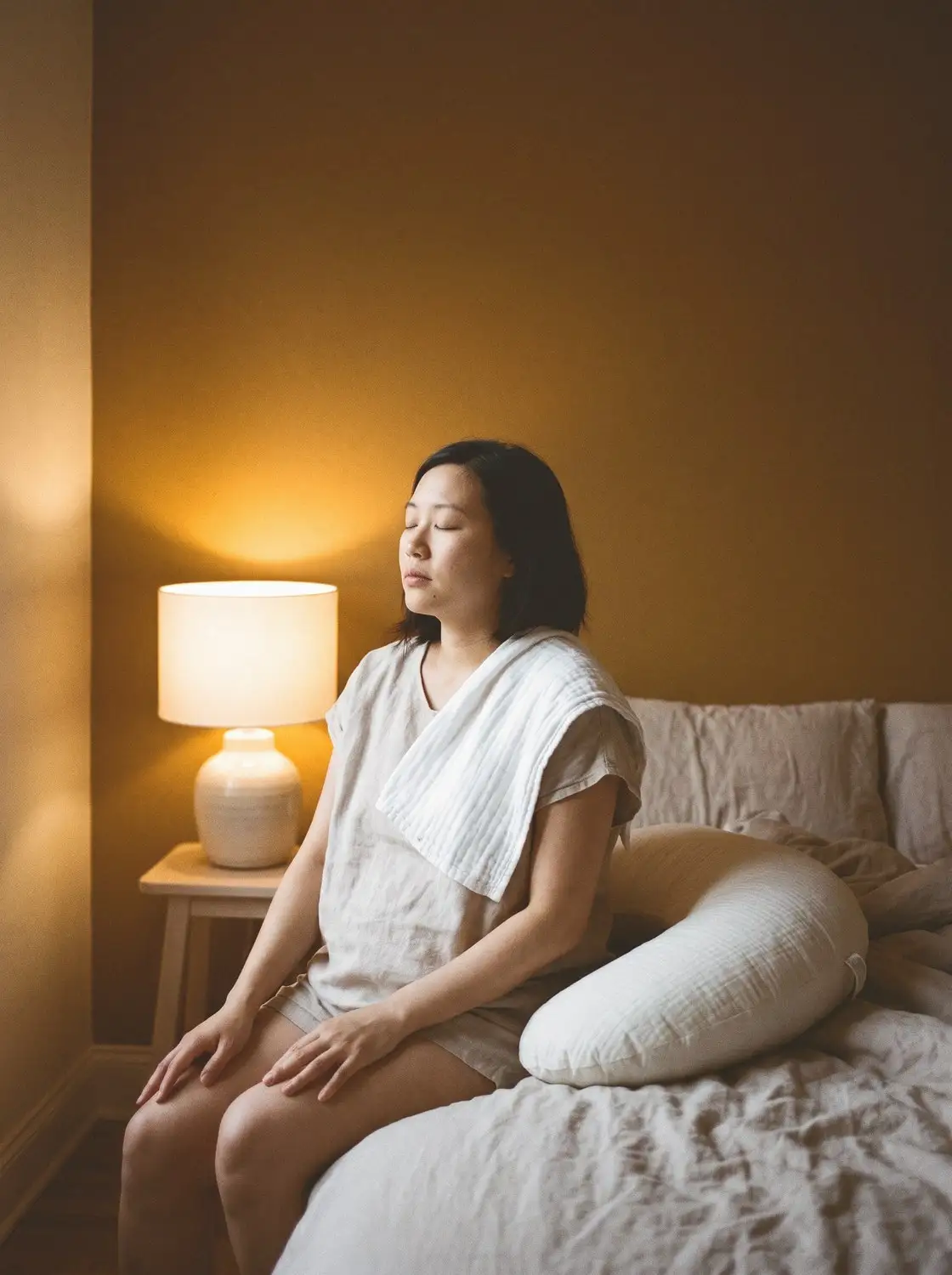
When can I start postpartum breathing exercises?
Slow, gentle breathing is fine from the first day after giving birth, whatever kind of birth you had. Start the connection breath below whenever it feels comfortable, lying on your side or propped up on pillows. If you had stitches, a difficult birth or a caesarean, keep everything soft and small.
What is pelvic floor breathing?
It’s a slow breath that reconnects three things pregnancy stretched: your diaphragm, your pelvic floor and your deep tummy muscles. Pelvic health physios often call it the connection breath. It works because your pelvic floor moves with your breath anyway: it relaxes as you breathe in and draws up a little as you breathe out (Talasz et al. 2022).
- Lie on your side or your back with your knees bent, or sit upright. One hand on your lower ribs, one low on your belly.
- Breathe in through your nose for 6 seconds. Let your ribs widen, your belly rise and your pelvic floor soften, like a balloon gently filling.
- Breathe out for 6 seconds. As you do, gently lift your pelvic floor, as if picking up a blueberry, and let your lower tummy draw in a little.
- Let go fully before the next breath. The release matters as much as the lift.
- Do 5 to 8 breaths, 2 or 3 times a day. If 6 feels long, use 4 or 5. Keep the lift gentle, never a hard squeeze.
The NHS also suggests regular pelvic floor squeezes: long ones held for up to 10 seconds and quick ones, about 10 of each, 3 times a day, breathing normally throughout. That training is the best-studied part of recovery: in a 2025 review, it cut the odds of leaking urine in the first year by about a third (Beamish et al. 2025).
Can breathing help diastasis recti?
Not on its own, but it’s often a first step. A gap between the two long tummy muscles is very common after pregnancy, and it usually closes by itself by about 8 weeks. The connection breath gently wakes up the deep muscles that physios then build on with specific exercises. Abdominal exercise programmes have reduced the gap in studies, though the evidence is low certainty (Beamish et al. 2025).
Leave sit-ups, planks and heavy lifting for later, and breathe out as you lift your baby or get up from the floor rather than holding your breath.
What breathing helps postpartum anxiety?
A slow breath with a longer out-breath, like the 4-6 breath at the top of this page. When worry spikes, try two breaths in through your nose, the second a small top-up, and one long breath out, the physiological sigh, then return to 4-6. Across 12 trials in adults, breathwork lowered stress a little more than control activities did, though not specifically in new parents (Fincham et al. 2023). Breathing exercises for anxiety has more to choose from.
Feeling tearful and up and down in the first couple of weeks is very common. If the low days don’t lift, or worry starts to take over, tell your midwife, health visitor or doctor.
What’s a breathing exercise for the 3am feed?
The quiet one. Once your baby is latched or settled with a bottle, drop your shoulders and breathe in through your nose for 4, out for 6, so softly nobody else would hear. Let each out-breath loosen your jaw and hands. A dozen breaths is about 2 minutes.
When the crying won’t stop and you feel it rising in you, it’s fine to put your baby down safely in their cot, step into the next room and take 10 slow breaths before you go back. Afterwards, awake at 3am has a breath for getting back to sleep.
Can breathing help me sleep with a newborn?
It may help you settle in the gaps, though it can’t give back the hours. When you get the chance to lie down, turn onto your side and breathe 4-6 with the lights low until you lose count. If counting keeps you awake,  Breathform can keep it for you on a dark screen. If you lie there wired instead, that’s common in the early weeks: rest still counts. For more on belly breathing itself, see diaphragmatic breathing, and for the months before the birth, breathing exercises for pregnancy.
Every study on this page (3)
- Talasz et al., 2022: The pelvic floor muscles work with the abdominal muscles as breathing-out muscles: they contract during the out-breath and relax during the in-breath; holding the breath in during effort loads the pelvic floor.
- Beamish et al., 2025: Systematic review and meta-analysis of 65 studies (21,334 participants) in the first year after birth: pelvic floor muscle training reduced the odds of urinary incontinence by 37% (moderate certainty); abdominal exercise training reduced the gap between the tummy muscles more than no exercise (low certainty).
- Fincham et al., 2023: Pooled trials suggest breathwork modestly eases stress, anxiety and low mood compared with control groups, though most trials had weaknesses.
Questions people ask
Can I do breathing exercises after a caesarean?
Yes. Gentle, slow breathing is fine from the first day, and it’s often easier lying on your side or propped up. Hold a pillow over your wound if you need to cough or laugh. Your pelvic floor still matters after a caesarean, since pregnancy itself puts weight on it, so the connection breath is worth learning too. Your midwife can tell you when to do more.
How often should I do pelvic floor breathing?
Little and often. A few rounds of the connection breath, 2 or 3 times a day, is a good start, and pairing it with feeds makes it easy to remember. The NHS suggests pelvic floor squeezes 3 times a day too, so you can do both together: a few connection breaths first, then your squeezes.
Is it normal for breathing to feel different after the birth?
Yes. With your baby no longer pressing up under your ribs, there’s room for a fuller breath again, and many people notice it within days. Tiredness and worry can make breathing feel quick and high instead. Sudden breathlessness, chest pain or coughing up blood in the weeks after the birth is different: call emergency services straight away (999 in the UK, 911 in the US).
When should I see a pelvic health physio?
If you leak when you cough, sneeze or run, feel heaviness or dragging low down, have pain during sex or in your pelvis, or your tummy gap is still obvious at about 8 weeks. Your GP can refer you, and in some areas you can refer yourself. A pelvic health physio can check how things are healing and give you exercises that fit.
Practices in this guide
Read next
Long read · 8 min
Breathing exercises for pregnancyGuide · 6 min
Breathing techniques for labourIn the moment · 5 min
Waking up at 3am? A breath for getting back to sleepTechnique · 7 min
Diaphragmatic breathing (belly breathing)Long read · 10 min
Breathing exercises for anxiety
More in People
Technique · 6 min
Lamaze breathing (patterned breathing)Technique · 6 min
Hypnobirthing breathing (up and down breathing)Guide · 5 min
Breathing exercises for teens and studentsGuide · 5 min
Breathing exercises for seniors and older adultsGuide · 6 min
How to breathe while running
Breathe gently, never strain, and stop if you feel dizzy, light-headed or short of breath.