KidsAges 4 to 145 min
Breathing exercises for the classroom
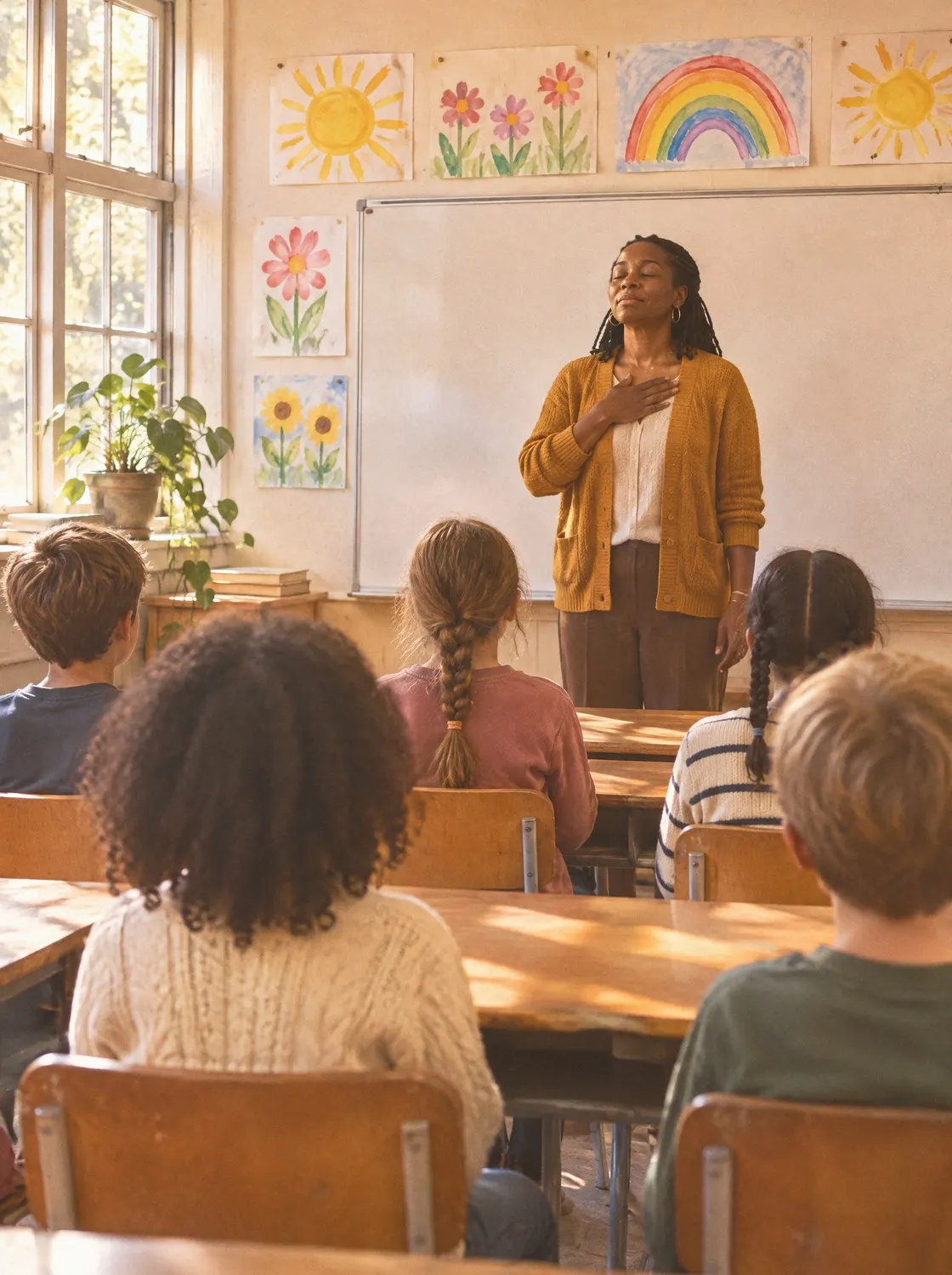
A class that has just come in from break, or is about to sit a test, can settle in two minutes if everyone breathes together. These breathing exercises for the classroom come with scripts to read aloud, by age, and shapes to trace on the whiteboard.
How do you teach breathing exercises in the classroom?
By doing them with the class, the same way, at the same times. After break, before a test, at the end of a long afternoon. Keep it to a minute or two, and lead with your own slow breath: children follow your pace more than your words. A few minutes of your own with  Breathform, before the class arrives, makes that pace easier to lead.
- Make it an invitation. “You can close your eyes or look at the floor.” Anyone can sit quietly instead.
- Give the eyes a job. Draw a star, a triangle or a square on the whiteboard and trace it as you breathe.
- Breathe out longer than in. That’s the settling part, at any age.
- Keep holds short or skip them with younger children: 2 or 3 seconds at most.
- Practise on calm days, so it’s familiar when the class is wound up.
If a child has asthma, follow their care plan and let them breathe in whatever way feels comfortable.
What are good breathing exercises for kindergarten?
For ages 4 to 6: breaths with a picture and a story. Star breathing is a good start: up a point as you breathe in, down as you breathe out. So is smell the flower, blow out the candle.
For a whole-body version, try balloon breathing: hands on tummies, and blow the balloon up slowly.
Read it slowly, and breathe along yourself:
Let’s blow up a balloon in our tummies. Hands on your tummy. Breathe in through your nose… and feel the balloon get bigger. Now let the air out slowly, like a balloon floating down… all the way. Let’s do it again. In… bigger… and out… slowly. One more. How does your tummy feel now?
Which breathing exercises for the classroom suit ages 7 to 10?
Shapes with a count. The triangle at the top of the page is ideal on a whiteboard: in up one side, hold down the other, out along the bottom. 5 triangles take about 45 seconds. Five-finger breathing needs nothing at all: children trace their own hand under the desk.
Look at the triangle. Breathe in as we go up this side: 1, 2, 3. Hold as we come down the other side: 1, 2, 3. Breathe out slowly along the bottom: 1, 2, 3. And again. Keep your shoulders soft. Last one… and let your breathing go back to normal.
Are there breathing exercises for older students?
Yes: the same breaths, introduced as what athletes and performers use. From 11, box breathing at adult counts suits tests and presentations: in for 4, hold for 4, out for 4, rest for 4. Keep the language grown-up, skip the stories and explain the why in one line: a slow out-breath slows your heart a little each time.
Older students can take it further on their own with breathing exercises for teens and students.
How long should a classroom breathing break be?
One to three minutes. With 4 to 6 year olds, 5 breaths is plenty: about 30 seconds. Older classes can manage 2 or 3 minutes. Stop while it’s still going well.
Routine · 2 minutes
The 2-minute settle after break
- Lights low, voice low. “Sit tall, feet on the floor.”
- 6 easy breaths: in for 2, out for 4, through soft lips, to bring the noise down.
- 6 triangles on the board, traced together.
- One ordinary breath, then a quiet first instruction.
Which breathing exercises work with the Zones of Regulation?
Any of them. Many schools use the Zones of Regulation, a curriculum that sorts feelings into four colours. Breathing is one of the calming tools often listed for the yellow and red zones. Star and box breathing are easy to draw on a zones poster, so children can choose one when they notice they’re wound up.
Do classroom breathing exercises work?
In one study of 122 children aged 10 or 11, taking a few deep breaths before a timed maths test lowered their anxiety and improved their scores (Khng 2017).
Bigger programmes are a different matter. In a trial across 84 UK secondary schools with 8,376 students, 10 lessons of mindfulness training were no better than usual teaching for wellbeing a year later (Kuyken et al. 2022).
So: a short breath helps a class settle in the moment, and it’s free. Treat it as a calm habit, not an answer to every hard day. More breaths for children of every age are in breathing exercises for kids.
How well each breath is studied
- Triangle breathingEarly research or tradition
- Box breathingSome evidence
- Pursed-lip breathingSome evidence
Every study on this page (2)
- Khng, 2017: 122 Primary 5 students (about age 11): taking deep breaths before a timed maths test reduced self-reported anxiety and improved test performance compared with a control group.
- Kuyken et al., 2022: MYRIAD cluster randomised trial in 84 UK schools (8,376 students aged 11 to 14): 10 lessons of school-based mindfulness training were no better than usual social-emotional teaching for depression risk, wellbeing or social-emotional functioning at 1 year.
Questions people ask
How do I get a class to calm down after break time?
Don’t wait for silence first: start breathing and let them join you. Lower the lights if you can, drop your voice and put the star or triangle on the board. Lead 5 slow breaths, then 1 minute of quiet tracing. The same routine at the same time every day probably matters more than which breath you choose: the habit does half the work.
Should children close their eyes during breathing exercises?
Only if they want to. Offer a choice: eyes closed, or eyes resting on the floor or the board. Some children feel uneasy with their eyes closed in a room full of people, and looking at a shape gives them something to follow. Tracing breaths work with eyes open, which is one reason they suit classrooms so well.
What if some children won’t join in?
That’s fine. Invite, never insist, and let them sit quietly or watch the board. Many children join in once it’s a normal part of the timetable. Some find focusing on their breath uncomfortable: tracing a shape with a finger or counting the points of the star gives them another way in.
Are there printable breathing cards for the classroom?
Yes. A set of cards on a ring or a poster by the door lets children pick a breath themselves, which helps it feel like theirs. Printable breathing exercises has cards to print and laminate, and children can colour in their own shapes too.
Read next
Kids · 8 min
Breathing exercises for kidsKids · 4 min
Star breathingKids · 4 min
Five-finger breathing (hand breathing)Kids · 4 min
Box breathing for kidsGuide · 5 min
Breathing exercises for teens and studentsTool · 3 min
Printable breathing exercises
More in Kids
Kids · 4 min
Rainbow breathingKids · 4 min
Balloon breathingKids · 4 min
Smell the flower, blow out the candle (hot chocolate breathing)Kids · 3 min
Lazy 8 breathing (figure 8 breathing)Kids · 4 min
Animal breaths for kidsKids · 4 min
Lion’s breathKids · 4 min
Breathing exercises for kids to sleep
Breathe gently, never strain, and stop if you feel dizzy, light-headed or short of breath.