Field guideWith holds
Box breathing (square breathing)
In the Breathform app, this is Box breathing
Follow the dot around the box: up as you breathe in, across as you hold, down as you breathe out, along the bottom as you rest.
- Pattern
- In 4 · hold 4 · out 4 · rest 4
- Pace
- 3.75 breaths a minute
- Length
- 2 min · 8 rounds
- Evidence
- Some evidence
How do you do box breathing?
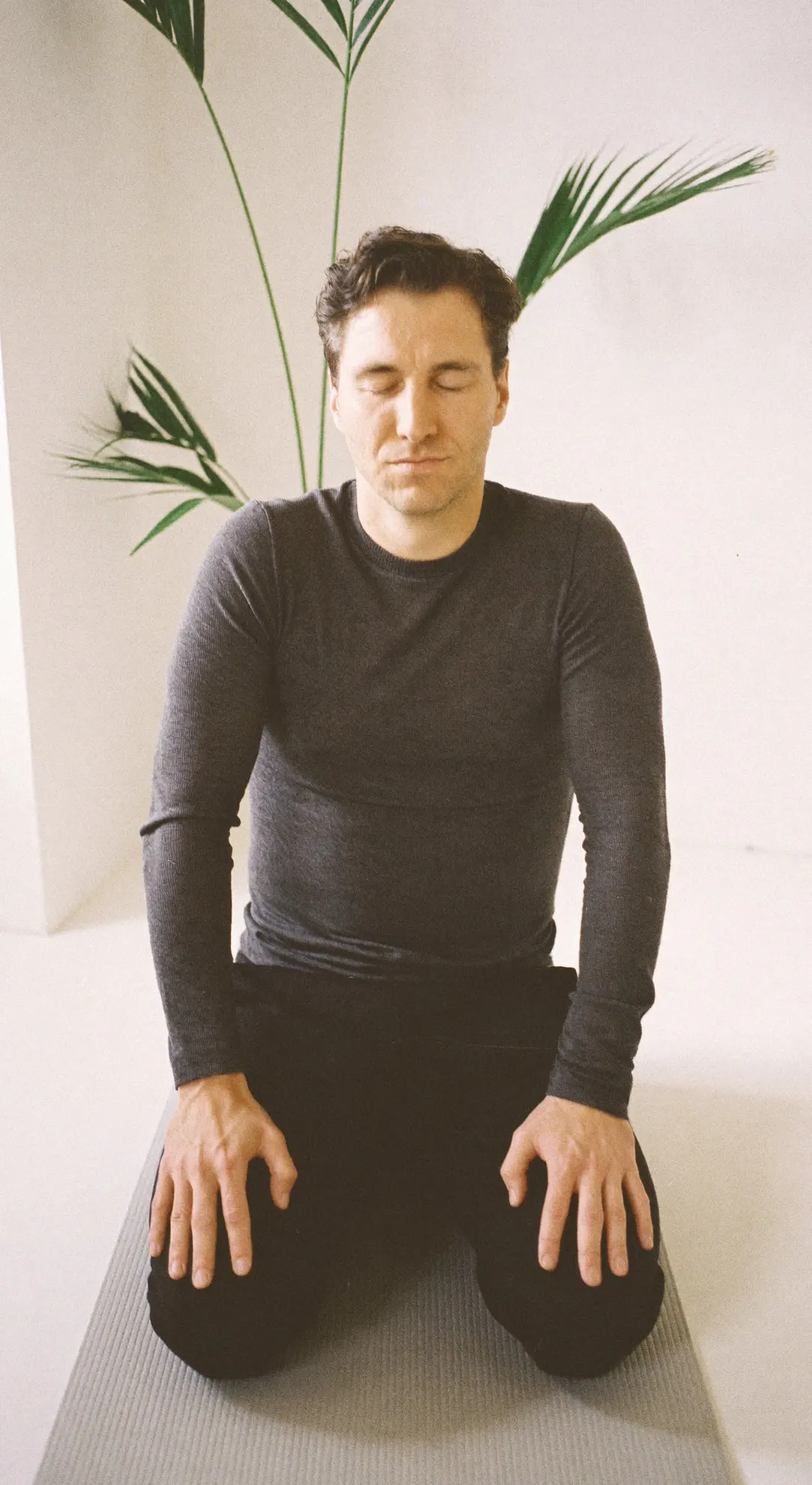
Sit with your back supported and your feet flat. Close your eyes if you like, once the count is in your head.
- Breathe in through your nose for 4 seconds. Let your belly and ribs widen first.
- Hold for 4 seconds. Keep your jaw and shoulders soft: it’s a pause, not a clench.
- Breathe out slowly for 4 seconds, through your nose or softly parted lips. Let your shoulders drop.
- Rest for 4 seconds with your lungs comfortably empty, then begin the next breath.
- Repeat for 8 rounds, about 2 minutes. If 4 feels long, try 3. If the holds make you tense, shorten them to 2: the slow pace matters more than the shape. If you feel light-headed, take a few normal breaths and carry on more gently.

How long should you do box breathing?
Two minutes is a good start: 8 rounds of 16 seconds. In the studies, people used it for 1 to 5 minutes at a time (Riedl et al. 2026, McAllister et al. 2026). If 4 seconds feels long, use 3. The slow pace matters more than the exact count.
You don’t need to sit on the floor or close your eyes. Any seat that lets your belly move will do, and a minute in the corridor counts as much as ten on a mat.
Is there a box breathing timer?
Yes: the box at the top of this page is one. Press Start and follow the dot. It walks up the left side as you breathe in, across the top as you hold, down as you breathe out and along the bottom as you rest. The buttons beside it set the count to 3, 4 or 5 seconds a side, and the plus and minus change how many rounds you do. For 5 minutes, the length used in the longer trials, set it to 19 rounds.
Without a screen, count slowly in your head (in, two, three, four) or follow the second hand of a clock. Tension tends to speed the count up, so if you notice it rushing, slow the next side down. A steady count matters more than an exact one. Or let  Breathform hold the pace: a soft tone marks each side, and it doesn’t hurry when you do.
| Each side | One round | Pace | 8 rounds |
|---|---|---|---|
| 3 seconds | 12 s | 5 breaths a minute | 1:36 |
| 4 seconds · default | 16 s | 3.75 breaths a minute | 2:08 |
| 5 seconds | 20 s | 3 breaths a minute | 2:40 |
Start at 3 if you’re new to it or doing it with children. Move to 4 once the holds feel easy, and to 5 only if you’d like a slower, deeper rhythm.
When is box breathing useful?
Whenever you’d like to feel steady before something: the call, the talk, the exam, the hard conversation. There’s a short routine for the corridor in breathing exercises for public speaking. Four equal sides give your attention one simple thing to follow, so it’s good when your thoughts scatter. It’s quiet, too. Nobody on the train or in the lift needs to know you’re doing it. When anxiety is what you’re steadying, breathing exercises for anxiety has more breaths to choose from.
What can you expect? Most people feel a little steadier within a few rounds: a slower breath, quieter shoulders, a thought that finishes before the next one starts. Some days it takes longer, and that’s fine. What box breathing won’t do is flood you with oxygen. At rest your blood is already nearly full of it. The change is in your pace, and in where your attention goes.
Why do Navy SEALs use box breathing?
You’ll often read that box breathing is the Navy SEAL breathing technique. Some military and police training does teach a box-style count, usually called tactical or combat breathing, for staying composed under pressure. The appeal is simple: a count you can follow with your eyes open slows your breathing and gives a busy mind one small job.
It isn’t a military invention, though. Counted breaths with holds have a long history in yoga, and most people now learn box breathing from teachers, therapists and breathing apps. Research on tactical breathing itself is still thin. In one lab study, 30 people tried both tactical breathing and a long out-breath while doing a timed task under rising noise. Tactical breathing kept their bodies calmer, while the long out-breath helped them perform better (Röttger et al. 2021).
What does the research say?
Box breathing has been tested in a handful of small trials. In one, 66 adults were split into three groups before a stressful virtual test. Those who did 5 minutes of box breathing had a smaller rise in heart rate and anxiety than those who breathed normally (McAllister et al. 2026). It was a single session, and cortisol, the main stress hormone, didn’t respond in any group.
In a smaller pilot, one minute of box breathing in real-life tense moments was linked to less anxiety five minutes later (Riedl et al. 2026). In a month-long Stanford trial, box breathing lifted mood within each session, but over the month it didn’t do significantly better than mindfulness meditation (Balban et al. 2023).
For heart rate variability (the small beat-to-beat changes that tend to grow when you’re at rest), plain slow breathing at 6 breaths a minute did better in a head-to-head test (Marchant et al. 2025). Straight after hard exercise, box breathing was also linked to a higher heart rate than 6 breaths a minute (Kasap & Aydin 2025).
So: a sensible tool for a tense moment, with modest, early evidence.
Every study on this page (6)
- Riedl et al., 2026: In a small pilot, one minute of box breathing or cyclic sighing in tense moments eased students' anxiety more than no exercise.
- McAllister et al., 2026: In 66 adults facing a stress test, box breathing or a long out-breath beforehand softened the rise in heart rate and anxiety.
- Röttger et al., 2021: In 30 people under lab pressure, tactical breathing calmed the body more, while a long out-breath helped performance more.
- Balban et al., 2023: Five minutes a day of cyclic sighing lifted mood a little more than mindfulness meditation, in 108 adults.
- Marchant et al., 2025: In 84 students, six breaths a minute raised heart-rhythm signs of calm modestly more than box or 4-7-8 breathing; none changed mood.
- Kasap & Aydin, 2025: In 40 active students recovering from hard cycling, box breathing left heart rate and felt effort higher than six breaths a minute.
Why does box breathing feel hard?
- The holds feel tight. Shorten them to 2 seconds and keep the in and out at 4, or try triangle breathing: one side fewer.
- Four feels long. Use 3 seconds a side. The count buttons under the box change it.
- You feel light-headed. Take a few normal breaths, then carry on more gently. Slower, not bigger.
- You clench on the hold. A hold is a pause, not a squeeze. Keep your jaw, throat and shoulders soft.
- Your mind wanders. That’s normal. Come back to the side you’re on: the dot keeps your place.
Can kids do box breathing?
Yes, with a shorter count. Three seconds a side suits most children, with a finger tracing the square in the air or on the table. Saying the sides out loud (up, across, down, along) helps younger ones keep the shape. Try it together:
Keep the holds short and soft for little ones. There are more games and shapes in box breathing for kids.
Box breathing or 4-7-8: which is better?
They do different jobs. Box breathing is even and steady, good for staying composed before something. 4-7-8 is slower, with a long out-breath, and is usually used to wind down before sleep. We put them side by side in box breathing vs 4-7-8. Breathform has both, free: Box breathing under More focused, and 4-7-8 as Relax, under Ready to rest.
If neither suits you, each of the other breaths changes one thing. Shorter holds: anchor breathing, with 2-second pauses. An even rhythm: coherent breathing, slow breathing or interval breathing, with a short rest. A longer out-breath: 4-6 breathing, 4-2-6 breathing, 4-4-6 breathing, 4-4-6-2 breathing, grounding breathing or pursed-lip breathing. A quick lift: the physiological sigh or breathing for energy. No count at all: mindful breathing or the 3-minute breathing space. Every pattern by number is in breathing patterns, and the more intense styles are in types of breathwork.
Questions people ask
What is 4-4-4-4 breathing?
It’s box breathing written as its count: in for 4 seconds, hold for 4, out for 4 and rest for 4. The four equal numbers are the four sides of the box. One round takes 16 seconds, so 8 rounds is about 2 minutes. If 4 feels long, 3-3-3-3 keeps the same shape at a quicker pace.
How many times a day can you do box breathing?
As often as it helps. A couple of minutes before something that matters is plenty. In one trial, people practised for 5 minutes a day for 28 days. It’s easiest to keep up if you tie it to something you already do every day, like the kettle boiling or the walk to work.
Why is it called tactical breathing?
Some soldiers and police officers learn a box-style pattern to stay composed under pressure, and call it tactical or combat breathing. The idea is the same as on this page: a steady count gives your attention one simple thing to hold when everything else is loud. Research on tactical breathing itself is still limited.
Does box breathing lower your heart rate?
It can stop it climbing as much. Adults who did 5 minutes of box breathing before a stressful test had a smaller rise in heart rate than those who breathed normally. For bringing a racing heart down, a breath with a longer out-breath and no holds is gentler: there’s more in how to lower your heart rate quickly.
Can I do box breathing with my eyes closed?
Yes, once the count is in your head. On this page the guide is visual. In the app, a haptic tap on your iPhone or Apple Watch marks each side, so you can close your eyes and keep your place.
Can box breathing help you sleep?
It can help you settle. For bedtime, breaths with a longer out-breath, such as 4-6 or 4-7-8, are the more usual choice: see breathing exercises for sleep. If box breathing is the one you know, try it lying down at 3 seconds a side and let the out-breath and the rest grow a little longer as you settle.
More on box breathing
Technique · 6 min
Physiological sigh (cyclic sighing)Technique · 7 min
Breathing patterns by numberSide by side · 6 min
Best breathing techniques: one honest tableQuestions · 6 min
Types of breathwork, from gentle to intenseKids · 8 min
Breathing exercises for kidsLong read · 7 min
Breathing exercises for focusIn the moment · 5 min
Breathing for flight anxietyQuestions · 5 min
Breathing exercises for beginners
If box breathing isn’t quite right
Technique · 5 min
Triangle breathingThree even sides to steady your attention.
In 3.5 · hold 3.5 · out 3.5 · In the app: Triangle
Technique · 5 min
Anchor breathing (4-2-4-2 breathing)Short pauses at the top and bottom that keep you present.
In 4 · hold 2 · out 4 · rest 2 · In the app: Anchor
Read next
Side by side · 5 min
Box breathing vs 4-7-8: which to use whenKids · 4 min
Box breathing for kidsLong read · 10 min
Breathing exercises for anxietyIn the moment · 5 min
Breathing exercises for public speaking
Breathe gently, never strain, and stop if you feel dizzy, light-headed or short of breath.