Start hereLights low
4-6 breathing, for 2 minutes
Long readSleep9 min
Breathing exercises for sleep
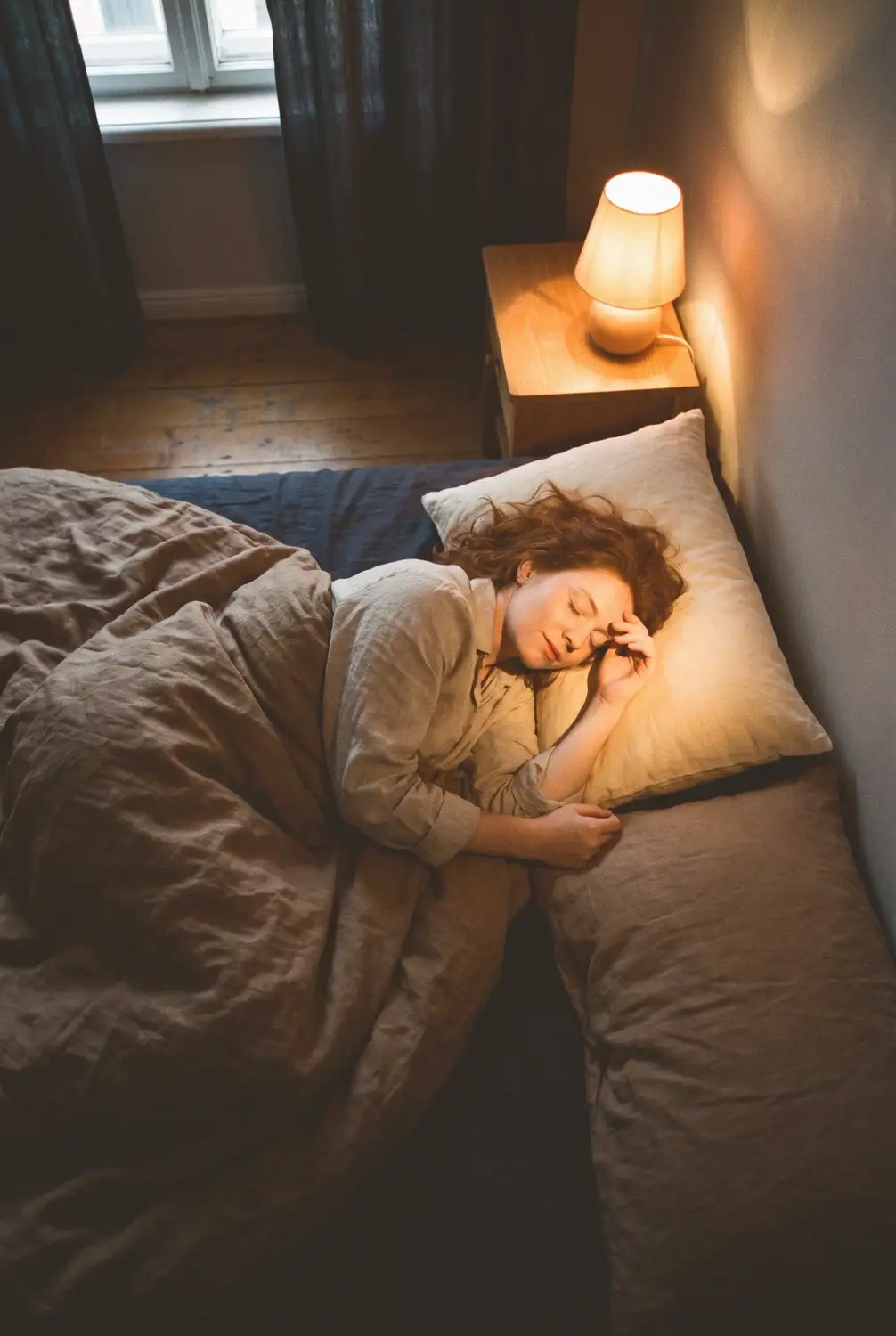
Lying awake, your breathing often stays a little quick and high, as if the day hasn’t quite ended. Slowing it down is one of the few things you can do in bed that doesn’t wake you up more. Of all the breathing exercises for sleep, the ones with a longer out-breath help most. Start with this one, lights low.
Why is it hard to switch off at night?
Stress keeps your body in day mode: a quicker heart, quicker breaths, a busy head. Quick, shallow breathing is part of that loop, and lying still in the dark you notice it more.
Your heart speeds up slightly as you breathe in and slows as you breathe out. A longer out-breath gives the slowing side more time. That’s why every breath below spends longer going out than coming in, or at least as long.
Which breathing exercises help you fall asleep?
Four breaths, for four kinds of night. Each one plays here with the lights low: press play, put your head back down and follow the tide with half an eye.
Mind still busy when the light goes off? Try 4-6 breathing.
The gentlest place to start: no holds, and the longer half on the way out.
- Lie on your back or your side, one hand on your belly.
- Breathe in through your nose for 4 seconds.
- Breathe out slowly for 6 seconds, through your nose or softly parted lips.
- Keep going for 5 to 10 minutes. If you lose count, start again from one.
Breathing at this pace raises heart rate variability, and slow breathing before bed improved self-reported sleep in small studies.
Full guide: 4-6 breathing
Want the classic? 4-7-8, four rounds.
Popularised by Dr Andrew Weil for winding down. The hold is long, so keep it comfortable.
- Breathe in quietly through your nose for 4 seconds.
- Hold for 7 seconds, softly, with your jaw loose.
- Breathe out through your mouth for 8 seconds, with a soft “whoosh”.
- Do 4 rounds, about 76 seconds. If the hold feels like too much, shorten it.
A popular technique with limited research and mixed short-term effects. In one lab comparison it raised heart rate variability less than plain breathing at 6 breaths a minute (Marchant et al. 2025). In a small study with no comparison group, heart rate and blood pressure dipped straight after it (Vierra et al. 2022).
Full guide: 4-7-8 breathing · or compare box breathing vs 4-7-8
Woke at 3am? Hum, quietly.
A low hum with your lips closed lengthens the out-breath on its own, and it’s quiet enough not to wake anyone.
- Stay lying down. Breathe in through your nose for 4 seconds.
- Breathe out for 6 seconds with a soft, low hum, lips closed.
- Feel the buzz in your face and chest. Keep it so quiet only you can hear it.
- A few minutes is plenty. Don’t check the time.
Small trials link humming breaths to higher heart rate variability. In one, blocking the sound made no difference, so the authors think the slow, long out-breath does the work (Kim et al. 2026).
Full guide: humming bee breath · and waking up at 3am
Rather follow an even count? Coherent breathing, 5 in and 5 out.
Six breaths a minute: close to the pace at which, for many adults, breathing and heart rhythm fall into step.
- Breathe in softly through your nose for 5 seconds.
- Breathe out for 5 seconds, as smooth as the in-breath.
- Keep it light for 10 to 15 minutes, or until you drift.
In one trial of 64 young adults, those who did 15 minutes of app-guided slow breathing, about 6 breaths a minute, each evening for 30 days rated their sleep better than a group who spent the time on social media (Laborde et al. 2019).
Full guide: coherent breathing
In  Breathform there’s also Open: six in and six out, the app’s slowest even rhythm, part of Breathform Full, for nights when you have a little more time.
What is the best breathing exercise for sleep?
The one you can follow half asleep. No study has crowned a winner: the research on sleep is about slow breathing in general, not one count. What the four above share is a slow pace, around 6 breaths a minute or slower, and an out-breath at least as long as the in-breath.
| Breath | One round | Choose it when |
|---|---|---|
| 4-6 breathing | 10 seconds | You want something easy, with no holds |
| 4-7-8, 4 rounds | 19 seconds | You like a clear count and a long, sinking out-breath |
| Humming | 10 seconds | You woke in the night and want to keep it quiet |
| Coherent, 5 and 5 | 10 seconds | You prefer an even rhythm for 10 minutes or more |
If you’re new to all of them, start with 4-6 breathing. It asks the least of you, and it’s hard to get wrong.
What about box breathing before bed?
It works if it’s the breath you already know. Box breathing is even and alert, built for staying steady before something, so at night it can feel a little brisk. Try it lying down at 3 seconds a side, then let the out-breath and the rest grow a little longer as you settle. More in box breathing.
Routine · 10 minutes
The 10-minute lights-out routine
- Lights off, phone face-down. Lie on your back or your side.
- 4 rounds of 4-7-8, about 76 seconds.
- Then 4-6 breathing for about 8 minutes, or until you lose count.
- If your mind wanders, don’t start over with effort. Just come back to the out-breath.
Breathing won’t knock you out. It can give you a quieter place to start from.
Do breathing exercises for sleep really help?
In a 2026 review of 9 studies with 457 people, slow breathing before bed improved how long and how well people said they slept. Sleep measured by devices and in sleep labs was inconclusive (Eide et al. 2026).
In a small sleep-lab study, 14 people with insomnia fell asleep sooner and woke less often after 20 minutes of slow breathing before bed (Tsai et al. 2015). And in a large review of heart-rate-variability biofeedback, the effects on sleep were among the smallest it found (Lehrer et al. 2020).
Relaxation also has a place in proper insomnia care: the American Academy of Sleep Medicine suggests relaxation therapy as one option for long-term insomnia, alongside its first choice, CBT for insomnia (Edinger et al. 2021).
So: a gentle way to wind down, with early, mostly self-reported evidence for sleep itself.
How well each breath is studied
- 4-6 breathingWell studied
- 4-7-8 breathingEarly research or tradition
- Humming bee breathSome evidence
- Coherent breathingWell studied
- Slow breathing (6-6)Some evidence
Every study on this page (10)
- Marchant et al., 2025: In 84 students, six breaths a minute raised heart-rhythm signs of calm modestly more than box or 4-7-8 breathing; none changed mood.
- Vierra et al., 2022: In 43 healthy young adults, heart rate and blood pressure dipped straight after 4-7-8 breathing, though quiet rest may partly explain it.
- Kim et al., 2026: In 24 healthy adults, humming slowed breathing to about six a minute; that pace, not the sound, seemed to affect heart rhythm.
- Laborde et al., 2019: In 64 healthy young adults, a month of 15-minute evening slow-breathing sessions improved self-rated sleep more than time on social media.
- Eide et al., 2026: Across nine studies, slow breathing before bed improved how well people felt they slept, but sleep-lab and tracker results were inconclusive.
- Tsai et al., 2015: In a small sleep-lab study, people reporting insomnia fell asleep sooner and woke less after 20 minutes of slow breathing before bed.
- Lehrer et al., 2020: Across 58 trials, breathing guided by live heart-rhythm feedback brought modest benefits, most for anxiety, low mood and performance, least for sleep.
- Edinger et al., 2021: The American Academy of Sleep Medicine guideline suggests relaxation therapy, and stimulus control, as single-component treatments for chronic insomnia in adults (conditional recommendations), and recommends multicomponent CBT for insomnia.
- Tang et al., 2007: People told to monitor a clock while trying to fall asleep reported more pre-sleep worry and took longer to fall asleep than those who didn’t, in both good and poor sleepers.
- Watso et al., 2023: In 20 young adults, breathing through the nose rather than the mouth slightly lowered blood pressure and raised heart-rhythm signs of calm.
How long should you breathe before sleep?
Start with 5 to 10 minutes. The studies above used 15 to 20 minutes an evening (Laborde et al. 2019, Tsai et al. 2015), so if it helps, give it longer. If you fall asleep first, that’s fine.
When it’s worry that keeps you up, racing thoughts at night has a breath for that, and falling asleep with anxiety goes further.
Can a breathing exercise help you fall asleep fast?
Not on a timer. Sleep comes when you stop chasing it, and a breath can’t switch it on. What a slow breath can do is take you out of the chase: it gives your attention one easy thing to follow instead of the clock.
The clock matters more than it seems. In one study, people asked to watch a clock while falling asleep worried more and took longer to drop off, good sleepers included (Tang et al. 2007). So turn the clock away, start the breath and let it be the only job you have.
What if breathing exercises keep you awake?
Some nights the exercise itself feels like work. That’s common, and it’s easy to adjust.
- Counting keeps you alert. Drop the numbers. Let the player keep time, or simply make each out-breath a little slower than the in-breath.
- The hold makes you tense. Leave it out. 4-6 breathing does the same job with no holds.
- Watching your breath makes you anxious. Put your attention on your hand rising and falling instead, or on the hum. Some people do better picturing a calm place, as in the military sleep method.
- You’ve been lying there a long time. Get up for a while, keep the lights low, and come back when you feel sleepy. It’s one of the oldest tricks in insomnia care.
What about the military sleep method?
You’ll see it promised to put you to sleep in 2 minutes. It’s a routine of relaxing your face and body one part at a time, with a slow breath along the way, then picturing somewhere calm. We look at it honestly in its own guide, “2 minutes” included: the military sleep method.
Questions people ask
What is 4-7-8 breathing for sleep?
It’s a slow breath, in for 4 seconds, hold for 7 and out for 8, done in bed for about 4 rounds. Dr Andrew Weil popularised it for winding down. Research on it is limited, so treat it as one good option rather than a switch. If the hold feels long, shorten it and keep the out-breath slow.
Should I breathe through my nose or mouth at night?
Through your nose, if it’s comfortable. In one small trial at rest, nose breathing was linked to lower diastolic blood pressure and more “rest” activity in heart rhythm than mouth breathing (Watso et al. 2023). 4-7-8 traditionally breathes out through the mouth, which is fine too.
Is it OK to fall asleep during a breathing exercise?
Yes. At bedtime that’s the idea. Nothing goes wrong if you stop counting halfway: your breathing simply finds its own rhythm again as you drift off. If you wake later, you can pick the breath up from the first round, without checking the time.
Can breathing exercises help with insomnia?
They may help you wind down. In one small sleep-lab study, people with insomnia fell asleep sooner after 20 minutes of slow breathing before bed. It’s a gentle thing to add to your evening rather than a cure. If sleep has been hard for months, the usual first treatment is a short course of CBT for insomnia, and relaxation is often part of it.
Should I do breathing exercises in bed or before bed?
Either works. In bed, with the lights off, is easiest: if you drift off halfway, nothing is lost. The studies mostly used 15 to 20 minutes in the evening before sleep. If lying in bed has started to feel like a place for worrying, do the breath in a chair with a low lamp first, then go to bed when you feel sleepy.
Which breathing exercise is best for deep sleep?
None has been shown to deepen sleep itself. In a 2026 review, people said they slept better, but sleep measured by devices and sleep labs didn’t clearly change. Pick the breath you find most restful, and keep it comfortable: a count you can follow half asleep beats a perfect one.
Also filed under Sleep 4-7-8 breathing (the relaxing breath) · 4-6 breathing (a longer exhale) · Humming bee breath (bhramari) · 4-4-6-2 breathing · Breathing exercises for kids to sleep · Is mouth taping safe, and does it work? · How to stop mouth breathing · How to stop doomscrolling · Coming off medication: breathing through the side effects
Read next
Technique · 7 min
4-7-8 breathing (the relaxing breath)Technique · 6 min
Humming bee breath (bhramari)
Breathe gently, never strain, and stop if you feel dizzy, light-headed or short of breath.