KidsAges 4 and up (grown-ups too)4 min
Five-finger breathinghand breathing
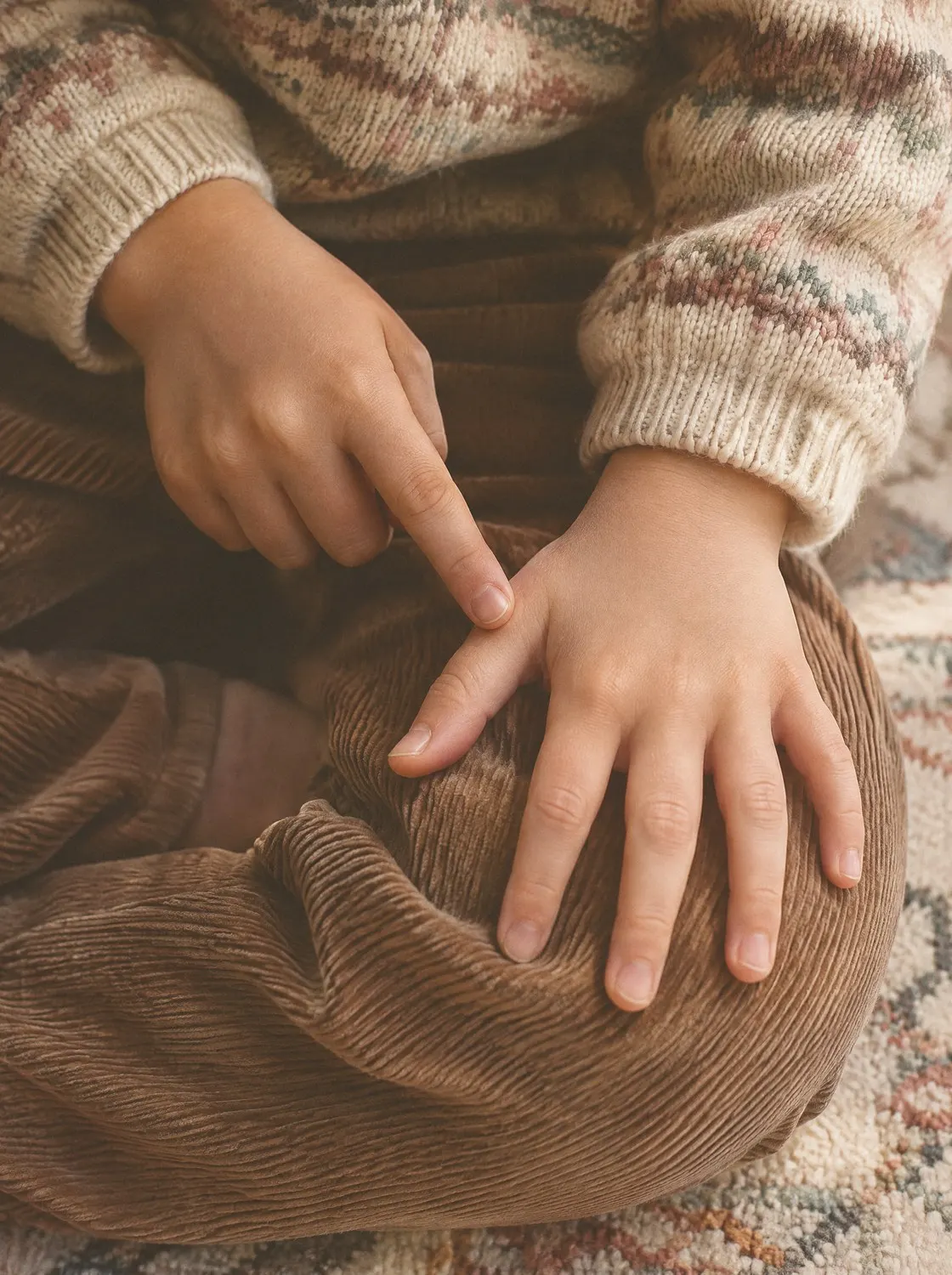
Spread one hand like a starfish and trace it with a finger of the other: up a finger as you breathe in, down as you breathe out. Five fingers, five slow breaths. It works for a worried five-year-old and for you in a meeting.
How do you do five-finger breathing?
Press Start on the hand above and follow the dot together, or trace your own hand.
- Spread one hand like a starfish, palm down on your lap or the table.
- Start at the bottom of your thumb, on the outside, with the pointer finger of your other hand.
- Breathe in through your nose for 3 seconds as you trace up to the tip.
- Breathe out slowly for 3 seconds as you trace down the other side.
- Do every finger: 5 fingers, 5 breaths, about 30 seconds. Then trace back the other way.
If anything, let the slide down each finger be the slower half: that’s the settling part.
How do you do hand breathing with kids?
Make it a game. Call it starfish breathing, trace their hand while they trace yours, or let them choose which finger to start on. Read it slowly and breathe along yourself:
Make your hand into a starfish. Let’s climb up your thumb… breathe in… and slide down… breathe out slowly. Now up your pointer finger… breathe in… and down… breathe out. Up the tall finger… and down. Up the ring finger… and down. Last one, the little finger… up… and all the way down. Wiggle your fingers. How does your body feel now?
Practise on calm days first, so it’s ready when a big feeling arrives. Your own slow breath is half the lesson, since children borrow your calm:  Breathform is for your few minutes at the end of the day. For a whole class at once, see breathing exercises for the classroom.
Is five-finger breathing for adults too?
Yes. It’s a quiet way to slow down when you can’t step away: in a meeting, on a call, in a waiting room. Trace your hand on your thigh or under the table. Grown-ups can slow it to 5 seconds in and 5 out, which is about 6 breaths a minute, the same pace as coherent breathing.
What is starfish breathing?
The same exercise with a picture: you spread your hand into a starfish shape before you trace it. Some versions use a drawing of a starfish with five arms instead of a hand. If your child likes stars more than starfish, star breathing traces the points of a star the same way.
Why trace your fingers?
Because it gives your eyes, hands and breath one job together. The finger sets the pace, so your breathing slows without you having to count. The touch on your skin is something to feel in the present moment, which is why it’s often taught alongside grounding breathing. And your hand is always with you.
How many hands should you do?
One hand is 5 breaths; going up and back is 10. With young children, one hand is often enough. Adults can do two or three hands, a minute or two in all. Stop while it still feels easy.
Does five-finger breathing work?
Five-finger breathing hasn’t been tested on its own. What it does is slow your breathing, and slow breathing has been studied a lot. A review of slow-breathing studies found that it raised heart rate variability, a sign your body is shifting towards rest, during practice and straight afterwards (Laborde et al. 2022). Another linked slow breathing with feeling calmer and less anxious (Zaccaro et al. 2018).
So: a simple, well-loved way to slow your breathing, with the evidence resting on the slow breath rather than the hand. More breaths for children are in breathing exercises for kids.
Every study on this page (2)
- Laborde et al., 2022: Across 223 studies, slow breathing raised heart-rhythm signs of calm, during practice and after, though that alone doesn't prove a health benefit.
- Zaccaro et al., 2018: In 15 small studies of healthy people, slow breathing was linked with feeling more relaxed and alert, and less anxious.
Questions people ask
Which finger do you start with?
It doesn’t matter. Most people start on the outside of the thumb and work towards the little finger, then come back the other way, which makes 10 breaths on one hand. Starting from the little finger works just as well. What matters is going up as you breathe in and down as you breathe out, so the shape keeps the rhythm for you.
Can you do five-finger breathing with your eyes closed?
Yes, and that’s one of its strengths. You can feel your way round your fingers without looking, so it works in bed, in the dark, on a bus or when you’d rather not open your eyes. With children, try it with eyes open first, so they learn the shape before they rely on touch.
Is there a five-finger breathing printable?
The best one is homemade. Draw round your child’s hand on paper, let them colour it in and add an arrow up and down each finger. Stick it by the bed or on the fridge. For ready-made cards, see printable breathing exercises.
Read next
Kids · 8 min
Breathing exercises for kidsKids · 4 min
Star breathingKids · 5 min
Breathing exercises for the classroomTechnique · 5 min
Grounding breathingTechnique · 6 min
Coherent breathing (resonance breathing)
More in Kids
Kids · 4 min
Rainbow breathingKids · 4 min
Balloon breathingKids · 4 min
Smell the flower, blow out the candle (hot chocolate breathing)Kids · 3 min
Lazy 8 breathing (figure 8 breathing)Kids · 4 min
Animal breaths for kidsKids · 4 min
Lion’s breathKids · 4 min
Box breathing for kidsKids · 4 min
Breathing exercises for kids to sleep
Breathe gently, never strain, and stop if you feel dizzy, light-headed or short of breath.