GuidePeople6 min
How to breathe while running
Gasping on a run usually means you’re going faster than your breathing can keep up with, not that you’re breathing wrong. Here’s how to breathe while running: an easy pace first, a rhythm that fits your stride and a slow breath for afterwards.
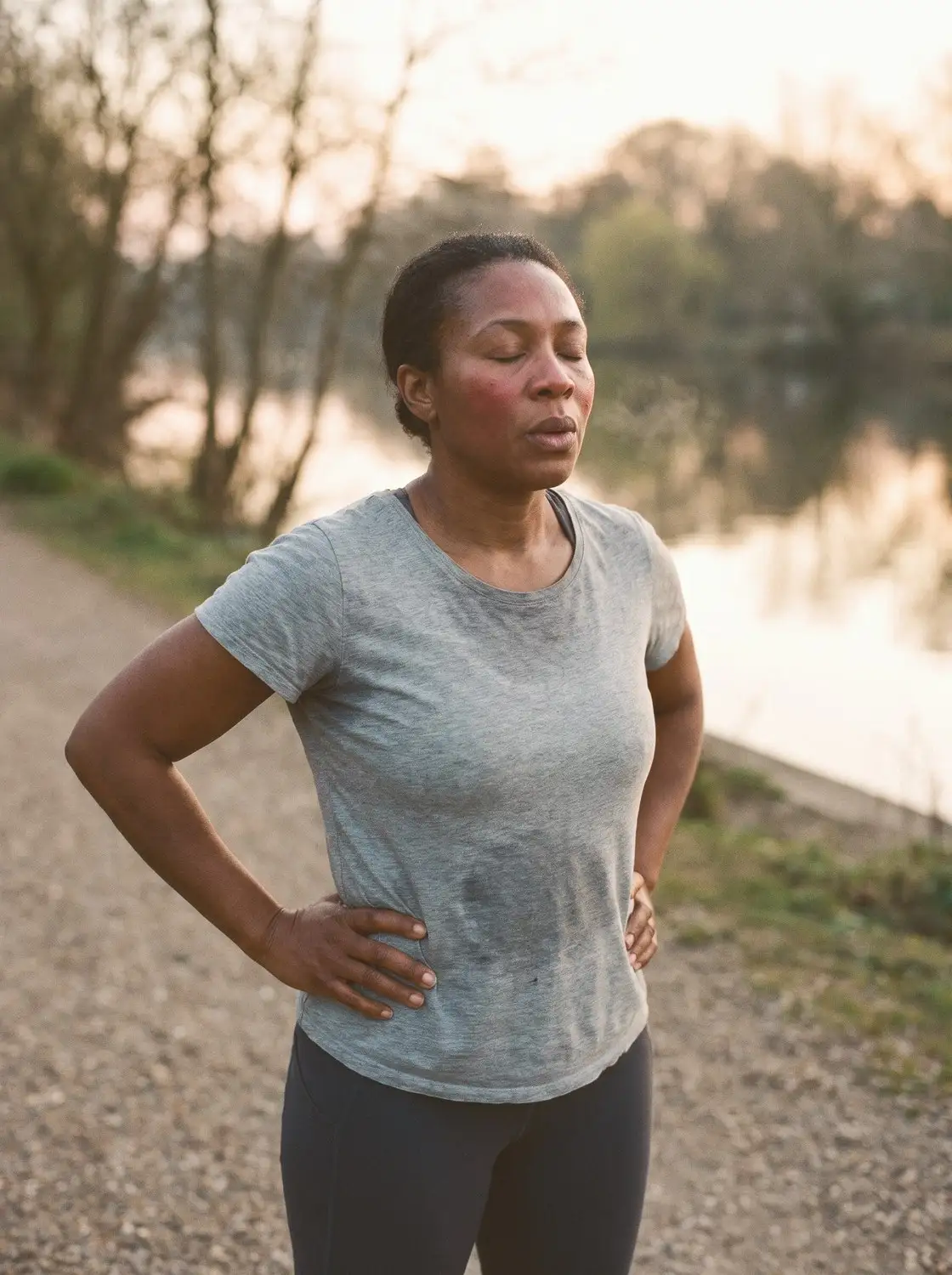
Practise the rhythm walking first, one count per step: in for 3 steps, out for 2.
How to breathe while running: four basics
Easily, and that starts with pace. Most breathlessness on a run is the pace talking, not your technique. Four things help.
- Slow to talking pace. If you can speak in short sentences, your breathing can keep up. Most of your running should feel like this.
- Use nose and mouth together. Let your jaw hang loose and the air come in whichever way is easiest.
- Breathe low. Let your belly move as you breathe in, rather than lifting your shoulders. Relaxed shoulders leave more room for each breath.
- Breathe out fully. A complete breath out makes room for the next one. Find a steady rhythm with your steps, and let it change as your pace does.
Should you breathe through your nose or mouth when running?
Both, for most runs. Breathing through your nose warms the air and keeps breathing slow, so it suits easy jogs and warm-ups. As you speed up, you need more air than your nose alone lets through, and your mouth opens without asking. When 984 runners were filmed during a 10 km race, only 3 of the 917 whose breathing could be judged were breathing through the nose alone, far fewer than lab studies had suggested (Niinimaa 1983).
You’ll see nose-only running promoted for all kinds of benefits. Try it on easy days if you like it, but it isn’t a rule. There’s more on the difference in nose breathing vs mouth breathing.
What is rhythmic breathing for running?
Matching your breath to your footsteps. Runners do it naturally: a classic study found that breathing locks to the stride in several ratios, most often one breath every 2 strides, or 2 steps in and 2 steps out (Bramble & Carrier 1983). Runners seem to prefer patterns that line each breath up with the easiest moment in the step (Daley et al. 2013).
The popular coaching method goes further, using an odd number of steps so each breath out lands on alternate feet. That comes from coaches, notably Budd Coates, and the claim that it prevents stitches or injuries hasn’t been tested. Use it if it helps you settle into a rhythm.
- Easy runs: 3 steps in, 2 out, or 3 and 3.
- Steady runs: 2 steps in, 2 out.
- Hard efforts: 2 in and 1 out, or 1 and 1, without worrying about it.
How do I stop getting out of breath when I run?
Slow down first, then build. Try a run-walk: run until talking gets hard, walk until your breathing settles, repeat. Warm up with 5 minutes of brisk walking, so your breathing has time to rise. Over a few weeks the same pace starts to feel easier.
When you stop to walk, a few pursed-lip breaths help you slow your breathing back down.
- Keep walking at an easy pace, shoulders loose.
- Breathe in through your nose for 2 steps or 2 seconds.
- Breathe out through softly pursed lips for 4.
- After 5 or 6 breaths, start running again.
Breathlessness that comes with chest pain, wheezing or dizziness is a reason to stop and see a doctor, not to push through.
How do I get rid of a side stitch?
Slow down, and breathe out long and slow. A stitch is common: about 70% of runners get one in a year, and about 1 in 5 in any single race. Nobody knows exactly what causes it, and ways to ease it mid-run are largely untested (Morton & Callister 2015). What runners commonly try:
- Slow to a jog or walk and take a few slow, full breaths out.
- Press gently into the painful spot with your fingers as you breathe out.
- Breathe out as the opposite foot lands to the side of the stitch: popular, unproven, worth a try.
- Next time, avoid a big meal or sugary drink for about 2 hours before you run.
What breathing helps recovery after a run?
Slow, even breathing, once you’ve walked for a few minutes. In one study, active students recovering from hard intervals had a higher heart rate and felt they were working harder with box breathing than with plain breathing at 6 breaths a minute (Kasap & Aydin 2025). So skip the holds and breathe evenly: 5 seconds in, 5 out.
Coherent breathing has the full guide to this pace.
Can breathing exercises improve running?
Not directly: slow breathing practice won’t make you faster on its own. It can help around the run. A few minutes of slow breathing before a race can steady nerves, and  Breathform works offline, so a crowded start with no signal doesn’t get in the way. The recovery breath above helps you wind down. If you’d like a gentle lift before you head out, breathing for energy has an in-breath-led pattern, though evidence for an alerting effect is limited. If you’ve come back to running later in life, breathing exercises for seniors has gentle seated breaths for the days in between.
Every study on this page (5)
- Niinimaa, 1983: Filming of 984 runners in a 10 km race: only 3 (0.3%) of the 917 analysed breathed through the nose alone, so nose-only breathing during self-paced endurance running was less common than laboratory studies had suggested.
- Bramble & Carrier, 1983: Running humans lock breathing to their stride in several ratios (4:1, 3:1, 2:1, 1:1, 5:2 and 3:2 strides per breath), with 2 strides per breath appearing to be favoured.
- Daley et al., 2013: 14 runners at a self-selected speed used breath-to-step patterns of 2:1 to 4:1 or none, and naturally preferred patterns that aligned breathing changes with assisting phases of the step.
- Morton & Callister, 2015: About 70% of runners report a stitch in the past year and about 1 in 5 get one in a single event; the cause is not settled; avoiding large meals and drinks, especially sugary ones, for about 2 hours beforehand is a common prevention tip; ways to relieve it during a run are unproven.
- Kasap & Aydin, 2025: In 40 active students recovering from hard cycling, box breathing left heart rate and felt effort higher than six breaths a minute.
Questions people ask
Is it bad to breathe through your mouth while running?
Not at all. Once you’re running at a steady pace, most people need the extra air the mouth lets in, so breathing through nose and mouth together is normal. Nose-only breathing is fine on easy runs if you enjoy it, but there’s no need to force it. Relax your jaw and let the air come in however it’s easiest.
What is the talk test?
It’s the simplest way to check your effort. If you can speak in short sentences while you run, you’re at an easy to moderate pace, where most of your running should be. If you can only manage a word or two, you’re working hard. If you can sing, you can probably go a little faster. Many beginners find their breathing problems vanish once they slow to talking pace.
How long until running stops feeling breathless?
Usually a few weeks of regular, easy running. Your heart, lungs and legs adapt together, so the same pace starts to feel easier. Run-walk plans help: the NHS Couch to 5K programme builds from short running intervals to 30 minutes over 9 weeks. Three runs a week at talking pace does more than one hard run that leaves you gasping.
Should I breathe in through my nose and out through my mouth?
On easy runs, that works well for many people: in through the nose, a longer breath out through the mouth. As you speed up, let the mouth join in on the breath in too. There’s no single correct way, so don’t let a rule make you tense. A relaxed jaw, low belly breaths and a full breath out matter more.
Practices in this guide
Read next
Side by side · 6 min
Nose breathing vs mouth breathing: what the evidence saysTechnique · 6 min
Pursed-lip breathingTechnique · 6 min
Coherent breathing (resonance breathing)Technique · 5 min
Breathing for energy (energising breath)Guide · 5 min
Breathing exercises for seniors and older adults
More in People
Long read · 8 min
Breathing exercises for pregnancyGuide · 6 min
Breathing techniques for labourTechnique · 6 min
Lamaze breathing (patterned breathing)Technique · 6 min
Hypnobirthing breathing (up and down breathing)Guide · 5 min
Postpartum breathing exercisesGuide · 5 min
Breathing exercises for teens and students
Breathe gently, never strain, and stop if you feel dizzy, light-headed or short of breath.