GuidePeople5 min
Breathing exercises for seniors and older adults
Slow breathing is one of the few exercises you can do sitting down, at any age, with nothing to buy. These breathing exercises for seniors are gentle and seated, at your own pace. They won’t train your lungs, but they can ease breathlessness on the stairs, settle a worried mind and help you wind down at night.
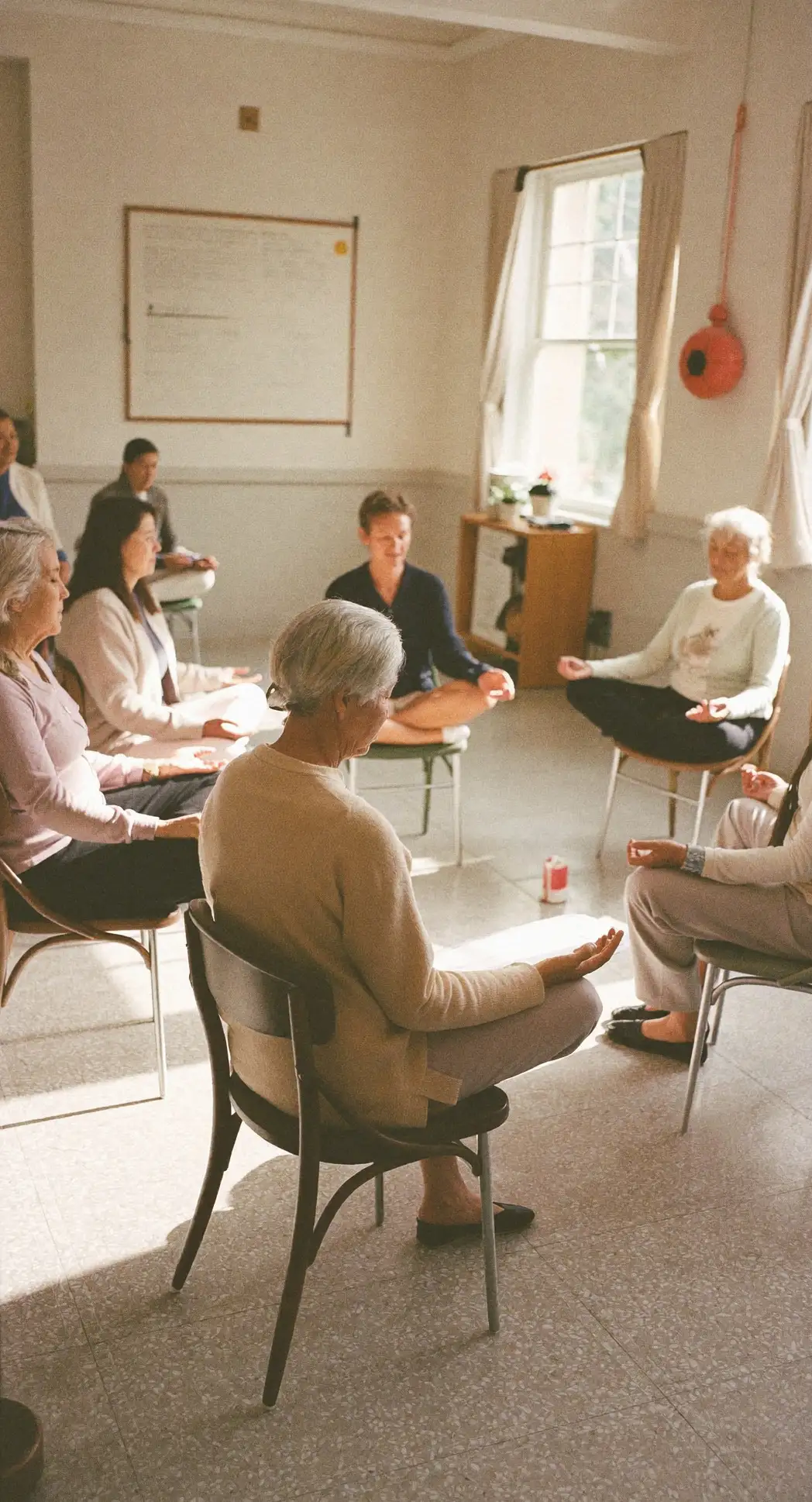
What are good breathing exercises for seniors?
Slow ones, done sitting down, where the breath out is as long as the breath in or longer. Here are three, for three different moments.
Puffed on the stairs? Pursed-lip breathing.
For getting your breath back after the stairs, the shops or the garden.
- Sit down, or lean on something steady. Let your shoulders drop.
- Breathe in gently through your nose for 2 seconds.
- Breathe out for 4 seconds through softly pursed lips, as if blowing on hot soup.
- Keep going until your breathing settles, usually a minute or two.
In lung disease, low-quality evidence suggests pursed-lip breathing may ease breathlessness (Pinna et al. 2025).
Full guide: pursed-lip breathing
Feeling tense or worried? Coherent breathing, 5 and 5.
An even, unhurried rhythm: 6 breaths a minute.
- Sit with your back supported and your feet flat.
- Breathe in softly through your nose for 5 seconds.
- Breathe out for 5 seconds, just as smooth.
- Carry on for 5 minutes, using the player at the top of the page. If 5 feels long, use 4.
In one study, a single 5-minute session of slow, deep breathing was followed by lower anxiety in both young and older adults, and a marker of the body’s rest response rose more in the older group. There was no comparison group (Magnon et al. 2021).
Full guide: coherent breathing
Ten quiet minutes in your chair? Slow belly breathing.
The slowest of the three, for when you have time to sit.
- Sit back in your chair, one hand resting on your belly.
- Breathe in slowly for 6 seconds and feel your hand rise.
- Breathe out slowly for 6 seconds and feel it fall.
- Do 10 breaths, about 2 minutes. If 6 feels long, use 4 or 5: comfort comes first.
Full guide: diaphragmatic breathing
Can older adults do breathing exercises sitting down?
Yes, and sitting is often the best way. Choose a firm chair with a back, ideally without wheels. Sit towards the back of the seat so you’re supported, feet flat and a little apart, hands resting on your thighs or belly. Sit tall without stiffening: slumping squashes the space your lungs need.
Do breathing exercises improve lung function in older people?
Not the gentle kind on this page. Slow, calm breathing isn’t designed to strengthen your lungs, and there’s little evidence it does. What keeps you fit for breathing is staying active: walking, gardening, anything that gets you a little out of breath.
Training the breathing muscles against resistance is a different thing, done with a small hand-held device, and best started with a physiotherapist. If you have COPD or another lung condition, ask about pulmonary rehabilitation, a programme of exercise and breathing advice.
Is slow breathing good for blood pressure in older adults?
In a review of trials, regular breathing at 10 breaths a minute or slower was linked to a modest fall in blood pressure: about 5.6 mmHg systolic and 3.0 diastolic on average (Chaddha et al. 2019). Results varied widely between trials, and not all were in older adults.
So: a gentle habit that may help a little, alongside your treatment, never instead of it. There’s more in breathing exercises to lower blood pressure.
How well each breath is studied
- Pursed-lip breathingSome evidence
- Coherent breathingWell studied
- Slow breathing (6-6)Some evidence
Every study on this page (4)
- Pinna et al., 2025: In people whose airways are narrowed by lung disease, weak evidence suggests pursed-lip breathing may moderately ease breathlessness in the short term.
- Magnon et al., 2021: In 47 younger and older adults, anxiety was lower after one five-minute slow-breathing session, though the study had no comparison group.
- Chaddha et al., 2019: Across 17 trials in people with high or borderline-high blood pressure, regular slow breathing modestly lowered blood pressure, though results varied.
- Eide et al., 2026: Across nine studies, slow breathing before bed improved how well people felt they slept, but sleep-lab and tracker results were inconclusive.
What breathing helps older people sleep?
A slow, even breath in bed, with the lights low. Coherent breathing works well lying down, or try breathing in for 4 and out for 6. In  Breathform, a dark screen and soft tones let you follow either with your eyes closed. In a 2026 review, slow breathing before bed improved how well people felt they slept, though sleep measured in a lab didn’t clearly change (Eide et al. 2026). Breathing exercises for sleep has more.
How often should seniors do breathing exercises?
A few minutes once or twice a day is plenty: morning and evening is easy to remember. Regular and gentle beats long and occasional.
Routine · 5 minutes
A 5-minute chair routine
- Sit tall in a steady chair, feet flat, hands on your thighs.
- 1 minute of pursed-lip breathing, 2 in and 4 out, to settle.
- 4 minutes of coherent breathing, 5 in and 5 out.
- Sit for a moment, then stand up slowly.
Questions people ask
Are breathing exercises safe for older people?
Gentle, slow breathing suits nearly everyone. Sit in a steady chair and keep every breath comfortable. If you feel dizzy or light-headed, go back to normal breathing for a minute. Stand up slowly at the end, as some people feel a little light-headed getting up after sitting still. If you have a heart or lung condition, your care team can tailor this.
What’s the best breathing exercise for breathlessness in older age?
Pursed-lip breathing: in through your nose for 2, out through softly pursed lips for 4. It slows your breathing and makes each breath out easier. Many people also find that sitting forward with their forearms resting on their thighs helps. Breathlessness that’s new, sudden or comes with chest pain needs a doctor rather than an exercise.
Can breathing exercises help with anxiety in older age?
They can help in the moment. In a study comparing young and older adults, one 5-minute session of slow, deep breathing was followed by lower anxiety in both groups. A few minutes of coherent breathing, morning and evening, is an easy habit to keep. For more ways to settle a worried mind, see breathing exercises for anxiety.
Should I breathe through my nose or my mouth?
Through your nose for calm breathing, if it’s comfortable: it naturally slows the breath and warms the air. For pursed-lip breathing, breathe in through your nose and out through your lips. If your nose is blocked, gentle mouth breathing is fine. The slow pace matters more than the route.
Practices in this guide
Read next
Technique · 6 min
Pursed-lip breathingGuide · 6 min
Breathing exercises to lower blood pressureLong read · 9 min
Breathing exercises for sleepTechnique · 5 min
Slow breathing exerciseTechnique · 7 min
Diaphragmatic breathing (belly breathing)
More in People
Long read · 8 min
Breathing exercises for pregnancyGuide · 6 min
Breathing techniques for labourTechnique · 6 min
Lamaze breathing (patterned breathing)Technique · 6 min
Hypnobirthing breathing (up and down breathing)Guide · 5 min
Postpartum breathing exercisesGuide · 5 min
Breathing exercises for teens and studentsGuide · 6 min
How to breathe while running
Breathe gently, never strain, and stop if you feel dizzy, light-headed or short of breath.