Start here
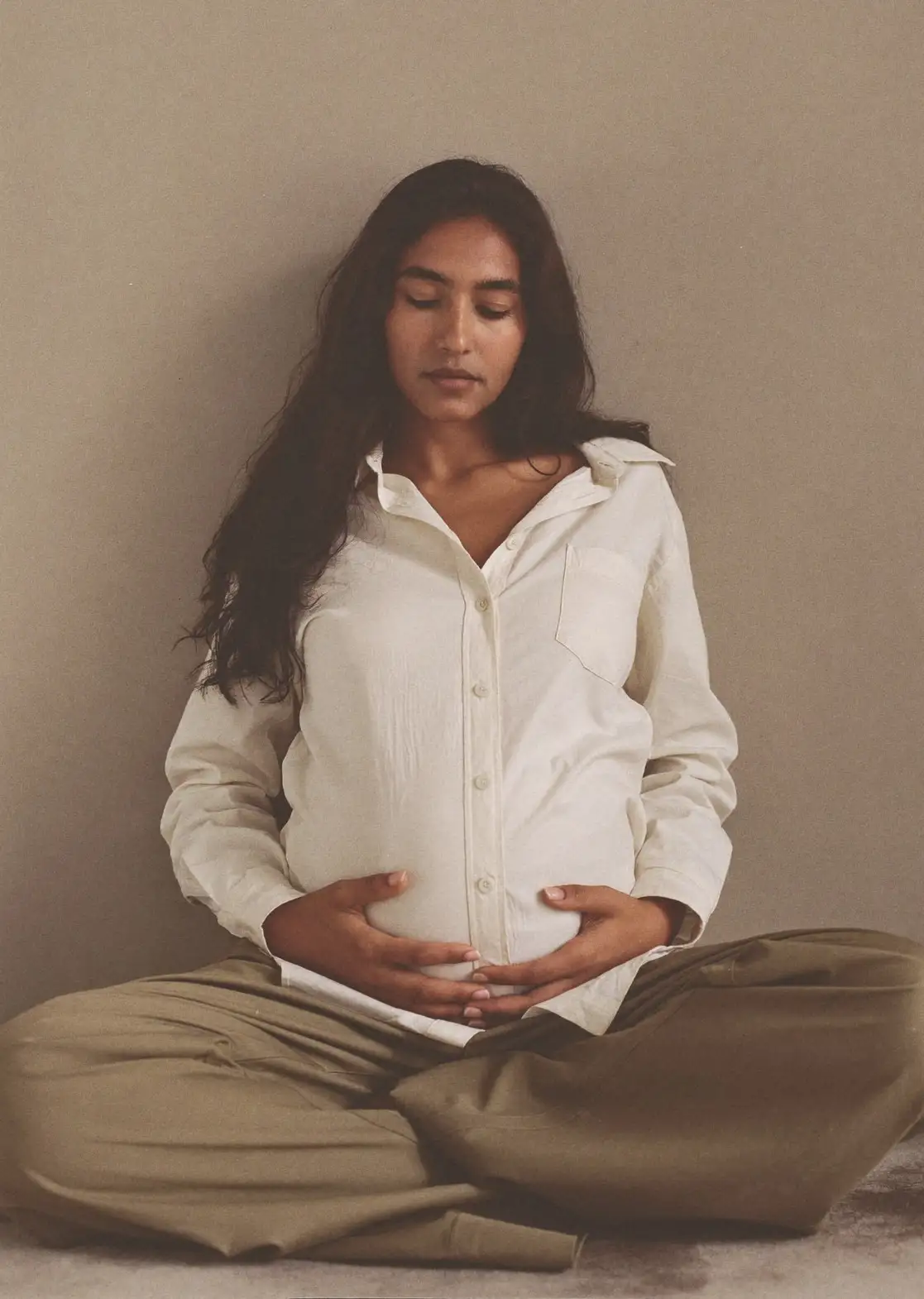
4-6 breathing, for 2 minutes
Long readPeople8 min
Breathing exercises for pregnancy
Pregnancy changes the way you breathe from the first weeks: bigger breaths, then a baby taking up the room under your ribs. Feeling a little short of breath is common and usually harmless. The best breathing exercises for pregnancy are slow and easy, with a longer out-breath and no holds. Start with this one.
Why am I short of breath while pregnant?
Because your body starts breathing for two early on. Pregnancy hormones, mainly progesterone, make your breathing centre more sensitive to carbon dioxide, so you take bigger breaths, even sitting still. In the first trimester the air you move each minute can rise by almost half. About 7 in 10 healthy pregnant women notice it as breathlessness, often from the first weeks (LoMauro & Aliverti 2015).
Later, your growing womb pushes your diaphragm up. Your ribcage widens to make room, but it can still feel crowded, especially when you slump or after a meal. That’s why every breath on this page is slower rather than bigger. An unhurried, longer out-breath usually feels easier than reaching for more air.
Breathlessness that comes on suddenly needs a call to your midwife or maternity unit straight away, and with chest pain, palpitations or feeling faint, call emergency services (999 in the UK, 911 in the US).
What are the best breathing exercises for pregnancy?
Slow ones with no holds, where the out-breath is as long as the in-breath or longer. Here are four, for four moments of the nine months. Each one plays here: press play and follow the circle.
Short of breath on the stairs? Breathe out through soft lips.
The quickest way to get your breath back: stop, stand tall and let the out-breath be twice as long as the in-breath.
- Stop and rest a hand on the rail or the back of a chair. Let your shoulders drop.
- Breathe in gently through your nose for 2 seconds.
- Breathe out for 4 seconds through softly pursed lips, as if cooling a spoonful of soup.
- Keep going for a minute or so, until your breathing settles by itself.
Pursed-lip breathing is best studied in lung disease, where low-quality evidence suggests it may ease breathlessness (Pinna et al. 2025). In pregnancy, think of it simply as a comfortable way to slow down.
Full guide: pursed-lip breathing
Worried, or can’t settle? Try 4-6 breathing.
The gentlest calming breath, and the one to learn first: it’s also the breath for early labour.
- Sit with your back supported and one hand resting on your bump.
- Breathe in through your nose for 4 seconds. Feel your ribs widen to the sides.
- Breathe out slowly for 6 seconds, through your nose or softly parted lips.
- Keep going for 2 to 5 minutes. If 4 feels long, use 3 in and 5 out.
In a small lab study of healthy adults, a longer out-breath felt more relaxing than a longer in-breath (Van Diest et al. 2014).
Full guide: 4-6 breathing
Lying awake in the third trimester? Coherent breathing, on your side.
An even 5 in and 5 out, quiet enough to do in bed without waking anyone.
- Lie on your left or right side, with a pillow between your knees and another under your bump if it helps.
- Breathe in softly through your nose for 5 seconds.
- Breathe out for 5 seconds, just as smooth.
- Stay with it for 5 to 10 minutes, or until you drift off. If 5 feels long, try 4.
Slow breathing before bed improved how people said they slept in a 2026 review, while sleep-lab measures were inconclusive (Eide et al. 2026). That review wasn’t specific to pregnancy.
Full guide: coherent breathing
Ten quiet minutes? Breathe low, into your ribs and back.
A slow, even breath for getting to know the space you breathe into now, and your pelvic floor along with it.
- Sit upright on a chair or a birth ball, feet apart, hands on the sides of your lower ribs.
- Breathe in for 6 seconds. Feel your ribs widen into your hands and your back. Let your belly and pelvic floor soften.
- Breathe out for 6 seconds. Notice a gentle, natural lift low down, without squeezing.
- Do 10 rounds, about 2 minutes. If 6 feels long, use 5 or 4: the easy pace matters more than the count.
Your pelvic floor moves with your breath: it relaxes as you breathe in and draws up a little as you breathe out (Talasz et al. 2022). Getting to know that rhythm now may help later, too: see postpartum breathing exercises.
How gentle should breathing be in pregnancy?
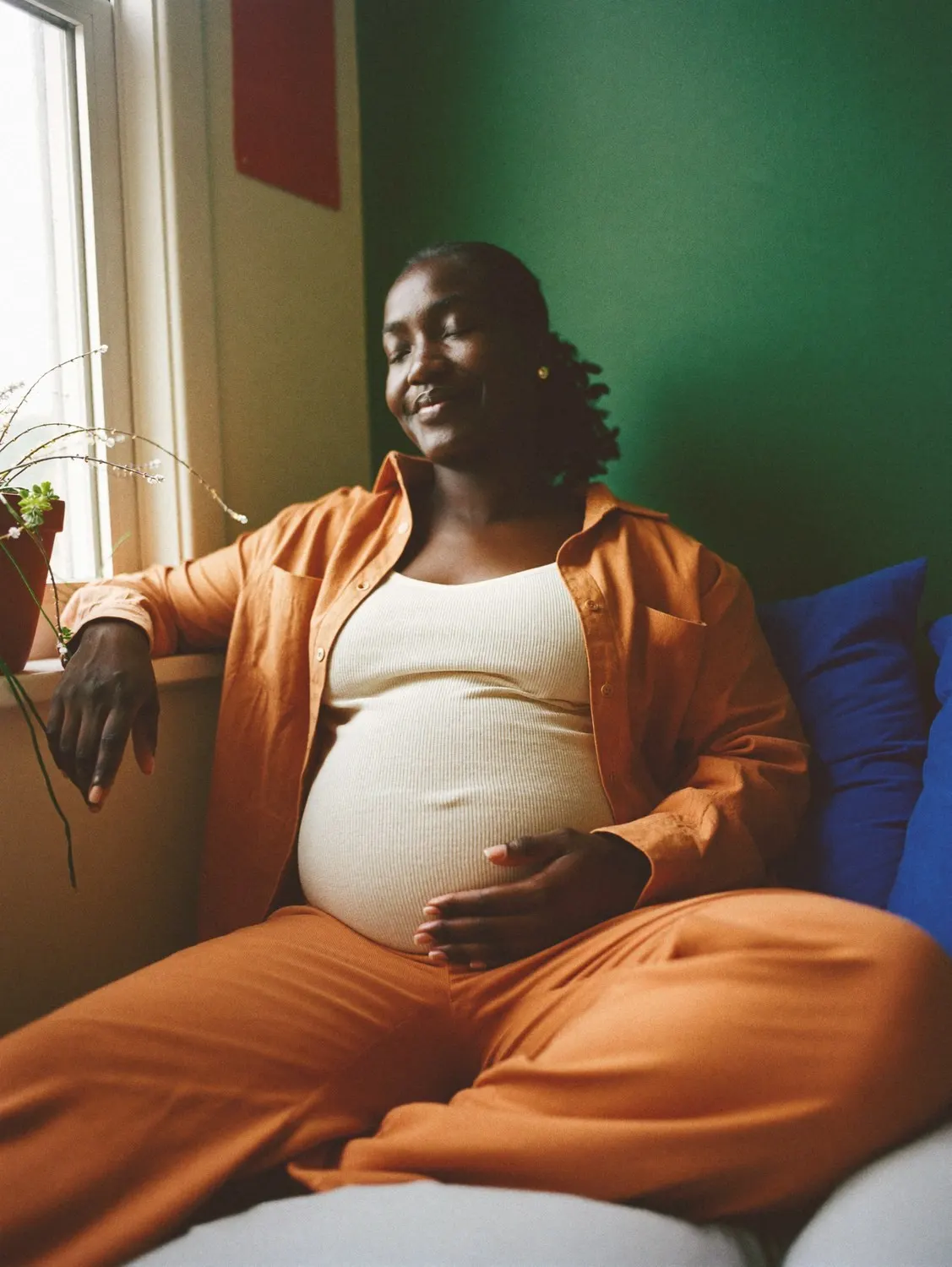
Gentle and slow, with every breath easy: no holds needed here, and no big, forced breaths. If you feel light-headed or tingly, you’re probably moving more air than you need. Take a few ordinary breaths, then carry on more softly.
Leave the intense styles until after the birth: fast, forceful breathing such as breath of fire, Wim Hof-style rounds and long breath holds. There’s more on those in types of breathwork.
Slower, not bigger. In pregnancy, the easy breath is the right one.
Do breathing exercises help in pregnancy?
In a 2024 review of 32 studies with 3,979 pregnant women, relaxation methods, deep breathing among them, lowered stress and symptoms of depression (Abera et al. 2024). Many of the studies tested other methods, such as yoga, music or muscle relaxation, so the effect of breathing alone is hard to pull apart.
In one trial, 60 first-time mothers in the second trimester practised relaxation breathing and muscle relaxation twice a day for 6 weeks. They felt less stressed and more in control than women who didn’t (Tragea et al. 2014). It was small, and everyone knew which group they were in.
So: a gentle, low-risk way to feel calmer, with good evidence for relaxation in pregnancy and early evidence for breathing on its own.
How well each breath is studied
- 4-6 breathingWell studied
- Pursed-lip breathingSome evidence
- Coherent breathingWell studied
- Slow breathing (6-6)Some evidence
Every study on this page (8)
- LoMauro & Aliverti, 2015: About 70% of healthy pregnant women report breathlessness in daily life, starting in the first trimester; the air breathed each minute rises by up to 48% in the first trimester through bigger breaths, with progesterone raising the breathing centre’s sensitivity to carbon dioxide; the growing uterus pushes the diaphragm upwards, and the lower ribcage widens to preserve total lung capacity.
- Pinna et al., 2025: In people whose airways are narrowed by lung disease, weak evidence suggests pursed-lip breathing may moderately ease breathlessness in the short term.
- Van Diest et al., 2014: In a small lab study of mostly young women, breathing out longer than in felt more relaxing than breathing in longer.
- Eide et al., 2026: Across nine studies, slow breathing before bed improved how well people felt they slept, but sleep-lab and tracker results were inconclusive.
- Talasz et al., 2022: The pelvic floor muscles work with the abdominal muscles as breathing-out muscles: they contract during the out-breath and relax during the in-breath.
- Abera et al., 2024: Systematic review and meta-analysis of 32 studies with 3,979 pregnant women: relaxation interventions, deep breathing among them, reduced maternal stress and depressive symptoms.
- Tragea et al., 2014: Randomised trial of 60 first-time mothers in the second trimester: 6 weeks of relaxation breathing and progressive muscle relaxation twice a day lowered perceived stress and raised sense of control compared with no programme.
- Cronin et al., 2019: Individual participant data meta-analysis (851 late stillbirths, 2,257 controls): going to sleep on the back from 28 weeks was linked to higher odds of late stillbirth; going to sleep on the left or right side appeared equally safe.
What breathing helps you sleep in the third trimester?
First, the position. From 28 weeks, settle to sleep on your side, left or right. A large analysis linked going to sleep on your back late in pregnancy with a higher risk of stillbirth, and found both sides equally safe (Cronin et al. 2019). If you wake up on your back, don’t worry: roll over and settle again.
Then the breath. Coherent breathing on your side, above, is a good fit, or 4-6 breathing with the lights low.  Breathform keeps either going with the screen locked, guided by soft tones, so the phone can lie face down beside you. A pillow between your knees and one behind your back makes side-lying easier to keep. If heartburn or a busy mind keeps you up, breathing exercises for sleep has more to choose from.
When should I start practising breathing for labour?
Whenever you like: the earlier, the more familiar. A few minutes most days in the last two or three months helps the breath feel automatic by the time you need it. The 4-6 breath above is the backbone of early labour, so you’re already practising.
Routine · 5 minutes
A 5-minute daily practice
- Sit tall, feet flat, one hand on your bump.
- 30 seconds of soft-lips breathing, 2 in and 4 out, to settle.
- 4 minutes of 4-6 breathing. Let the out-breath do the work.
- Finish with one ordinary breath, and notice how your shoulders feel.
When you’re ready for the birth itself, breathing techniques for labour goes stage by stage. If you’re choosing a class, Lamaze breathing and hypnobirthing breathing show what each one teaches.
Can breathing help with morning sickness?
It hasn’t been well tested. Some people find that slow breathing through the nose, near an open window, helps a wave of nausea pass, but it won’t stop sickness itself. There’s a short routine in breathing exercises for nausea. If you’re being sick many times a day or can’t keep fluids down, tell your midwife or GP: that needs more than a breath.
Questions people ask
Can I do 4-7-8 breathing while pregnant?
You can keep its shape and leave out the long hold. There’s no need for it in pregnancy: the long, slow out-breath is the part that settles you. Try breathing in for 4 and out for 8, or pause for just 2 seconds if you like a little stillness at the top. If any hold makes you tense or light-headed, drop it. The full pattern is in 4-7-8 breathing.
Is it normal to feel breathless in early pregnancy?
Yes, very. It often starts in the first trimester, long before your bump is big enough to press on anything. Hormones make you breathe more deeply, and your brain notices the change. It tends to feel strongest on stairs, in warm rooms and when you talk while you walk. Slow down, sit tall and let each out-breath take its time.
How often should I do breathing exercises when pregnant?
A few minutes most days is plenty. Short and regular beats long and rare: the aim is for a slow breath to feel familiar when you need it, on a bad night, before a scan or in early labour. Tie it to something you already do every day, like the first cup of tea or getting into bed.
Is breathwork safe during pregnancy?
Gentle, slow breathwork is a good fit. Save the intense styles for after the birth: rapid or forceful breathing, long breath holds and anything designed to make you tingle or feel altered. If you join a class, choose one made for pregnancy, or tell the teacher you’re pregnant so they can adapt it for you.
What position is best for breathing exercises in pregnancy?
Whichever lets your ribs move. Sitting upright on a chair or a birth ball, or lying on your side with pillows, suits most people. Slumping squashes the space under your ribs, so sit tall. Lying flat on your back can leave you feeling faint later in pregnancy, so in the third trimester turn onto your side.
More in People
- 1
Guide · 5 min
Breathing exercises for teens and studentsFor exam corridors, late nights and the group chat.
- 2
Guide · 5 min
Breathing exercises for seniors and older adultsGentle, seated breaths, at your own pace.
- 3
Guide · 6 min
How to breathe while runningFind a rhythm that fits your stride and a slow breath for afterwards.
Also filed under People Breathing exercises for kids · Breathing exercises for the classroom
Read next
Guide · 4 min
Breathing exercises for nauseaLong read · 9 min
Breathing exercises for sleep
Breathe gently, never strain, and stop if you feel dizzy, light-headed or short of breath.