Technique6 min
Hypnobirthing breathing (up and down breathing)
In 4 · out 8. Closest in the app: Unwind
Follow the tide: it rises as you breathe in and falls as you breathe out.
- Pattern
- In 4 · out 8
- Pace
- 5 breaths a minute
- Length
- 2 min · 10 rounds
- Evidence
- Some evidence
What is hypnobirthing breathing?
Hypnobirthing is a family of antenatal courses that prepare you for birth with deep relaxation, self-hypnosis, visualisation and breathing. Several programmes use the name, and some NHS trusts teach their own versions, led by midwives. You stay awake, aware and in control: it’s deep relaxation, not a trance.
The breathing is the part you can learn on your own. There are two breaths: up breathing for the surges of the first stage, and down breathing for the birth. Both are slow, quiet and through the nose, and both make the out-breath the long half.
What is up breathing?
Up breathing is a slow breath for each surge (the word many courses use for a contraction): in through your nose for about 4 seconds, out through your nose for about 8. Imagine a balloon in your belly, filling as you breathe in and slowly emptying as you breathe out. It’s also called surge breathing or balloon breathing.
- Settle. Sit, or lie on your side, close your eyes and let your shoulders drop.
- Breathe in slowly through your nose for about 4 seconds as the surge begins. Picture the balloon filling.
- Breathe out slowly through your nose for about 8 seconds. Let the balloon empty and your jaw, hands and shoulders soften.
- Repeat through the surge: 4 or 5 up breaths carry you through a surge that lasts a minute.
- Rest as it fades, with an ordinary breath. If 8 feels long, breathe out for 6 and build up over a few days.
Counts vary from course to course: some teach 4 in and 7 out, some ask for a longer in-breath. The detail matters less than the shape: a long, unhurried out-breath that leaves you a little softer than before.
How do you breathe through a surge?
One breath at a time. Start up breathing as soon as you feel the surge begin, before it peaks, and keep your attention on the out-breath. If a surge outruns the count, don’t chase it: let the breath be shorter for a moment, then lengthen it again as the surge eases. Between surges, breathe normally and rest.
What is down breathing?
Down breathing is a gentle breath for the second stage, when your baby is moving down to be born. You breathe in through your nose, then breathe out slowly and steadily, imagining the breath travelling down your body and out, like the shape of a J. That’s why some courses call it J breathing.
- Breathe in through your nose, a comfortable breath, as the surge starts.
- Breathe out slowly and steadily for as long as feels natural, directing the breath down and out.
- Stay soft through your jaw and bottom. There’s no need to hold your breath or strain.
- Repeat through the surge, then rest.
Your womb does most of the work. Down breathing aims to go with it rather than add a forced push. If labour needs more help, or you have an epidural, your midwife may guide you to push actively. Your midwife can tell you how hypnobirthing fits your birth plan. Some courses suggest practising down breathing on the loo, where the feeling is similar.
Routine · 10 minutes a day
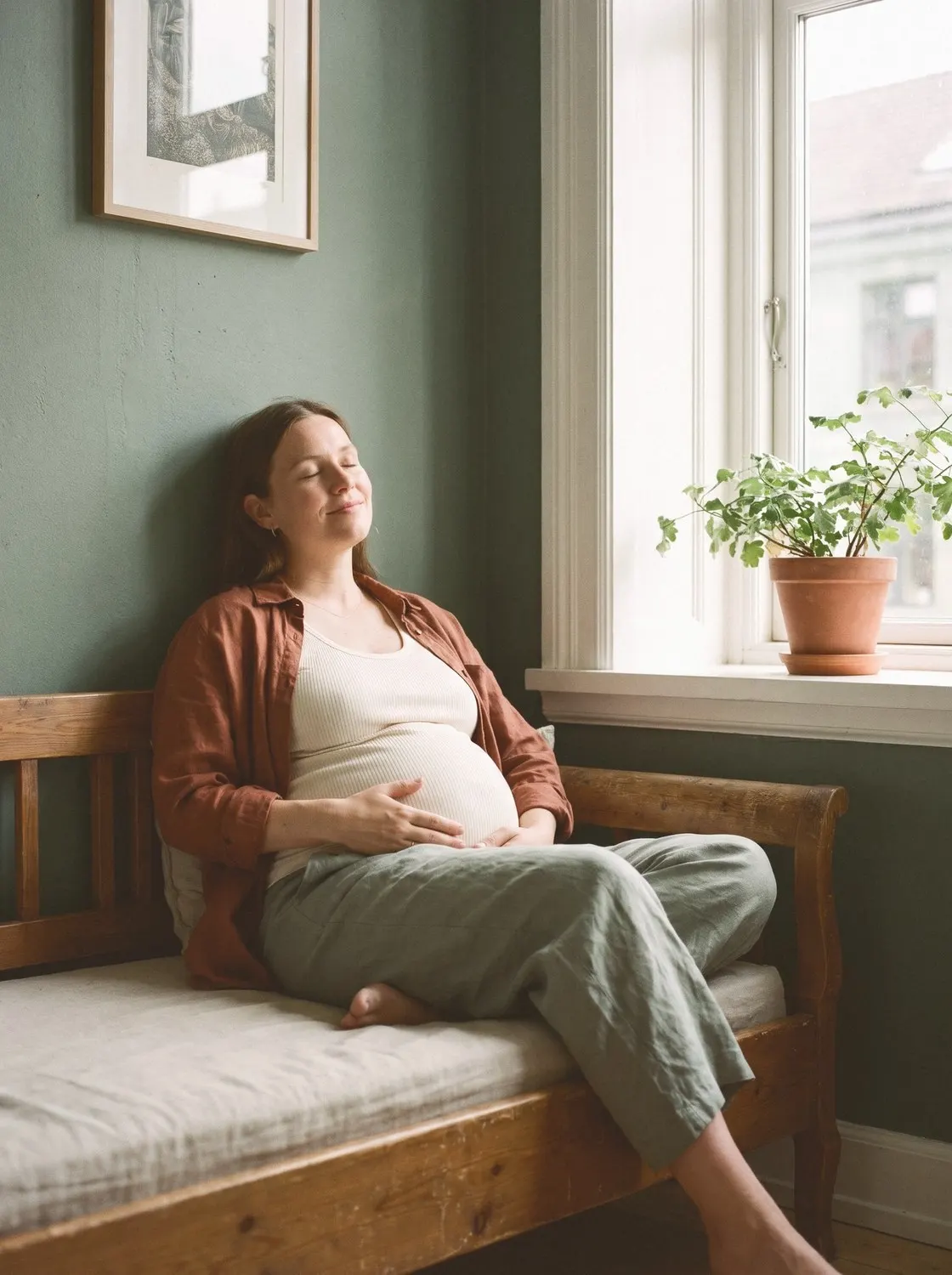
A practice plan for the last weeks
- 2 minutes of ordinary, quiet breathing with your eyes closed, letting your body get heavy.
- 5 minutes of up breathing. Start at 4 in and 6 out, and stretch the out-breath to 8 over a week or two.
- 1 minute of down breathing, just to keep it familiar.
- 2 minutes of rest, with your partner’s hand resting lightly on your shoulder, if they’re with you.
Start from about 30 weeks, and practise at the same time each day, such as in bed before sleep, so it becomes a habit. Rehearsing with your birth partner means their voice and touch become cues for the breath.
Does hypnobirthing breathing work?
A Cochrane review of 9 trials with 2,954 women found that hypnosis may reduce the overall use of pain medication in labour, but not epidurals. The evidence was low quality (Madden et al. 2016).
In a UK trial, 680 first-time mothers had two group self-hypnosis sessions and daily audio, or usual care. Epidural use didn’t change: 28% against 30%. Women in the hypnosis group did report less fear and anxiety after the birth than they’d expected (Downe et al. 2015). A smaller trial of 80 first-time mothers linked a 4-week hypnobirthing course with less fear and lower pain scores (Buran & Aksu 2022).
So: hypnobirthing may help you feel calmer and less afraid, but probably won’t change whether you have an epidural. The breath itself is a long, slow out-breath, which felt more relaxing than a long in-breath in one small lab study (Van Diest et al. 2014).
When should I start practising hypnobirthing breathing?
Around the start of the third trimester is a good time, and earlier is fine. Courses often begin from about 28 weeks. What matters is regular practice, so the breath feels familiar by the time labour starts. History in  Breathform shows your days in a row, which helps on the evenings you’d rather skip. Breathing exercises for pregnancy has gentle breaths for the months before, and postpartum breathing exercises for the weeks after.
Hypnobirthing or Lamaze?
They share more than they differ. Both build on slow breathing with a long out-breath. Hypnobirthing stays slow and turns inward, with relaxation and visualisation. Lamaze adds lighter, quicker patterns for the peaks, such as hee-hee-hoo. We put them side by side on Lamaze breathing, and breathing techniques for labour shows how either fits each stage. If you like a count with a hold, 4-7-8 breathing has the same long out-breath, though there’s no need for the hold in labour.
Every study on this page (4)
- Madden et al., 2016: Cochrane review of 9 trials (2,954 women): hypnosis may reduce the overall use of pain medication in labour, but not epidural use; no clear differences in satisfaction with pain relief, sense of coping or spontaneous vaginal birth; low-quality evidence.
- Downe et al., 2015: Randomised trial of 680 first-time mothers in 3 NHS trusts: two group self-hypnosis sessions plus daily audio did not change epidural use (27.9% vs 30.3%); women in the hypnosis group had less fear and anxiety after the birth than they had anticipated.
- Buran & Aksu, 2022: Randomised trial of 80 first-time mothers: a 4-week hypnobirthing course was linked to less fear of childbirth, lower pain scores in labour and higher birth satisfaction than routine care.
- Van Diest et al., 2014: In a small lab study of mostly young women, breathing out longer than in felt more relaxing than breathing in longer.
Questions people ask
Why do hypnobirthing courses say surges instead of contractions?
Because words shape what you expect. A surge or a wave describes how a contraction feels: it rises, peaks and fades, and then it’s over. Many people find that framing calmer than a word they’ve only heard in dramatic birth scenes. It’s your labour, though: use whichever word feels right, and your midwife will understand either.
Can you use hypnobirthing breathing with gas and air or an epidural?
Yes. Hypnobirthing works alongside any pain relief. Up breathing fits gas and air well, since both reward slow, steady breaths. With an epidural you may not feel the surges much, but slow breathing still helps you stay calm, and your midwife can tell you when to start down breathing or pushing.
Is hypnobirthing just breathing?
Not just breathing. Courses usually combine learning how labour works, deep relaxation, self-hypnosis scripts and audio, visualisation, a role for your birth partner and ideas for a calm birth room. Breathing is the part you can take anywhere: into the car, onto the ward, into theatre if your plans change.
Do I need to do a hypnobirthing course?
Not to learn the breathing: you can practise up and down breathing from this page. A course adds structure, recorded relaxations and coaching for your birth partner. Some NHS trusts run their own courses taught by midwives, often from around 28 weeks, and there are many private ones. Ask your midwife what’s available locally.
Read next
Technique · 6 min
Lamaze breathing (patterned breathing)The classic birth breaths, from slow and easy to hee-hee-hoo.
Guide · 6 min
Breathing techniques for labourSlow breaths for the early waves, lighter ones near the end.
Long read · 8 min
Breathing exercises for pregnancySlow, easy breaths for the months of waiting, and the nights.
Technique · 7 min
4-7-8 breathing (the relaxing breath)The classic for winding down, honestly explained.
In 4 · hold 7 · out 8 · In the app: Relax
Guide · 5 min
Postpartum breathing exercisesA few slow breaths for the newborn weeks, and for your core.
More in People
Guide · 5 min
Breathing exercises for teens and studentsGuide · 5 min
Breathing exercises for seniors and older adultsGuide · 6 min
How to breathe while running
Breathe gently, never strain, and stop if you feel dizzy, light-headed or short of breath.