Field guideTechnique7 min
Diaphragmatic breathing (belly breathing)
In 6 · out 6. Closest in the app: Open
Follow the tide: it rises as you breathe in and falls as you breathe out.
- Pattern
- In 6 · out 6
- Pace
- 5 breaths a minute
- Length
- 2 min · 10 rounds
- Evidence
- Some evidence
How do you do diaphragmatic breathing?
Start lying down: it’s the easiest way to feel what your belly is doing. Bend your knees so your lower back can rest, and loosen anything tight around your waist.
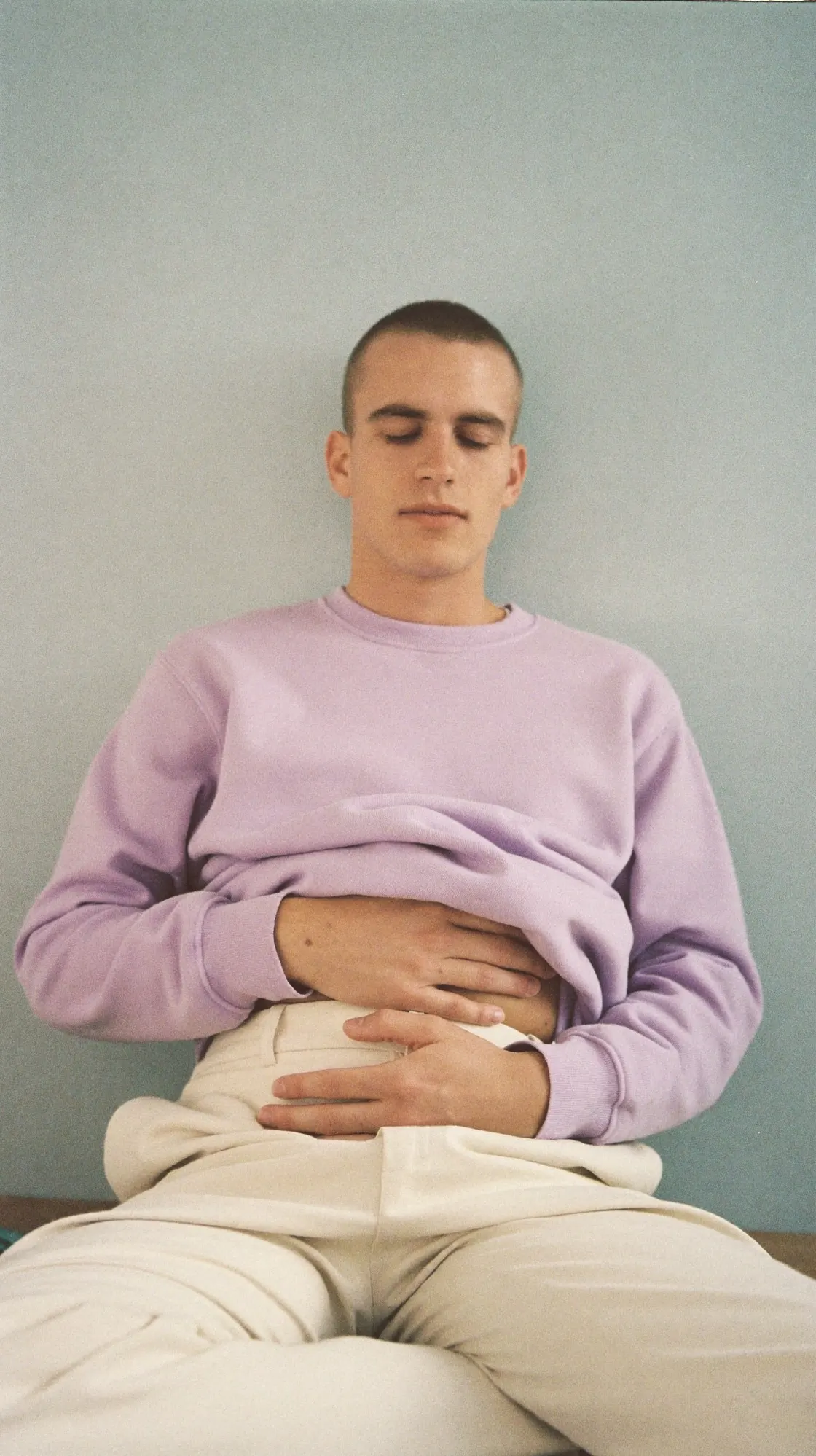
- Hands on. Rest one hand on your chest and the other on your belly, just below your ribs.
- Breathe in slowly through your nose for 4 to 6 seconds. Let your belly rise into your lower hand. The hand on your chest barely moves.
- Breathe out slowly for about 6 seconds, through your nose or softly pursed lips. Feel your belly sink back down on its own.
- Stay soft. Shoulders down, jaw loose, neck easy. Slower, not bigger: if you can hear yourself gasping, make the breath smaller.
- Carry on for 5 to 10 minutes. If 6 seconds feels long, start with 4 in and 5 out. If you feel light-headed, take a few ordinary breaths and carry on more gently.
Six in and six out is 5 breaths a minute, at the slow end of what feels easy. If it feels like a stretch, try 5 in and 5 out instead (the player further down), and lengthen it over a few days if you’d like to.
How do I know if I’m breathing from my diaphragm?
Watch your hands. When you breathe from your diaphragm, the lower hand rises as you breathe in and the upper hand stays almost still. If the top hand lifts first, or your shoulders creep up towards your ears, you’re breathing high in your chest.
Here’s what’s going on underneath. Your diaphragm is a dome-shaped sheet of muscle under your lungs. When it tightens, it flattens downwards, drawing air in and nudging your belly out of the way. Strictly, every breath uses it. “Diaphragmatic breathing” means letting it do most of the work, instead of the muscles in your neck and upper chest.
Your belly doesn’t need to balloon. A soft, steady rise is enough, and your lower ribs widen a little to the sides as well.
Should you practise lying down, sitting or standing?
Start lying down, then take it upright. Lying on your back makes the belly easiest to feel, and gravity helps it fall on the out-breath. Sitting and standing are where you’ll use it day to day, and how to breathe properly puts it together with the other two everyday habits.
| Position | How | Good for |
|---|---|---|
| Lying | Knees bent, feet flat, a hand on your chest and one on your belly | Learning it, and winding down in bed |
| Sitting | Back supported, feet on the floor, shoulders loose | Your desk, the train, the waiting room |
| Standing | Knees soft, weight even, one hand on your belly | The queue, the minute before a talk |
On the train or at your desk,  Breathform on Apple Watch taps your wrist at each turn of the breath, so you can practise without anyone noticing.
Upright, it often feels harder at first, because the muscles that hold you up also brace your belly. Sit back in the chair rather than perching, and let your belly be soft. If a tight waistband is in the way, it isn’t you.
What are the benefits of diaphragmatic breathing?
The best-known trial is small. In it, 40 office workers were split into two groups, and one had 20 coached sessions of diaphragmatic breathing over 8 weeks. Afterwards, the breathing group had lower negative mood than at the start, lower cortisol (a stress hormone) and a bigger gain in sustained attention than the group with no training (Ma et al. 2017). The groups weren’t truly randomised, and the coached pace was very slow, about 4 breaths a minute.
For anxiety, a review of 40 trials of breathing-based therapies, diaphragmatic breathing among them, found they eased anxiety more than control conditions (Leyro et al. 2021). Most of those trials were at high risk of bias, so the size of the effect is uncertain.
In COPD, diaphragmatic breathing appears to help exercise capacity and breathing function, according to a review of 25 reviews and trials, though the author calls the quality of the studies poor (Hamasaki 2020). Gentle, seated versions are in breathing exercises for seniors. For reflux, a 2026 review of 10 small trials found a modest drop in symptoms (Abureesh et al. 2026).
So: a gentle, sensible habit with promising early evidence, and most of its calming effect probably comes from the slow pace it makes easy.
How well each breath is studied
- Slow breathing (6-6)Some evidence
- Coherent breathingWell studied
Every study on this page (5)
- Ma et al., 2017: In 40 IT workers, eight weeks of coached belly breathing lowered a stress hormone; gains in mood and focus were less clear.
- Leyro et al., 2021: Across 40 trials with 3,047 people, breathing-based therapies eased anxiety more than comparison groups, but most trials had design flaws.
- Hamasaki, 2020: A narrative review of 10 systematic reviews and 15 randomised trials: diaphragmatic breathing appears to improve exercise capacity and respiratory function in COPD, but its exact usefulness in clinical practice is unclear because of the poor quality of studies.
- Abureesh et al., 2026: A meta-analysis of 10 randomised trials with 476 people with GERD found a modest improvement in reflux symptom scores with diaphragmatic breathing, with substantial heterogeneity between trials.
- Laborde et al., 2022: Across 223 studies, slow breathing raised heart-rhythm signs of calm, during practice and after, though that alone doesn't prove a health benefit.
Is belly breathing the same as diaphragmatic breathing?
Yes. Belly breathing, abdominal breathing and diaphragmatic breathing are three names for the same thing: the belly name says what you see, the diaphragm name says what’s doing the work. Its opposite is chest breathing, where the upper chest and shoulders lift with each breath. We set the two side by side in chest breathing vs belly breathing.
The yoga version, three-part breath, starts the same way and then lets the breath rise on through the ribs and upper chest. It’s a fuller breath. Diaphragmatic breathing keeps it low.
Does diaphragmatic breathing help anxiety?
It can help you feel steadier. When you’re anxious, breathing tends to go fast and high, into the upper chest. Breathing low into your belly makes it much easier to slow down, and slow breathing is what most of the research measures. Breathing at around 6 breaths a minute reliably raises heart rate variability, the small beat-to-beat changes that tend to grow when you’re at rest (Laborde et al. 2022).
Five in and five out is that pace. Try it with a hand on your belly:
If anxiety is what brought you here, breathing exercises for anxiety has more breaths for the moments it climbs. If you have a lung condition such as COPD or asthma, your respiratory team can show you how belly breathing fits alongside your care.
Why does belly breathing feel hard?
- Your chest rises first. Common, especially if you’ve breathed high for years. Press gently with your lower hand and breathe into it, as if it were a small weight.
- Your belly won’t move at all. Try lying on your front with your forehead on your hands. You’ll feel your back and belly widen against the floor.
- You feel light-headed. You’re breathing bigger, not slower. Make each breath smaller and quieter.
- It feels like hard work. Your diaphragm hasn’t had much practice leading. Keep sessions short, 3 to 5 minutes, and they’ll get easier.
- It vanishes when you sit up. Normal. Practise lying down for a week, then sitting, then standing. Shallow breathing has more on why breath creeps upwards during the day.
Questions people ask
Should I breathe through my nose or mouth?
Breathe in through your nose if you can: it slows the air down and makes a low breath easier. Breathe out through your nose or through softly pursed lips, as if cooling a spoonful of soup. Pursed lips make the out-breath longer without effort, which is why they’re often taught together, as in pursed-lip breathing.
How long does it take to learn diaphragmatic breathing?
Most people feel their belly move within a session or two lying down. Making it your easy, everyday way of breathing takes longer: think weeks of short practice rather than days. Five to ten minutes once or twice a day is plenty. Tie it to something you already do, like the minute after you switch the light off.
Can diaphragmatic breathing help with reflux?
It may help some people. The diaphragm wraps around the bottom of the food pipe and helps keep stomach acid where it belongs, and a 2026 review of 10 small trials found a modest drop in reflux symptoms with regular practice. It’s used alongside the usual treatment, not instead of it. There’s a routine in breathing exercises for GERD.
Does belly breathing help you sleep?
It can help you settle. A slow belly breath lying in bed is a gentle way to let the day go, especially if you make the out-breath a little longer than the in-breath. It won’t knock you out, but it gives you a quieter place to start from. There are four bedtime breaths in breathing exercises for sleep.
Is it normal to feel dizzy when I start?
A little light-headedness in the first minutes is common, and it usually means you’re breathing bigger, not slower. Make each breath smaller and quieter, keep the pace slow and it settles. If it doesn’t, take a few ordinary breaths and come back to it later. Low and gentle is the aim: your belly should rise softly, not balloon.
Read next
Side by side · 5 min
Chest breathing vs belly breathing: where your breath goesWhere your breath goes, and how to move it lower.
Long read · 9 min
How to breathe properlyLower, slower, through the nose: the basics, without the lecture.
Technique · 5 min
Three-part breath (dirga pranayama)Fill from the belly, then the ribs, then the chest, and let it go.
Guide · 5 min
Shallow breathingBreathing high and quick? Here’s why it happens, and how to breathe lower.
Technique · 6 min
Pursed-lip breathingBreathe out slowly through softly pursed lips, as if blowing on a candle.
In 2 · out 4 · In the app: Ease
Kids · 4 min
Balloon breathingFill your tummy like a balloon, then let it float down slowly.
More in Techniques
Technique · 8 min
Box breathing (square breathing)Technique · 7 min
4-7-8 breathing (the relaxing breath)Technique · 6 min
Coherent breathing (resonance breathing)Technique · 6 min
Physiological sigh (cyclic sighing)Technique · 5 min
Triangle breathingTechnique · 5 min
4-6 breathing (a longer exhale)Technique · 6 min
Humming bee breath (bhramari)Technique · 6 min
Alternate nostril breathing (nadi shodhana)
Breathe gently, never strain, and stop if you feel dizzy, light-headed or short of breath.