In the momentEveryday4 min
Morning breathing exercises: a 3-minute routine
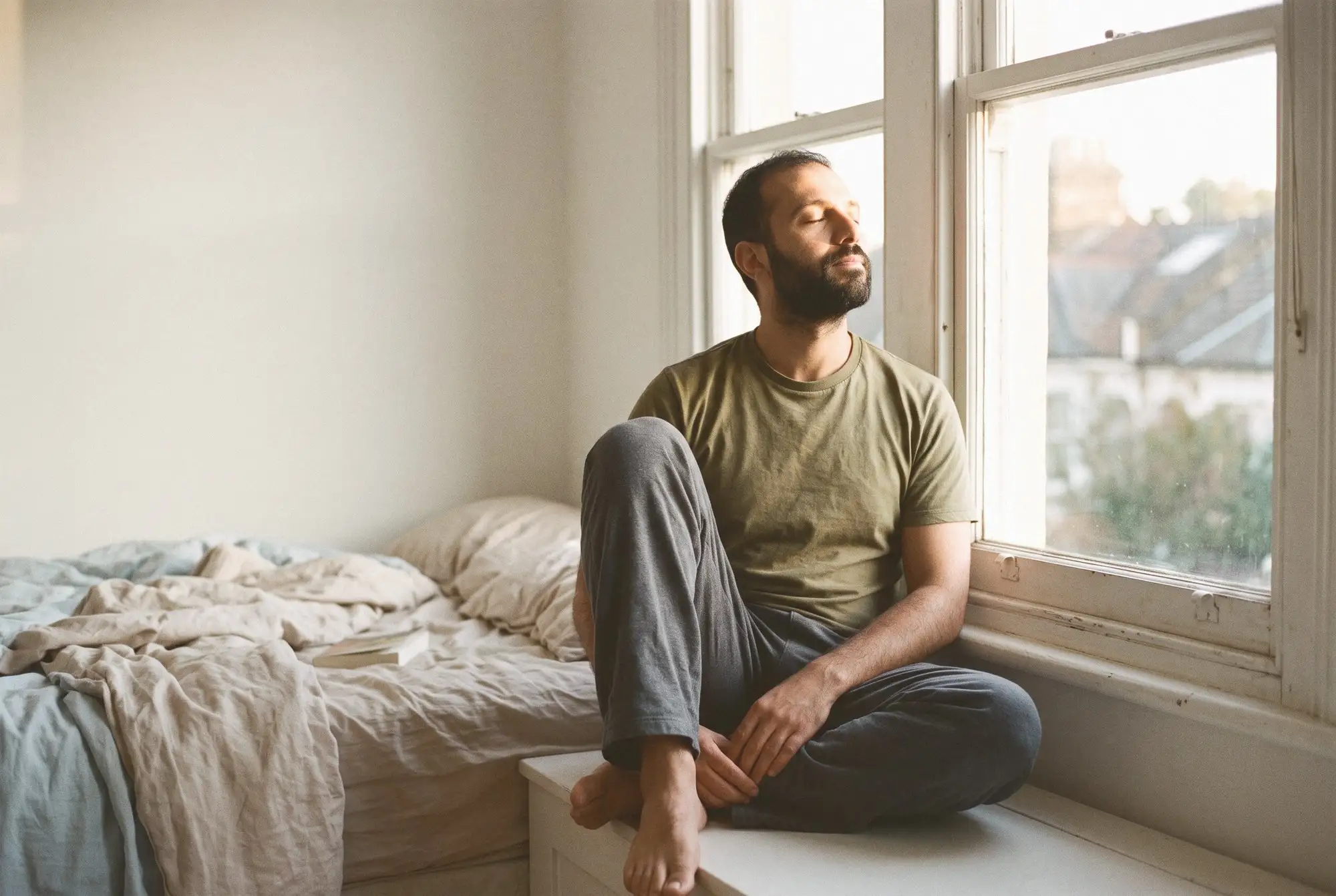
Before the phone, before the kettle, before the day asks anything. Three minutes, sitting up in bed or by a window.
Energising breath · In 4 · out 2
What are the best morning breathing exercises?
Something slow first, then something a little brighter. The slow part settles you; the brighter part lifts you out of the fog.
Routine · 3 minutes
The 3-minute morning routine
- Sit up in bed against the headboard, or on a chair by a window. Feet down if you can, shoulders easy.
- 8 rounds of Open, about 90 seconds: breathe in for 6 seconds, filling from your belly upwards, then out for 6.
- 10 rounds of Rise, 1 minute: breathe in for 4 seconds, out for 2, light and unforced.
- One ordinary breath, then stand up and open the curtains.
Play Open first, then switch to Rise. If you feel light-headed during Rise, stop and breathe normally: it’s meant to be a gentle lift, never a push.
What breathing wakes you up?
A longer in-breath is the usual answer, and it’s what Rise does. Be honest with yourself about what it can do, though.
The grogginess you feel on waking has a name, sleep inertia. It slows your thinking for a while and fades the longer you’re awake (Hilditch and McHill 2019). No breath switches it off.
There’s little direct research on breathing to wake up. In one small lab study, people actually felt more positively energised breathing with a longer out-breath than with a longer in-breath (Van Diest et al. 2014). And a review of slow breathing studies found people often felt more alert and full of vigour afterwards (Zaccaro et al. 2018).
So: the lift probably comes from sitting up, slowing down and paying attention, as much as from the ratio. Rise is a pleasant way to end, not a magic switch. For more on this, see breathing for energy.

How long should a morning breathing routine be?
Three minutes is enough, and short enough to keep doing. A routine you do most mornings beats a longer one you skip. If you have more time, stay with the slow part: coherent breathing, 5 in and 5 out, for 10 minutes is a lovely start to a slow weekend.
Can breathing help morning anxiety?
Yes, but skip the lift. If you wake with a racing heart or a knot in your stomach, the last thing you need is more energy. Swap Rise for a few minutes of 4-6 breathing, in for 4 and out for 6, which gives the out-breath more time. There’s more in breathing exercises for anxiety.
If it’s morning sickness that greets you, breathing exercises for pregnancy looks at what a slow breath can and can’t do for it.
Should you breathe before coffee?
Why not both. Do the routine while the kettle boils or the coffee brews, then enjoy the cup. With  Breathform on Apple Watch, both breaths start from your wrist, so the phone can wait until after. Coffee and a slow breath don’t compete: one changes your chemistry, the other your pace. If you’re cutting down, caffeine withdrawal has a breath for the foggy first days.
Is it better to breathe in the morning or at night?
They do different jobs. In the morning, a breath sets the pace for the day, and breathing exercises for focus can carry it into work. At night, a longer out-breath helps you put the day down: see breathing exercises for sleep. The best time is the one you’ll keep. If you’re new to all this, breathing exercises for beginners is a good place to start.
Every study on this page (3)
- Hilditch and McHill, 2019: Sleep inertia, the grogginess felt on waking, impairs thinking and reaction speed, and fades as time awake increases; it is worse after sleep loss and depends on the time of day you wake.
- Van Diest et al., 2014: In a small lab study of mostly young women, breathing out longer than in felt more relaxing than breathing in longer.
- Zaccaro et al., 2018: In 15 small studies of healthy people, slow breathing was linked with feeling more relaxed and alert, and less anxious.
Questions people ask
Should I do breathing exercises in bed?
Sitting up in bed is perfect. Lying down is fine too, but it’s easier to drift back to sleep, so if you’d like the routine to wake you, sit up against the headboard or move to a chair by a window. Open the curtains first, if you can.
Is morning breathwork the same as a breathing exercise?
Not always. Some morning breathwork is fast, deep breathing with long holds, as in the Wim Hof method. It feels energising to some people but can make you dizzy or tingly, so do it sitting or lying down, never in water or while driving. The routine on this page is slow and gentle instead. More in what is breathwork?
How do I make morning breathing a habit?
Tie it to something you already do every morning, like the kettle, the first glass of water or sitting on the edge of the bed. Keep it short, so it’s easy on busy days. Do it in the same place each time. Missing a day doesn’t matter: just do it the next morning.
Practices in this guide
Read next
Technique · 5 min
Breathing for energy (energising breath)Long read · 7 min
Breathing exercises for focusTechnique · 6 min
Coherent breathing (resonance breathing)Technique · 5 min
Slow breathing exerciseQuestions · 5 min
Breathing exercises for beginnersGuide · 5 min
Caffeine withdrawal: the first few days
More in Everyday
In the moment · 5 min
Breathing exercises for public speakingIn the moment · 5 min
Breathing for flight anxietyIn the moment · 4 min
Breathing exercises at workGuide · 5 min
How to stop doomscrolling
Breathe gently, never strain, and stop if you feel dizzy, light-headed or short of breath.