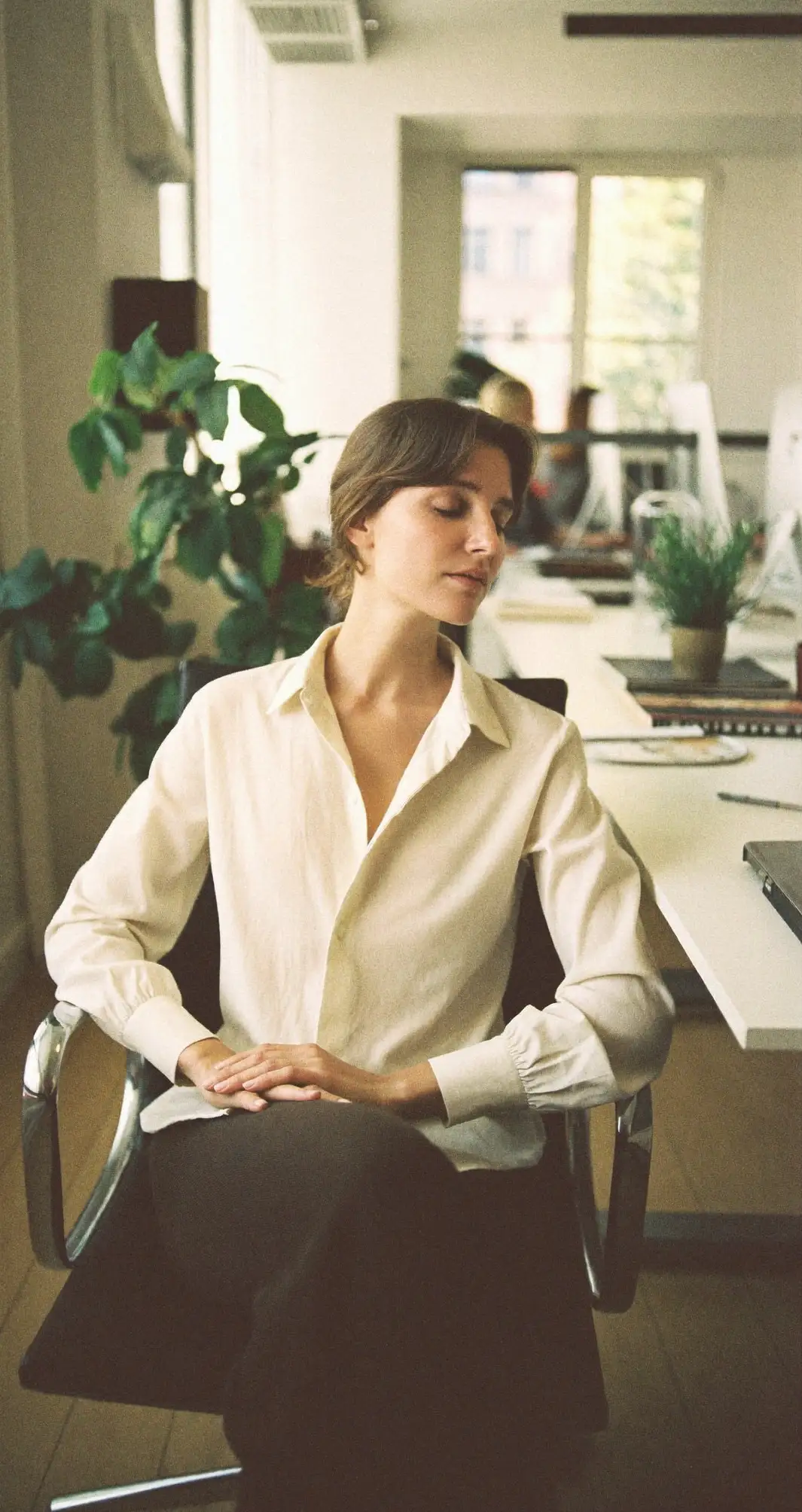
In the momentEveryday4 min
Breathing exercises at work
A one-minute break at your desk, between the email and the reply. Eyes open, and nobody needs to know.
Physiological sigh · In 2 · in again 1 · out 6
What are the best breathing exercises at work?
Start with this one: a double breath in and a long breath out, the same shape as the sigh your body does on its own. It takes a minute and needs nothing but a chair.
- Sit back so the chair takes your weight. Feet flat, hands off the keyboard.
- Breathe in through your nose for about 2 seconds.
- Take a second, smaller sip of air on top, about 1 second.
- Let it all go in a long, slow breath out for about 6 seconds, through your nose or softly parted lips.
- Repeat for about a minute, 6 or 7 rounds. Then take one ordinary breath and go back to work.
Seven rounds is the one-minute version, and you can set it that way in  Breathform: Reset’s full 10 rounds take about 90 seconds. More on the double breath in the physiological sigh.
How do you calm down at work without anyone noticing?
Keep your eyes open, breathe through your nose and make no sound. Lengthen each out-breath a little, so it’s slower than the breath in. From the outside, you look like someone reading.
If you’d like a count, try triangle breathing and trace a small triangle on the desk with one finger: up one side as you breathe in, down the other as you hold, along the bottom as you breathe out. Your feet flat on the floor help too.
Why do you hold your breath on email?
Many people do. The writer Linda Stone noticed she held her breath, or breathed very shallowly, while she read email, and in 2008 she called it “email apnoea”. She went on to watch others do the same at their screens. It was an informal observation rather than a study, but it rings true for a lot of people.
The likely culprits are anticipation, hunched shoulders and leaning in towards the screen. The fix is to notice. When you catch yourself, sit back and let one long breath out. If you’ve been sighing a lot at your desk, that may be your body doing the same thing for you: see why do I sigh so much?
How often should you take a breathing break?
Every hour or two is a good rhythm, or at the natural seams of the day: after a call, before a reply, when you sit back down after lunch.
Short breaks help a little in general. A review of 19 studies with 2,335 people found that breaks of up to 10 minutes gave small lifts in energy and small drops in tiredness, though no clear boost to performance (Albulescu et al. 2022).
For this breath itself, 5 minutes a day of cyclic sighing lifted mood more than mindfulness meditation in a month-long trial (Balban et al. 2023), and a pilot linked one minute of it in tense real-life moments to less anxiety (Riedl et al. 2026).
So: a one-minute breath won’t transform your day, but it’s a cheap, quick way to come back to it.
How well each breath is studied
- Physiological sighSome evidence
- Triangle breathingEarly research or tradition
- Interval breathingSome evidence
Every study on this page (3)
- Albulescu et al., 2022: A meta-analysis of 22 study samples (2,335 people) found micro-breaks of up to 10 minutes gave small boosts to vigour and small reductions in fatigue; the effect on overall performance was not significant.
- Balban et al., 2023: Five minutes a day of cyclic sighing lifted mood a little more than mindfulness meditation, in 108 adults.
- Riedl et al., 2026: In a small pilot, one minute of box breathing or cyclic sighing in tense moments eased students' anxiety more than no exercise.
Can a short breathing break help you focus?
It can help you return to the task more settled. Two minutes of box breathing before a block of deep work is the routine in breathing exercises for focus. And for a slightly longer pause, the 3-minute breathing space is a mindfulness practice built for exactly this kind of moment.
Questions people ask
What’s a good breathing exercise for work stress?
A long out-breath is the quickest to reach for. The one-minute reset on this page (two breaths in, one long breath out) suits a sharp moment, like a tense email. For a steadier kind of stress that builds over the day, two minutes of triangle breathing at lunch or between meetings gives your attention a break as well as your body.
Can I do breathing exercises in a meeting?
Yes, quietly. Breathe in through your nose and make the out-breath a little longer, through your nose too, while you listen. Nobody will notice. Keep your eyes on the speaker and your feet flat. Before you speak, let one slow breath out, then take a small, easy breath in and start.
Is it OK to close my eyes at my desk?
If you’re comfortable, yes, for a minute. If you’d rather not, rest your eyes on something still a little way off: a window, a plant, the far wall. The breath works the same either way. Headphones with nothing playing can make a busy office feel quieter while you do it.
Practices in this guide
Read next
Technique · 6 min
Physiological sigh (cyclic sighing)Long read · 7 min
Breathing exercises for focusTechnique · 5 min
The 3-minute breathing spaceTechnique · 5 min
Triangle breathingQuestions · 5 min
Why do I sigh so much?
More in Everyday
In the moment · 5 min
Breathing exercises for public speakingIn the moment · 5 min
Breathing for flight anxietyIn the moment · 4 min
Morning breathing exercises: a 3-minute routineGuide · 5 min
How to stop doomscrolling
Breathe gently, never strain, and stop if you feel dizzy, light-headed or short of breath.