GuideBody5 min
Caffeine withdrawal: the first few days
Day two without coffee: a dull headache, a head full of cotton wool and not much patience. It’s caffeine withdrawal, it’s temporary, and a slower breath helps with the parts it can reach.
What are the symptoms of caffeine withdrawal?
A review of 66 studies settled on ten that reliably show up: headache, tiredness, low energy, feeling less alert, drowsiness, feeling less content, low mood, difficulty concentrating, irritability and a foggy, not-quite-there head. Flu-like aches and nausea probably belong on the list too (Juliano and Griffiths 2004).
The headache is the famous one: about half the people in the experiments got it. For about 1 in 8, symptoms were bad enough to get in the way of the day. Not much caffeine is needed: stopping as little as 100 mg a day brought on symptoms in some people, and the more you’re used to, the stronger they tend to be.
How long does caffeine withdrawal last?
| Typically | |
|---|---|
| Starts | 12 to 24 hours after your last caffeine |
| Worst | 20 to 51 hours in, so usually day two |
| Over | Within 2 to 9 days |
So if you stop on a Friday, Saturday and Sunday are likely to be the hard days, and for many people it’s over within the week.
How do you cut down on caffeine without the headache?
Slowly. In a trial of people seeking help to cut down, a simple plan for reducing caffeine step by step over 6 weeks cut how much they had, and the change still held 20 weeks later (Sweeney et al. 2019).
- Count your starting point: coffee, tea, cola and energy drinks all count.
- Cut a little every few days, over a few weeks, rather than everything at once.
- Swap rather than skip. A half-caff, a tea or a decaf keeps the ritual while the dose comes down.
- Move your last cup earlier. Even 6 hours before bed, a strong dose disturbed sleep in one trial.
- Expect a dip, and give it a breath instead of a cup.
The sleep trial gave people a large dose, 400 mg, at bedtime, 3 hours or 6 hours before bed. All three disturbed sleep (Drake et al. 2013). An earlier cut-off is often the easiest first step.

Which breathing helps with caffeine withdrawal?
Match the breath to the symptom.
Irritable and short-tempered? 4-6 breathing.
The breath at the top of this page. In for 4, out for 6, for 2 minutes, before you answer the email or the person. The longer out-breath is the part that takes the heat out.
Foggy at 3pm? Box breathing, then a walk.
Four equal sides give a cotton-wool head one simple thing to follow: in for 4, hold for 4, out for 4, rest for 4, for 2 minutes. Then stand up and walk, even just to the end of the corridor. It won’t replace the coffee, and it isn’t meant to. More in breathing exercises for focus and breathing for energy.
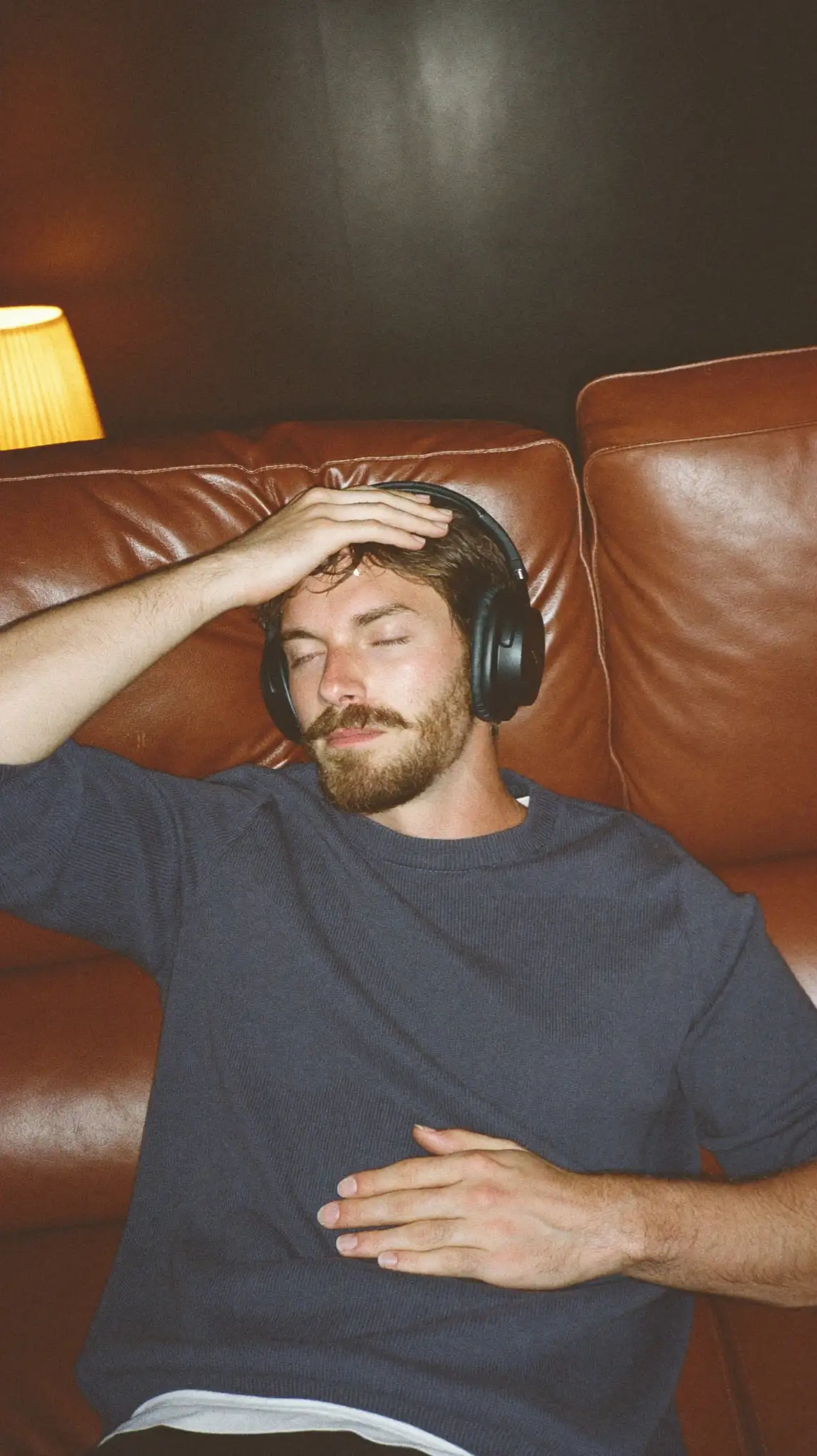
Headache? Lie back, loosen your jaw, breathe low.
Lie or sit back with your eyes closed and the light low. Unclench your jaw, let your tongue rest and breathe slowly into your belly, in for 4 and out for 6. It won’t lift the headache, but it can stop clenched shoulders and a tight jaw adding to it. With the lights off,  Breathform has a dark screen and soft tones, so you needn’t look at anything bright.
What about caffeine jitters?
That’s the other side of the same coin: too much rather than too little. If you’ve overdone it and feel shaky and wired, skip the next cup, have some water and something to eat, and slow your breathing down with a long out-breath. A few physiological sighs, two breaths in through your nose and one long breath out through your mouth, are quick to reach for: see how to calm down.
Does breathing help with caffeine withdrawal?
No study has tested breathing exercises for caffeine withdrawal itself, so here’s what’s known about the parts breathing can reach.
In a review of 12 trials with 785 adults, breathwork, mostly slow breathing, lowered self-reported stress a little more than the comparison conditions did (Fincham et al. 2023). In a remote trial of 108 adults, 5 minutes a day of cyclic sighing lifted mood more than mindfulness meditation (Balban et al. 2023).
So: a gentle way to take the edge off the irritable, foggy days. Not a treatment for the headache, which fades on its own as your body adjusts. If you’re cutting down more than one thing at once, breathing exercises to quit smoking has more breaths for cravings.
How well each breath is studied
- 4-6 breathingWell studied
- Box breathingSome evidence
- Physiological sighSome evidence
Every study on this page (5)
- Juliano and Griffiths, 2004: Review of 57 experimental and 9 survey studies: validated caffeine withdrawal symptoms are headache, fatigue, decreased energy, decreased alertness, drowsiness, decreased contentedness, depressed mood, difficulty concentrating, irritability and feeling foggy; flu-like symptoms, nausea and muscle pain are likely. Headache occurred in 50%; 13% had clinically significant distress or impairment. Onset 12–24 hours after abstinence, peak at 20–51 hours, duration 2–9 days; symptoms increased with dose and occurred after stopping doses as low as 100 mg a day.
- Sweeney et al., 2019: In a randomised trial of people with problematic caffeine use, a manual-only programme for gradually reducing caffeine over 6 weeks significantly reduced caffeine consumption, confirmed by saliva tests, with reductions sustained 20 weeks after treatment.
- Drake et al., 2013: 400 mg of caffeine taken at bedtime, 3 hours or 6 hours before bed significantly disturbed sleep compared with placebo; the authors recommend avoiding substantial caffeine for at least 6 hours before bed.
- Fincham et al., 2023: Pooled trials suggest breathwork modestly eases stress, anxiety and low mood compared with control groups, though most trials had weaknesses.
- Balban et al., 2023: Five minutes a day of cyclic sighing lifted mood a little more than mindfulness meditation, in 108 adults.
Questions people ask
What helps a caffeine withdrawal headache?
Time, mostly: it usually fades within a few days. Cutting down slowly rather than stopping overnight is the gentler route, because the more caffeine you stop at once, the stronger the symptoms tend to be. Meanwhile rest, eat regularly and use whatever you’d normally take for a headache, if it’s safe for you. A slow breath with your jaw loose won’t lift it, but it can help stop tension adding to it.
How much caffeine does it take to get withdrawal?
Less than you might think. In the experiments behind the main review, stopping even about 100 mg a day brought on symptoms in some people, and the more caffeine you’re used to, the more likely and stronger the symptoms tend to be. That’s one reason a gradual plan works better than a sudden stop if you drink a lot.
Is it better to quit caffeine gradually or cold turkey?
Gradually, for most people. In a trial of people who wanted to cut down, a simple manual for reducing caffeine step by step over 6 weeks cut how much they drank, and the change still held 20 weeks later. Stopping all at once works too, but expect a rougher few days: plan it for a quiet weekend rather than a big week at work.
Can caffeine withdrawal cause anxiety?
Anxiety isn’t one of the well-established symptoms. The ones the research supports are headache, tiredness, low energy, drowsiness, difficulty concentrating, feeling foggy, irritability and low mood. Feeling flat and on edge at once is common, though, and a few minutes of slow breathing with a longer out-breath is a good way to take the edge off either.
Practices in this guide
Read next
Long read · 7 min
Breathing exercises for focusTechnique · 5 min
Breathing for energy (energising breath)Technique · 8 min
Box breathing (square breathing)Technique · 5 min
4-6 breathing (a longer exhale)Long read · 9 min
Breathing exercises to quit smoking
More in Body
Guide · 5 min
Tight chest anxiety: a breath that loosens itGuide · 5 min
Air hunger anxiety: when you can’t get a full breathLong read · 10 min
How to calm your nervous systemGuide · 6 min
Vagus nerve reset: what breathing can (and can’t) doGuide · 5 min
How to improve HRV with breathingQuestions · 6 min
What is HRV, and what’s a good HRV?Guide · 5 min
How to lower heart rate quicklyGuide · 6 min
Breathing exercises to lower blood pressure
Breathe gently, never strain, and stop if you feel dizzy, light-headed or short of breath.