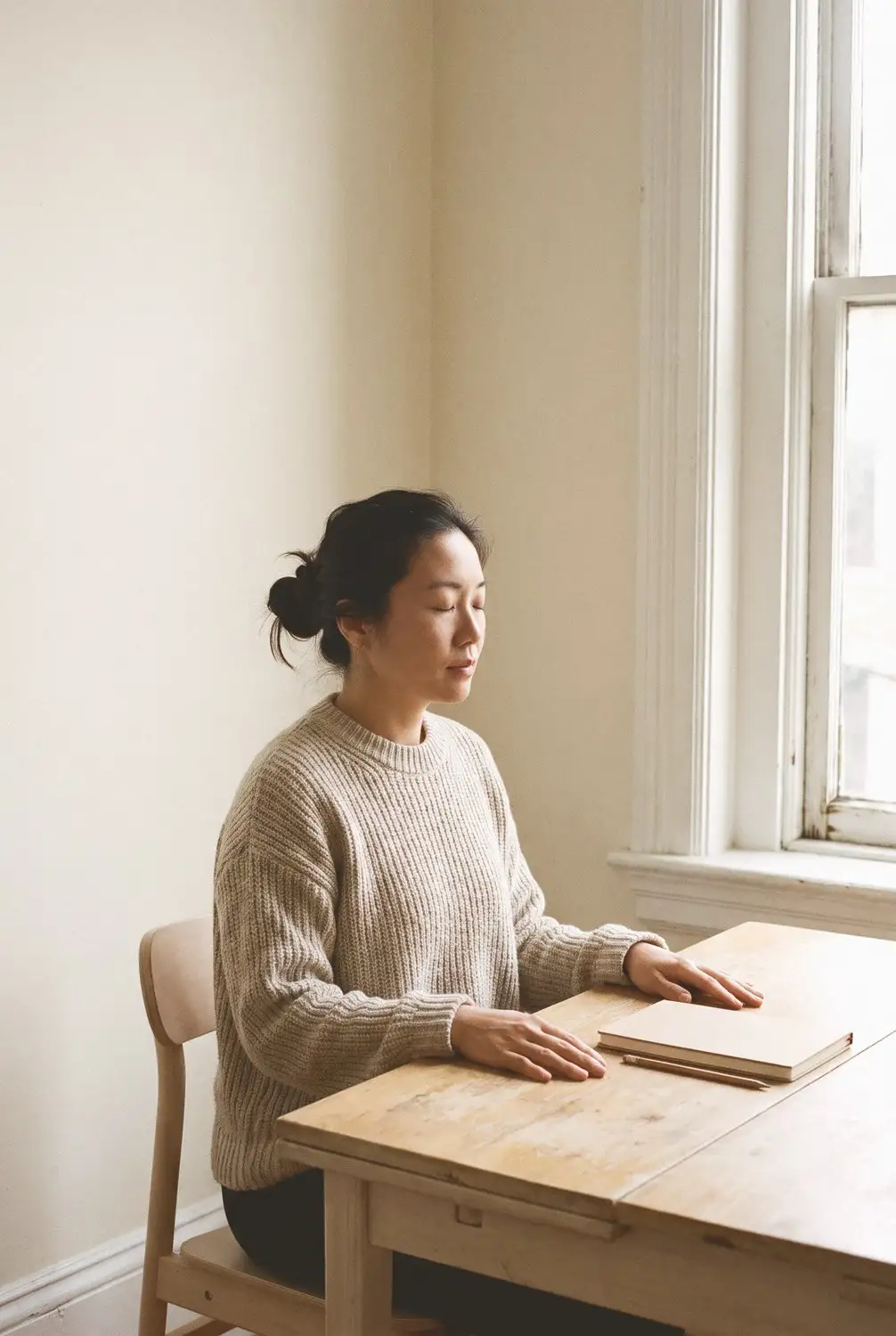
Start here
Box breathing, for 2 minutes
Long readEveryday7 min
Breathing exercises for focus
When your attention keeps sliding off the page, it often helps to slow down before you speed up. Of all the breathing exercises for focus, a counted breath is the simplest: it gives your mind one steady line to follow. Two minutes is enough to start.
Why do you lose focus when you’re stressed?
Stress pulls your attention outward. Your body gets ready to react: a quicker heart, quicker, higher breaths, eyes scanning for the next thing. That’s useful for a near miss on a bike and useless for a spreadsheet. Your mind keeps hopping, and every ping feels urgent.
A counted breath works from both ends. The slow pace nudges your body towards rest, and the count gives your attention a simple job with a clear edge: you always know whether you’re on it or not. When you drift, you notice sooner. That noticing is the skill focus is built on.
What are the best breathing exercises for focus?
Four breaths, for four kinds of work. Each plays here: press play and follow with your eyes open or closed.
Before deep work? Box breathing, 2 minutes.
Four equal sides. The holds are what make it focusing: they ask a little attention of you.
- Sit upright with your feet flat and your hands on the desk or your thighs.
- Breathe in through your nose for 4 seconds, hold for 4.
- Breathe out for 4 seconds, then rest for 4 with your lungs comfortably empty.
- Do 8 rounds, about 2 minutes. If 4 feels long, use 3.
In one trial, 5 minutes of box breathing before a stressful test blunted the rise in heart rate and anxiety (McAllister et al. 2026).
Full guide: box breathing
Holds feel like too much? Triangle breathing.
Box breathing with one side fewer: in, hold and out, all the same length. A little quicker to settle into.
- Breathe in for 3.5 seconds.
- Hold gently for 3.5 seconds, jaw and shoulders soft.
- Breathe out for 3.5 seconds.
- Do 11 rounds, about 2 minutes, or trace a triangle on the desk with one finger as you go.
Not studied as its own technique; at about 6 breaths a minute it sits within slow breathing, which research links to calmer physiology.
Full guide: triangle breathing
Want something to keep you there? Anchor breathing.
Short pauses at the top and bottom of each breath work like anchor points: easy to follow for longer, with none of the effort of long holds.
- Breathe in for 4 seconds, then pause for 2.
- Breathe out for 4 seconds, then pause for 2.
- Keep going for 10 rounds, 2 minutes, or longer with your eyes on a fixed point.
A gentler box-style pattern at 5 breaths a minute, drawing on slow-breathing research rather than direct tests.
Full guide: anchor breathing
Flagging in the afternoon? A few rounds of Rise.
The calming ratio turned around: a longer breath in, a short way out, for a little more lift.
- Sit or stand tall. Breathe in for 4 seconds, filling low then high.
- Breathe out easily for 2 seconds.
- Do 10 rounds, 1 minute. Keep it light. If you feel light-headed, stop and breathe normally.
Evidence for an alerting effect is limited, so take it as a gentle pick-me-up, best paired with daylight and a short walk.
Full guide: breathing for energy
Box or triangle breathing for focus?
Both work. Box breathing asks a little more of you, which is why it suits the minutes before something demanding. Triangle breathing is easier to keep up, so it suits a longer stretch or a tired head.
| Feature | Box breathing | Triangle breathing |
|---|---|---|
| Pattern | In 4 · hold 4 · out 4 · rest 4 | In 3.5 · hold 3.5 · out 3.5 |
| One round | 16 seconds | 10.5 seconds |
| The feel | Even, alert, a little effort | Lighter, easier to keep going |
| Best for | The 2 minutes before deep work | A longer stretch, or a tired afternoon |
| Evidence | Some evidence | Early research or tradition |
| Full guide | Box breathing | Triangle breathing |
Routine · 2 minutes
The 2-minute before-deep-work routine
- Clear the decks. Close the tabs you don’t need and put your phone out of sight.
- 6 rounds of box breathing, about 90 seconds, eyes open or closed.
- One long sigh: a breath in, a second small sip on top, then a long, slow breath out.
- Look at the first line of the task and begin before you think about it.
Slow down for two minutes, then start before you think about it.
How long should you breathe before deep work?
About 2 minutes. In the studies, people used box breathing and similar breaths for 1 to 5 minutes at a time (Riedl et al. 2026, McAllister et al. 2026). Longer isn’t better here: the point is to arrive, not to fill the morning. If you lose focus later, a minute of the same breath brings you back: set Box breathing to 4 rounds in  Breathform and it’s done in about a minute.
Does breathing really help concentration?
In an 8-week study of 40 employees at a tech company, those coached in slow belly breathing improved more on a sustained-attention test than a group with no training, and their cortisol fell while the other group’s didn’t. The untrained group improved on attention too, and the groups weren’t truly randomised (Ma et al. 2017).
In a pilot with 47 students, one minute of box breathing in real tense moments was linked to fewer errors of impulse on an attention test, but also to slower reactions (Riedl et al. 2026). And in a noisy, timed lab task, a long out-breath helped people perform better, while tactical breathing lowered their physical arousal more (Röttger et al. 2021).
A review of slow breathing studies found people often felt more relaxed, alert and full of vigour afterwards (Zaccaro et al. 2018).
So: a useful way to settle into work, with small, mixed effects on attention itself.
How well each breath is studied
- Box breathingSome evidence
- Triangle breathingEarly research or tradition
- Anchor breathingEarly research or tradition
- Energising breathEarly research or tradition
Every study on this page (6)
- McAllister et al., 2026: In 66 adults facing a stress test, box breathing or a long out-breath beforehand softened the rise in heart rate and anxiety.
- Riedl et al., 2026: In a small pilot, one minute of box breathing or cyclic sighing in tense moments eased students' anxiety more than no exercise.
- Ma et al., 2017: In 40 IT workers, eight weeks of coached belly breathing lowered a stress hormone; gains in mood and focus were less clear.
- Röttger et al., 2021: In 30 people under lab pressure, tactical breathing calmed the body more, while a long out-breath helped performance more.
- Zaccaro et al., 2018: In 15 small studies of healthy people, slow breathing was linked with feeling more relaxed and alert, and less anxious.
- Zelano et al., 2016: In a small study, natural nose breathing paced the brain's emotion and memory areas, and recall was sharper on the in-breath.
Does nose breathing help concentration?
Maybe a little, but don’t expect a boost. In one lab study, people recognised fearful faces faster and recalled images more accurately while breathing in through the nose (Zelano et al. 2016). The tests were brief, and the study looked at natural breathing, not a practice. Breathe through your nose if it’s comfortable: it tends to keep your breath slower and lower anyway.
Can breathing exercises help with ADHD?
They can’t treat ADHD, and they won’t replace whatever support works for you. Some people with ADHD find a short, visual breath easier than sitting with their thoughts: something to watch, a count to keep, an end in sight. If two minutes feels long, start with one. Stand up, keep your eyes open, follow the player’s dot, trace a shape with your finger. Short and often beats long and rare.
Where else can a breath help your day?
Focus pages for the moments that test it:
- Before something that matters: breathing exercises for public speaking, exams and interviews, with a 2-minute corridor routine.
- Between the email and the reply: breathing exercises at work, a one-minute break at your desk.
- Before the phone and the kettle: morning breathing exercises, a 3-minute routine.
- Before take-off: breathing for flight anxiety, with a routine for the bumps.
- Exam season: breathing exercises for teens and students.
Questions people ask
What is the best breathing exercise for concentration?
There isn’t one proven best. Box breathing is a good default: four equal sides give your attention a clear job, and it has been tested in small trials for tense moments. If the holds bother you, triangle breathing or Anchor’s short pauses do the same job more gently. The one you’ll actually do before work is the best one.
Can breathing replace a coffee?
Not really, and it doesn’t need to. Coffee changes your chemistry; a slow breath changes your pace and gives your attention somewhere to settle. They work well together: a couple of minutes of box breathing while the kettle boils, then the coffee, then the first task. If coffee makes you jittery, the breath can take the edge off.
Should I breathe through my nose while I work?
If it’s comfortable, yes. Nose breathing tends to be slower and quieter, and it keeps the breath low. One lab study linked breathing in through the nose to more accurate memory recall in quick tests, but it’s an early finding, not a reason to expect a boost. Mostly, notice when you’re holding your breath and let it go.
How often should I do breathing exercises for focus?
Once before each block of deep work is a good rhythm, plus whenever you notice you’ve read the same line three times. Two minutes is plenty. Some people tie it to a cue they already have: opening the laptop, the start of a focus timer, the walk back from lunch.
More in Everyday
- 1
In the moment · 5 min
Breathing for flight anxietyA routine for take-off, and one for the bumps.
- 2
Guide · 5 min
How to stop doomscrollingOne breath between the reach and the scroll.
Also filed under Everyday Box breathing (square breathing) · Breathing for energy (energising breath) · Anchor breathing (4-2-4-2 breathing) · The 3-minute breathing space · Breathing exercises to quit smoking · Nicotine cravings, breath by breath · Caffeine withdrawal: the first few days · Sugar cravings and stress eating
Read next
Technique · 8 min
Box breathing (square breathing)Technique · 5 min
Breathing for energy (energising breath)Technique · 5 min
Triangle breathing
Breathe gently, never strain, and stop if you feel dizzy, light-headed or short of breath.