Field guideTechnique5 min
The 3-minute breathing space
In 5 · out 5. Closest in the app: Coherent
Follow the tide: it rises as you breathe in and falls as you breathe out.
- Pattern
- In 5 · out 5
- Pace
- 6 breaths a minute
- Length
- 3 min · 18 rounds
- Evidence
- Early research or tradition
What is the 3-minute breathing space?
It’s a mini meditation you can do anywhere, in about 3 minutes. Instead of changing your breath, you use it as a place to rest your attention for a moment, between the noise of whatever came before and whatever comes next. People often describe its shape as an hourglass: wide attention, then narrow, then wide again.
What are the three steps of the breathing space?
Sit upright, in a way that feels awake rather than slumped. Close your eyes or lower your gaze.
- Becoming aware, about 1 minute. Ask yourself, “What’s here right now?” Notice your thoughts, your feelings and any sensations in your body. Don’t try to change them. Just name them.
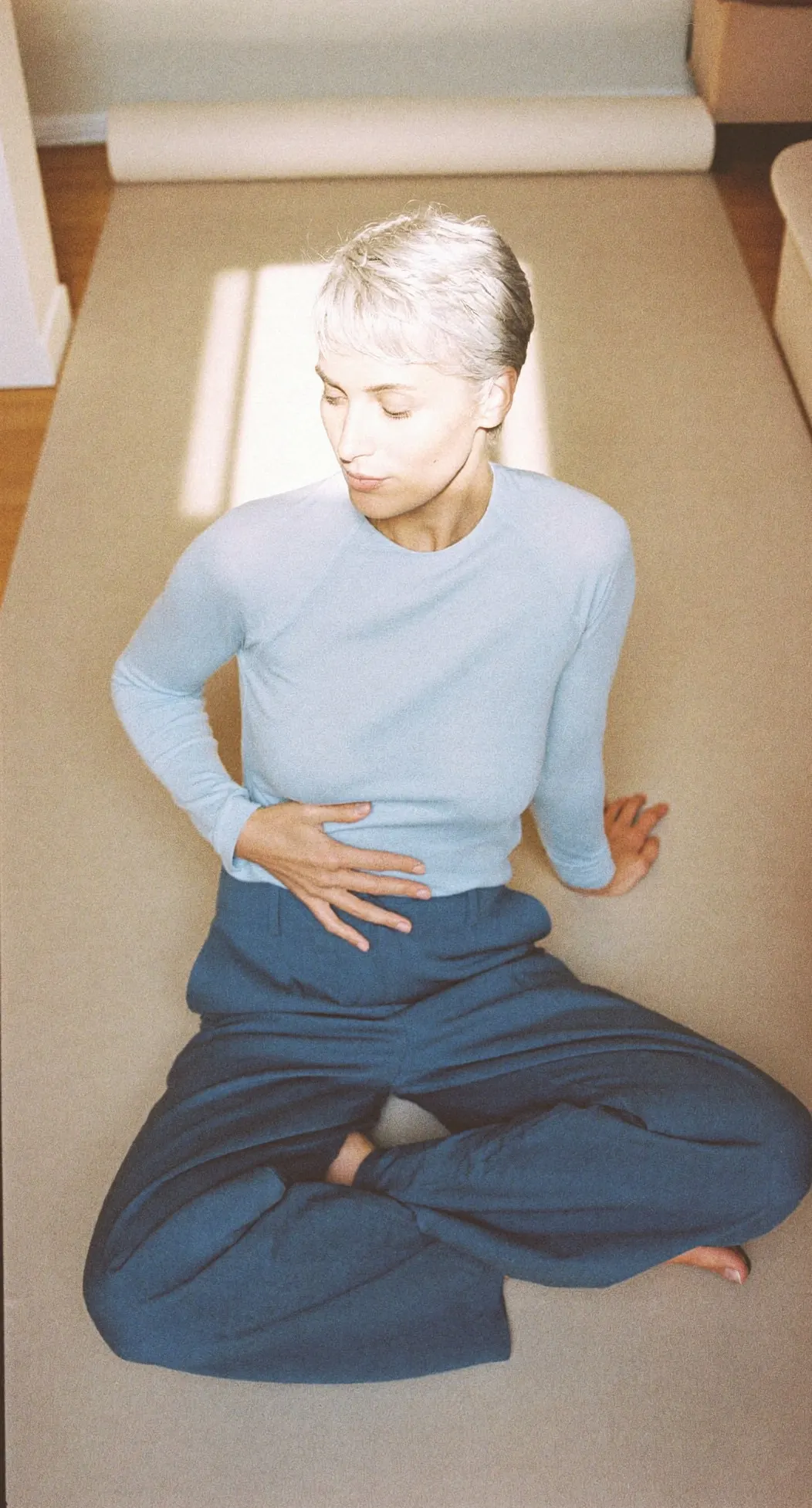
- Gathering, about 1 minute. Narrow your attention to the breath in your belly. Follow each breath in and each breath out. When your mind wanders, gently come back.
- Expanding, about 1 minute. Widen your attention to your whole body: your posture, your face, any tension, as if your whole body is breathing.
Then open your eyes and carry that wider attention into the next thing you do.
The player runs for 3 minutes at an easy 5 in and 5 out. Use it as a timer: let it pace your breath in step 2 if that helps, or simply let it keep time while you breathe naturally.
Where does the 3-minute breathing space come from?
It was developed by Zindel Segal, Mark Williams and John Teasdale as part of mindfulness-based cognitive therapy (MBCT), an 8-week course designed to help people who have had depression stay well. They wanted something short and portable that would carry the longer meditations into everyday life. Williams later made it widely known through the book Mindfulness: Finding Peace in a Frantic World, written with Danny Penman.
When should I use the breathing space?
MBCT courses suggest two kinds of use:
- At set times, often three times a day, so it becomes a habit: after you sit down at your desk, at lunch, before you leave work.
- When you need it: when you notice stress, worry or a low mood building, or before you react.
Everyday cues help. Try it while your computer starts up, after you park, before you open a difficult email or in the lift on the way to a meeting.
If it’s the working day that wears you down, breathing exercises at work has more for the desk. And when everything at once is the problem, try breathing exercises for overwhelm.
Is the breathing space the same as a breathing exercise?
Not quite. A breathing exercise changes your breath on purpose: slower, longer out, a hold, as in box breathing. The breathing space mostly leaves your breath alone and changes your attention instead. The breath is simply the anchor in the middle step. It’s a short, structured form of mindful breathing.
If you’d like your breath slowed down as well, you can do a breathing exercise in step 2, or follow it with one: tell  Breathform how you’d like to feel, and it starts a gentle breath of about two minutes. When you need to settle quickly, how to calm down starts with the breath.
What is the breathing space good for?
The breathing space hasn’t been tested much on its own. The course it comes from has. Across 9 trials with 1,258 people who had been depressed before, those who did MBCT were less likely to become depressed again within 60 weeks than those who didn’t (Kuyken et al. 2016). The breathing space is one part of that 8-week course, alongside longer practices and teaching, so the result belongs to the whole programme.
Short attention practice on the breath does seem to train the mind. In one online trial, 4 weeks of breath counting reduced mind wandering compared with other training (Levinson et al. 2014).
So: a quick, well-loved way to step out of autopilot, from a course with good evidence. On its own, it’s a gentle habit rather than a treatment.
Every study on this page (2)
- Kuyken et al., 2016: An individual patient data meta-analysis of 9 randomised trials with 1,258 people found mindfulness-based cognitive therapy reduced the risk of depressive relapse within 60 weeks compared with not receiving it (hazard ratio 0.69).
- Levinson et al., 2014: In a randomised online study, 4 weeks of breath counting training improved mindfulness and reduced mind wandering compared with working-memory training and no training.
Questions people ask
Can I do the breathing space with my eyes open?
Yes. Closing your eyes makes it easier to turn inwards, but it isn’t required. With your eyes open, rest your gaze softly on the floor a little way ahead, or on one still thing. That makes the breathing space easy to do at a desk, on a train or in a meeting, without anyone noticing.
Does it have to be exactly 3 minutes?
Three minutes is a guide, not a rule: roughly one for each step. On a busy day, three breaths per step still keeps the shape: notice, gather, widen. When you have more time, let each step stretch. What matters is the hourglass, wide then narrow then wide again, more than the clock.
What should I do in step 1 if I don’t like what I notice?
Notice it anyway, as kindly as you can, and let it be there. Step 1 isn’t about feeling good; it’s about seeing what’s here. You might say to yourself, “There’s worry,” or “My shoulders are tight.” Naming it is enough. Then move on to the breath. You’re not trying to fix the feeling, just to make room around it.
Is there an audio version I can follow?
Many MBCT teachers and mindfulness centres share free recordings, often around 3 to 4 minutes long. The player on this page works as a timer you can follow with the steps in front of you. After a few goes, most people don’t need a guide at all: the three steps are easy to remember.
Read next
Technique · 6 min
Mindful breathing (breathing meditation)Notice the breath, lose it, come back: that’s the whole practice.
In the moment · 4 min
Breathing exercises at workBetween the email and the reply.
Guide · 4 min
How to calm downOne breath to do now, and two more if you need them.
Guide · 4 min
Breathing exercises for overwhelmFor the days that are too much: one slow breath, then another.
Technique · 5 min
Interval breathing (breathing with a rest)Let the silence complete the breath.
In 5 · out 5 · rest 2 · In the app: Interval
More in Techniques
Technique · 8 min
Box breathing (square breathing)Technique · 7 min
4-7-8 breathing (the relaxing breath)Technique · 6 min
Coherent breathing (resonance breathing)Technique · 6 min
Physiological sigh (cyclic sighing)Technique · 5 min
Triangle breathingTechnique · 5 min
4-6 breathing (a longer exhale)Technique · 6 min
Humming bee breath (bhramari)Technique · 6 min
Pursed-lip breathing
Breathe gently, never strain, and stop if you feel dizzy, light-headed or short of breath.