Field guideEven rhythms
Alternate nostril breathing (nadi shodhana)
In the Breathform app, this is Balance
Follow the tide: it rises as you breathe in and falls as you breathe out.
- Pattern
- In 4 · out 4
- Pace
- 7.5 breaths a minute
- Length
- 2 min · 14 rounds
- Evidence
- Some evidence
How do you do alternate nostril breathing?
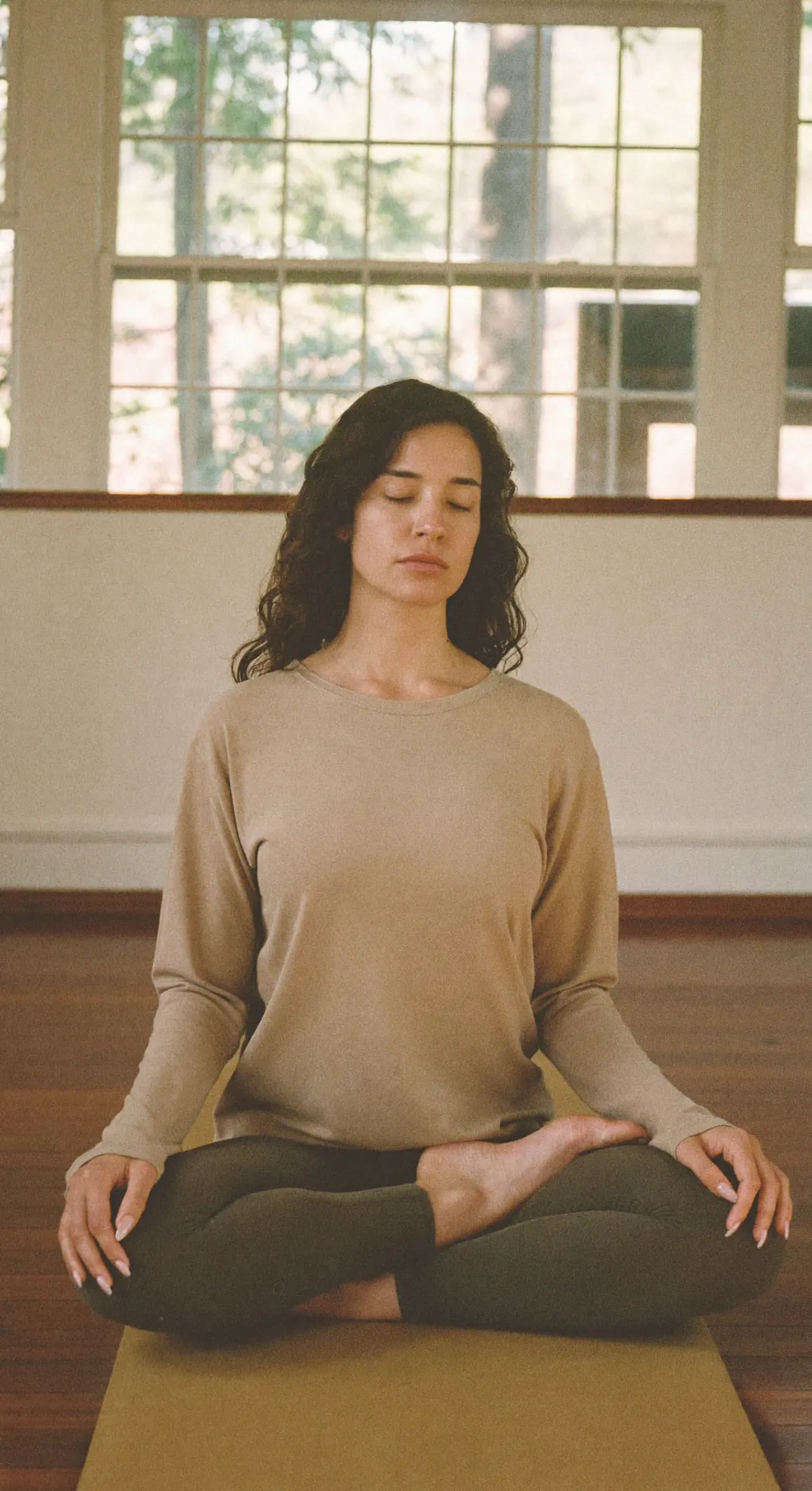
Sit tall, on a chair or on the floor, so your chest has room. Rest your left hand in your lap and bring your right hand to your face: your thumb will close the right nostril and your ring finger the left. Fold your index and middle fingers into your palm, or rest them lightly between your eyebrows.
- Close your right nostril with your thumb and breathe in through the left for 4 seconds. Slow and quiet.
- Switch. Close the left with your ring finger, lift your thumb and breathe out through the right for 4 seconds.
- Breathe in through the right for 4 seconds, keeping the left closed.
- Switch back. Close the right with your thumb, lift your ring finger and breathe out through the left for 4 seconds. That’s one full cycle.
- Repeat for about 2 minutes. Keep the touch light, just enough to close the nostril. If your arm tires, rest your elbow on your other hand or a cushion.
The player at the top names the side for each breath (left in, right out, then right in, left out), so after a few rounds you can close your eyes and follow the words. One rule keeps it straight: breathe in on the side you just breathed out of, then switch.
Which nostril do you start with?
Most teachers start by breathing in through the left and finish by breathing out through the left, so each cycle ends where it began. There’s no evidence that the side matters, so if starting on the right feels more natural, that’s fine. Left-handed? Mirror everything: left thumb on the left nostril, ring finger on the right.
It’s normal for one side to feel more open than the other, and for that to change through the day.
What are the benefits of alternate nostril breathing?
Mostly the benefits of breathing slowly, with a gentle task for your hands and attention. In one study, 20 people new to it did 30 minutes of alternate nostril breathing and 30 minutes of plain paced breathing, both at 5 breaths a minute. Heart rate variability rose after both, and the authors suggest the slow rate, not the switching, did most of the work (Ghiya & Lee 2012).
In a crossover trial of 34 students, 10 minutes of nadi shodhana didn’t change heart rate variability compared with resting. Men reported larger drops in stress and negative feelings after it, a result that still needs repeating (Avcık et al. 2026).
For blood pressure, a review of 6 randomised trials with 525 people found larger drops after alternate nostril breathing than after no practice or a placebo. But the trials differed hugely, and several mixed it with other yoga, so the authors urge caution (Nam et al. 2024).
So: a calming traditional practice whose effects look much like other slow breathing. You’ll also read that it balances the two halves of your brain. It’s a lovely image, but there’s no good evidence for it.
Every study on this page (3)
- Ghiya & Lee, 2012: In 20 adults new to yoga breathing, alternate-nostril breathing affected heart rhythm much like plain slow breathing; the slow pace seemed key.
- Avcık et al., 2026: In 34 students, neither 4-7-8 nor alternate-nostril (Nadi Shodhana) breathing changed heart-rhythm measures; stress and mood effects differed between women and men.
- Nam et al., 2024: Alternate-nostril breathing was linked with lower blood pressure across six trials, but results varied so widely that the authors urge caution.
Is alternate nostril breathing good for anxiety?
It can be a good fit. The slow pace helps your body settle, and the hand movements give a restless mind something to do, which some people find easier than sitting with a count. The version in  Breathform has no holds, so it stays gentle when your chest feels tight. Breathing exercises for anxiety has more to choose from.
Nadi shodhana or anulom vilom: what’s the difference?
Both names mean alternate nostril breathing, and teachers use them in different ways. Nadi shodhana is usually translated as “channel cleaning”. Anulom vilom means roughly “with the grain and against the grain”, after the breath going one way and then the other. In many classes, anulom vilom is the simple version with no holds, and nadi shodhana sometimes adds a short pause with both nostrils closed. Breathform’s Balance is the simple version: no holds, just the switch.
It’s one of the core breaths of pranayama, alongside humming bee breath and ujjayi breathing.
How long should you do alternate nostril breathing?
Two to five minutes is plenty to start; the player runs for just under 2. The two studies above used sessions of 10 and 30 minutes, which is a long time to hold an arm up to your face. Once the switching feels natural, you can slow it down:
| Pattern | The count | One round | Pace | 14 rounds |
|---|---|---|---|---|
| 4-4 · default | In 4 · out 4 | 8 s | 7.5 breaths a minute | 1:52 |
| 5-5 | In 5 · out 5 | 10 s | 6 breaths a minute | 2:20 |
| 6-6 | In 6 · out 6 | 12 s | 5 breaths a minute | 2:48 |
| 4-6 | In 4 · out 6 | 10 s | 6 breaths a minute | 2:20 |
Each row is one breath in through one side and out through the other. The same even counts without the switching are equal breathing.
Why does alternate nostril breathing feel awkward?
- You lose track of the side. Follow the words on the player, or keep to the rule: in on the side you just breathed out of, then switch.
- Your arm gets tired. Rest your elbow on your other hand, a cushion or a table. Lowering your chin a touch helps too.
- You press too hard. A fingertip’s weight is enough to close a nostril. Pressing makes your face tense.
- The breath feels thin. One nostril lets in less air, so slow down rather than pulling harder. Four seconds is plenty.
- You feel light-headed. Take a few normal breaths through both nostrils, then carry on more gently.
Questions people ask
Does alternate nostril breathing lower blood pressure?
It may help a little, but the evidence is shaky. A review found bigger drops in blood pressure after alternate nostril breathing than after no practice, but the trials varied hugely. Regular slow breathing of any kind is linked to modest drops in people with raised blood pressure. Use it alongside your treatment, not instead of it: see breathing exercises to lower blood pressure.
What if one nostril is blocked?
Breathe through both and keep the rhythm, or move your fingers as if switching and picture the air changing sides. It’s common for one side to feel more open than the other. If a cold has blocked your nose properly, give this one a rest for a few days and breathe slowly through softly parted lips instead.
Can I do it without using my hand?
Yes. Some people simply imagine the air moving in one side and out the other, and find that just as calming. The hand version makes the switch real and gives your attention more to do. In the app, Balance shows which side comes next on the screen, so you can follow it either way.
Is alternate nostril breathing good before bed?
It can be, for a few minutes as you wind down. Some people find the hand movements keep them a little alert, so it often suits the evening better than the moment the light goes off. In bed, a breath with no hands and a long out-breath, like 4-6 breathing, is easier to drift off with.
If alternate nostril breathing isn’t quite right
Technique · 6 min
Humming bee breath (bhramari)A low hum on the out-breath, quiet enough for 3am.
In 4 · hum 6 · In the app: Hum
Read next
Long read · 9 min
Pranayama: yoga breathing for beginnersGuide · 6 min
Breathing exercises to lower blood pressureTechnique · 6 min
Ujjayi breathing (ocean breath)Technique · 5 min
Equal breathing (sama vritti)
Breathe gently, never strain, and stop if you feel dizzy, light-headed or short of breath.