
Start here
Slow nose breathing, for 2 minutes
Long readLearn9 min
How to breathe properly
Your breathing looks after itself, and most of the time it does a fine job. But stress, screens and long days at a desk can leave it high, quick and a little tight. Learning how to breathe properly isn’t about getting it right. It’s three easy habits to come back to. Start with this one.
How should you breathe normally?
Quietly, through your nose, low in your body and without much effort. At rest, most adults breathe about 12 to 20 times a minute. If someone sat next to you, they wouldn’t hear you breathe, and your shoulders wouldn’t rise and fall.
That’s the easy, automatic kind. Breathing practice is something else: a few minutes of breathing slower than usual, on purpose, to help your body settle. Both matter, and the three habits below serve both.
There’s no single right way to breathe. Your breathing changes all day, faster on the stairs, slower in sleep, and it should. What helps is having a calm default to come back to.
Am I breathing wrong?
Probably not. You’ll see headlines claiming most people breathe wrong. Breathing is too adaptable for that: your body adjusts it every minute. But habits do creep in, especially with stress or long hours sitting, and they’re worth a look. This takes one minute.
- Sit as you usually sit. Set a timer for 60 seconds and count your breaths without changing them.
- Notice the route. Is your mouth open or closed? Is the air coming through your nose?
- Notice the place. Rest one hand on your chest and one on your belly. Which moves first?
- Notice your shoulders. Do they rise with each breath in?
- Notice the sound. Can you hear yourself breathing?
A count between 12 and 20, a closed mouth, the lower hand leading, quiet shoulders and no sound: that’s an easy, settled breath. If you found a quick count, an open mouth, a busy top hand or rising shoulders, the habits below are for you. None of it is a diagnosis. It’s simply where to start.
How to breathe properly: the three habits
Each habit comes with a breath to try here and now. Do them in order the first time; after that, use whichever one you need, wherever you are: three of the four, Coherent, Ease and Unwind, are free in  Breathform.
Mouth open at rest? Breathe through your nose.
The nose filters, warms and moistens the air, and because it’s a narrower path, breaths through it tend to be slower and quieter. Two popular routes to more nose breathing have their own pages: mouth taping at night and Buteyko breathing.
- Close your lips and rest your tongue on the roof of your mouth, teeth slightly apart.
- Breathe in through your nose for 5 seconds.
- Breathe out through your nose for 5 seconds, just as smoothly.
- Keep going for 2 to 3 minutes. If your nose feels stuffy, breathe out through soft lips.
In one small trial, 5 minutes of nose breathing at rest was linked to slightly lower diastolic blood pressure than 5 minutes of mouth breathing (Watso et al. 2023).
Full guide: nose breathing vs mouth breathing
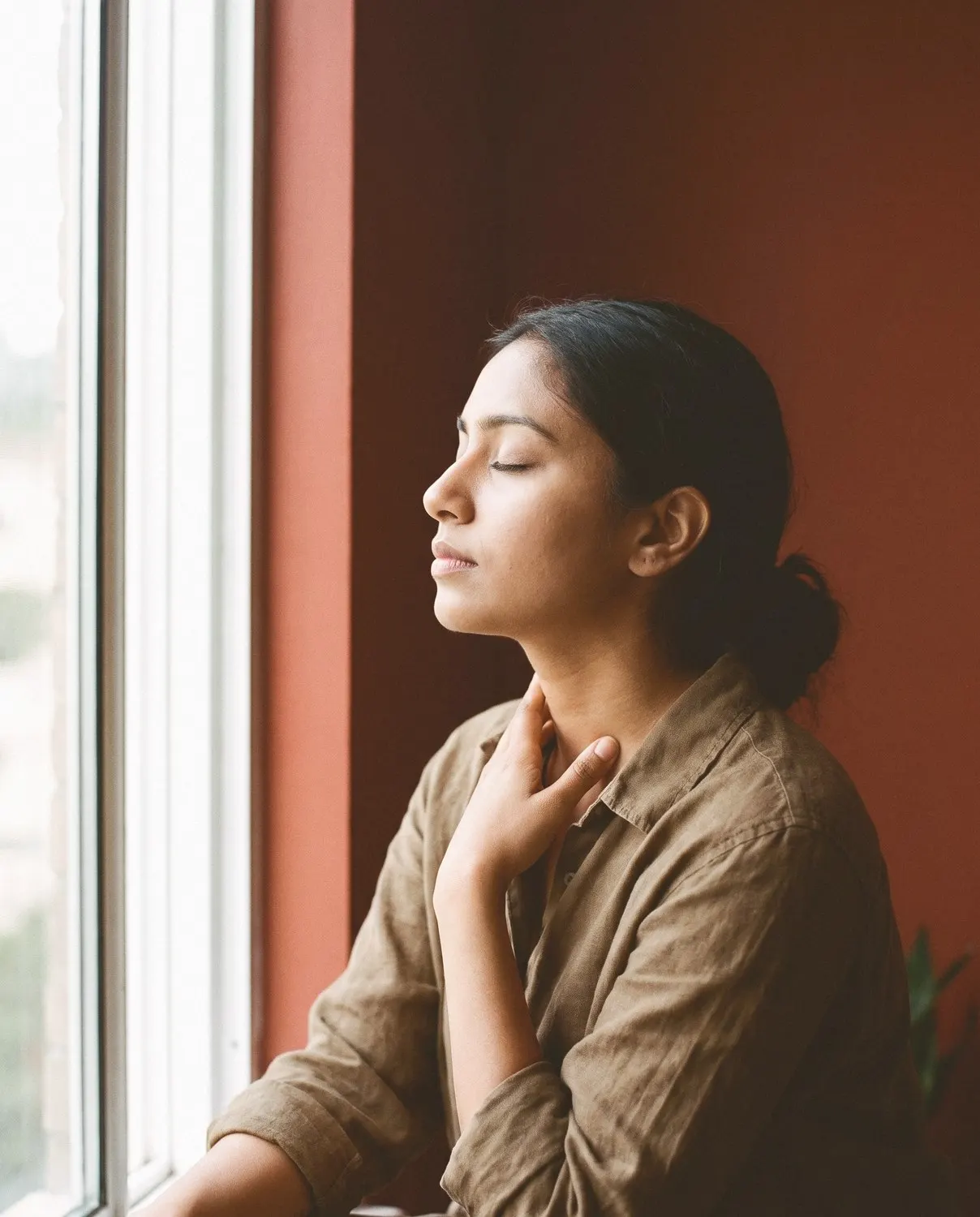
Shoulders doing the work? Breathe lower.
Your diaphragm, a dome of muscle under your lungs, is built to do most of the work at rest. When it does, your belly and lower ribs widen and your shoulders stay still.
- Lie on your back, or sit tall, with one hand on your belly.
- Breathe in through your nose for 6 seconds, letting the hand rise first.
- Breathe out for 6 seconds and feel it sink.
- Keep the breath soft. If 6 feels long, use 4 or 5: lower matters more than longer.
Breathing at about 5 breaths a minute sits in the range used in heart rate variability research. How you sit matters too: in one study, slumped sitting reduced lung capacity and airflow (Lin et al. 2006).
Full guide: diaphragmatic breathing
Breath quick and tight? Slow down, and breathe out longer.
Your heart speeds up slightly as you breathe in and slows as you breathe out. A longer, softer out-breath gives the slowing side more time.
- Breathe in gently through your nose for 2 seconds.
- Breathe out through softly pursed lips for 4 seconds, as if cooling a spoonful of soup.
- After a minute, if it feels easy, switch to 4-6 breathing: in for 4, out for 6.
- Stop pushing if you feel light-headed. Smaller breaths, not bigger.
Breathing in for 4 and out for 6 sits in a well-studied slow range that raises heart rate variability.
Full guide: 4-6 breathing
How should you breathe when you’re stressed?
Slower, with a longer out-breath, and through your nose if you can. Stress pushes breathing up and speeds it up; the three habits push it back down. The quickest version is a sigh on purpose: a breath in through your nose, a small second sip of air on top, then a long, slow breath out through your mouth. Two or three of those, and your breathing often starts to settle by itself.
For a hard moment that won’t pass, a counted breath gives your mind something to hold. Breathing exercises for anxiety has one for each kind of moment, and the physiological sigh has its own guide. If you’re choosing between counts, box breathing vs 4-7-8 and the best breathing techniques compare them side by side.
Should your belly or chest move when you breathe?
Both move a little, but the belly and lower ribs should lead. If your upper chest and shoulders rise first on every breath, you’re breathing mostly from your chest, which is normal when you’re running and tiring as an all-day habit. The two-hand check and the fix are in chest breathing vs belly breathing, and if your breath often feels high and unfinished, see shallow breathing.
How many breaths a minute is normal?
About 12 to 20 at rest, for adults. Slow breathing practice brings that down to 4 to 10 for a while, and heart rate variability, a sign of the body at rest, tends to be greatest at around 6 breaths a minute (Russo et al. 2017). You don’t need to live there. A few minutes a day is the practice; the rest of the time, your body chooses.
| Pattern | The count | One round | Pace | 10 rounds |
|---|---|---|---|---|
| Pursed-lip | In 2 · out 4 | 6 s | 10 breaths a minute | 1:00 |
| 4-6 | In 4 · out 6 | 10 s | 6 breaths a minute | 1:40 |
| Coherent | In 5 · out 5 | 10 s | 6 breaths a minute | 1:40 |
| Slow 6-6 | In 6 · out 6 | 12 s | 5 breaths a minute | 2:00 |
There’s more on what’s normal, for adults and children, in normal breathing rate.
How do you take a proper deep breath?
Slowly, not hugely. When someone says “take a deep breath”, many of us gulp a big one through the mouth and lift our shoulders. That can leave you light-headed, because big, fast breaths blow off more carbon dioxide than you need to lose.
- Breathe out first, slowly, through your nose or soft lips. Empty, but don’t squeeze.
- Breathe in through your nose for about 4 seconds. Let it arrive low, in your belly and ribs.
- Breathe out for about 6 seconds, longer than the breath in, and let your shoulders drop.
- Do 3 of these, then breathe normally. One good breath beats ten big ones.
Slower, not bigger. A deep breath is a long one, not a large one.
If deep breathing makes you dizzy or your fingers tingle, that’s the sign to breathe more gently: why deep breathing makes you dizzy explains what’s happening.
How can I train myself to breathe better?
A few minutes a day, tied to something you already do, works better than a long session now and then. You don’t need a class for this, though if you’re curious what one involves, what is breathwork? explains the styles.
Routine · 5 minutes
The 5-minute daily practice
- Sit tall with your feet flat, lips closed, one hand on your belly.
- 4 minutes of coherent breathing: 5 seconds in, 5 seconds out, all through the nose.
- Then 1 minute of slow breathing: 6 in, 6 out, slower and lower.
- Finish with one ordinary breath, and notice how it feels.
Do it with the kettle on, after brushing your teeth or before you open your laptop. After a week, try the same slow breath while you walk. During the day, use small cues to check in: a red light, a ringing phone, the lift doors closing. Each time, lips together, breathe low, let the out-breath be the longer half.
If you’re new to all this, breathing exercises for beginners has a gentle 7-day plan.
Does breathing properly really make a difference?
For a few minutes of slow breathing, yes, with good evidence. A review of 223 studies found that slow breathing raised heart rate variability, a marker of the body’s rest-and-digest side, during practice, straight after one session and after programmes lasting weeks (Laborde et al. 2022). Across 15 smaller studies, people reported feeling more relaxed and alert, and less anxious, after slow breathing (Zaccaro et al. 2018).
For stress, a meta-analysis of 12 trials with 785 adults found breathing practices lowered self-reported stress by a small-to-medium amount compared with control groups, with most trials at moderate risk of bias (Fincham et al. 2023). And in a head-to-head lab test, plain breathing at 6 breaths a minute raised heart rate variability more than box breathing or 4-7-8 (Marchant et al. 2025).
What’s less clear is whether your all-day, automatic breathing needs fixing. Most research is about short practice sessions, not about breathing “perfectly” around the clock. The science page has every study we use, and the benefits of slow breathing goes deeper.
So: practise slow, low nose breathing for a few minutes a day, and let your body handle the rest.
How well each breath is studied
- Coherent breathingWell studied
- Slow breathing (6-6)Some evidence
Every study on this page (7)
- Watso et al., 2023: In 20 young adults, breathing through the nose rather than the mouth slightly lowered blood pressure and raised heart-rhythm signs of calm.
- Lin et al., 2006: In 70 volunteers, slumped sitting significantly reduced lung capacity and expiratory flow compared with upright sitting.
- Russo et al., 2017: An overview of research in healthy people suggests slow breathing affects the heart, lungs and nervous system; more study is needed.
- Laborde et al., 2022: Across 223 studies, slow breathing raised heart-rhythm signs of calm, during practice and after, though that alone doesn't prove a health benefit.
- Zaccaro et al., 2018: In 15 small studies of healthy people, slow breathing was linked with feeling more relaxed and alert, and less anxious.
- Fincham et al., 2023: Pooled trials suggest breathwork modestly eases stress, anxiety and low mood compared with control groups, though most trials had weaknesses.
- Marchant et al., 2025: In 84 students, six breaths a minute raised heart-rhythm signs of calm modestly more than box or 4-7-8 breathing; none changed mood.
Questions people ask
Is it bad to breathe through your mouth?
Now and then it’s simply useful: on a run, with a cold, when you’re laughing. As an all-day habit, mouth breathing tends to bring a dry mouth and snoring, and it’s often a sign the nose needs help. Breathing through your nose at rest is the comfortable default. If your mouth is open most of the time, how to stop mouth breathing starts with the nose.
Should you breathe in through your nose and out through your mouth?
Either is fine for the out-breath. In through the nose matters most, because that’s where the air is filtered, warmed and moistened. Out through the nose keeps things quiet and slow; out through softly parted lips makes a long out-breath easier to pace, which is why 4-7-8 and pursed-lip breathing use it. Pick whichever feels calmer to you.
Why do I hold my breath without realising?
Many people do it while they concentrate: reading an email, threading a needle, waiting for a page to load. It’s a small bracing habit, not a problem in itself. If you notice it often, let it be a cue: breathe out slowly, let the next breath come in through your nose, and carry on. Over time, the noticing itself starts to soften the habit.
Can you breathe too slowly?
You can push it too far. If a slow count leaves you gasping, straining or reaching for big breaths, it’s too slow for you right now. Speed up a little: 6 to 10 breaths a minute is plenty for most practice. Even slow breathing can tip into over-breathing if each breath is very large, so keep the breaths soft as well as slow.
Does posture affect your breathing?
Yes, a little. Slumping squashes the space under your ribs, so your diaphragm has less room to move and breaths tend to get higher and smaller. In one study of 70 people, slumped sitting measurably reduced lung capacity compared with sitting upright. You don’t need a perfect posture: sit tall enough that your belly can move, and get up now and then.
More in Learn
- 1
Side by side · 6 min
Best breathing techniques: one honest tableTwelve techniques in one table: pace, holds, best for, evidence.
- 2
Questions · 5 min
Why does deep breathing make me dizzy?Usually you’re breathing more than you need. Breathe more gently, not more deeply.
- 3
Questions · 6 min
What is breathwork?Any practice where you change your breathing on purpose.
- 4
Side by side · 5 min
Box breathing vs 4-7-8: which to use whenOne keeps you steady for the meeting. The other helps you put the day down.
- 5
Side by side · 5 min
Is mouth taping safe, and does it work?A popular habit, looked at calmly.
- 6
Research · 10 min
Slow breathing benefits: what it does to your bodyHeart rate, HRV, blood pressure, mood: what slow breathing does, and its honest limits.
- 7
Questions · 5 min
Why do I sigh so much?A sigh is a double breath in and a long breath out, and your body does it on its own.
- 8
Research · 6 min
CO2 tolerance and the BOLT scoreWhat the tests measure, and why we explain them rather than train them.
Also filed under Learn Diaphragmatic breathing (belly breathing) · Buteyko breathing · Pranayama: yoga breathing for beginners · Types of breathwork, from gentle to intense · What is HRV, and what’s a good HRV? · How to activate your parasympathetic nervous system · How to stop mouth breathing · Shallow breathing
Read next
Technique · 7 min
Diaphragmatic breathing (belly breathing)Guide · 5 min
Shallow breathing
Breathe gently, never strain, and stop if you feel dizzy, light-headed or short of breath.