A breath forBody5 min
Shallow breathing
Breathing high and quick, as if your lungs only fill halfway? It’s common, especially when you’re stressed, sitting a lot or sore. It’s rarely a sign of anything serious, and it usually responds to something simple: a slower breath, lower down. Try this one first.
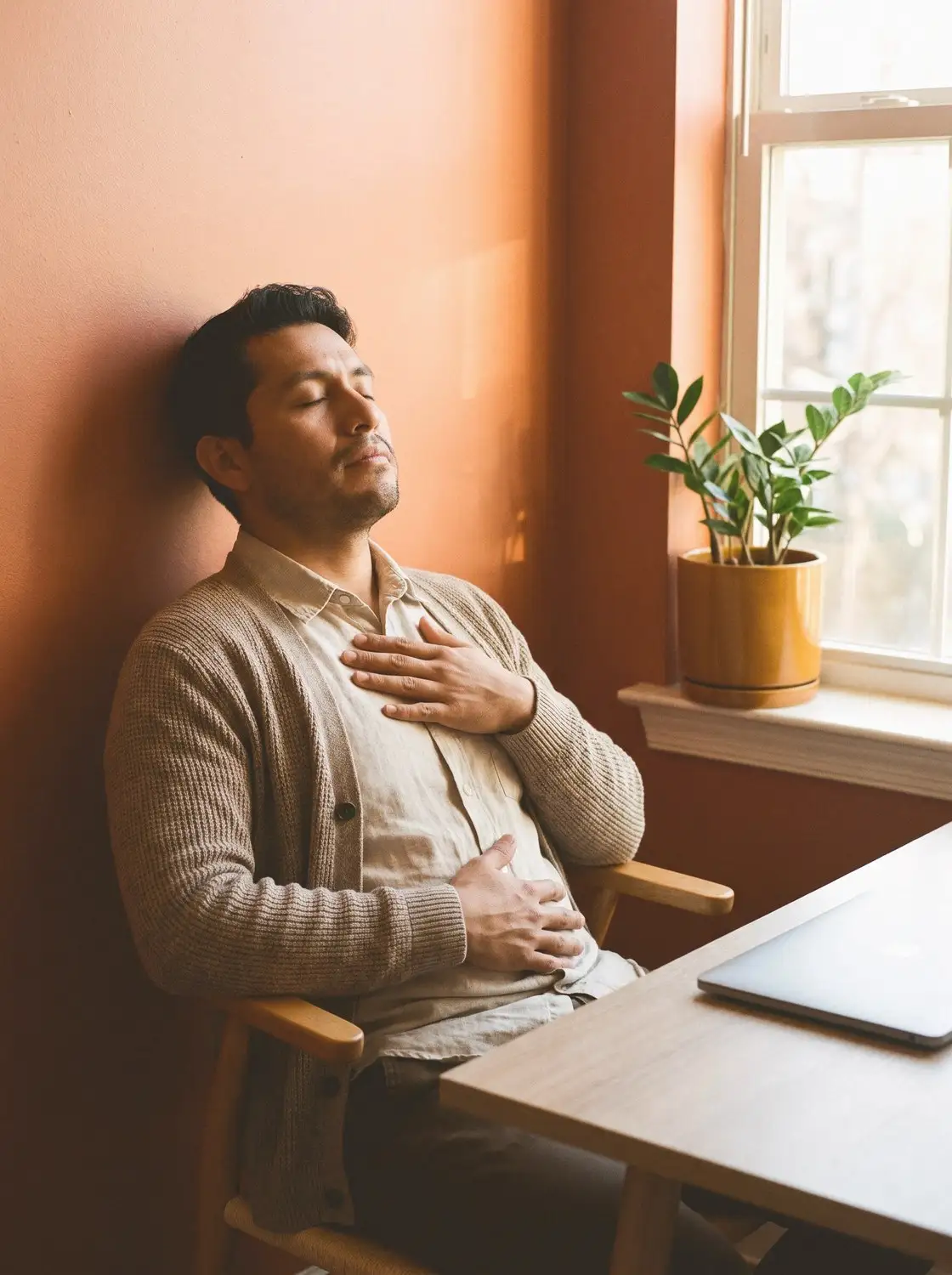
This is pursed-lip breathing: 2 seconds in through your nose, 4 seconds out through softly pursed lips, as if you were cooling a spoonful of soup. Short enough to follow when your breath feels tight.
What causes shallow breathing?
Mostly everyday things, and often several at once.
- Stress and worry. Anxious moments speed the breath. In one lab study, when people were stressed, the more anxious among them sped up their breathing more than they deepened it (Masaoka and Homma 1997).
- Sitting slumped. In a study of 70 people, slumped sitting reduced lung capacity and airflow compared with sitting upright (Lin et al. 2006). Hours at a laptop add up.
- Pain. When it hurts to move, you guard against deep breaths without noticing.
- Tight clothes and holding your stomach in. Both leave your diaphragm less room to move.
- Being unwell. A cold, a chest infection, asthma or a heart or lung condition can all make breathing quicker and smaller.
Is shallow breathing a sign of anxiety?
Often, yes, and it works in both directions. Anxiety makes breathing quicker and higher, and quick, high breathing can make your body feel more on edge, which feeds the worry. That’s why a slower, lower breath helps: it interrupts the loop from the body’s side. If the shallow breathing comes with a tight chest, tight chest anxiety has a breath for that. If it’s the feeling that you can’t get a full breath, see air hunger.
What does shallow breathing feel like?
Usually less like a symptom and more like a background hum. You might notice:
- breaths that never feel quite satisfying, so you keep sighing or yawning
- your shoulders and neck doing the work, rising a little on each breath
- a tight or heavy feeling across your chest
- light-headedness or tingling fingers, if the quick breaths tip into over-breathing
Breathing specialists describe breathing mostly with the upper chest, when there’s no illness behind it, as a pattern that can leave people breathless (Boulding et al. 2016). The good news in that: a pattern can be changed. A couple of minutes most days helps, and  Breathform’s History shows the days you’ve practised.
Can shallow breathing make you tired?
It may add to it. Breathing high in the chest asks small neck and shoulder muscles to work all day, and the anxiety that often goes with it is tiring in itself. There’s little research on tiredness directly. It isn’t that you’re short of oxygen: at rest, your blood is already nearly full of it. Slower breathing changes your pace, not your oxygen, and that’s often what feels restful.
How do I stop shallow breathing?
Practise slow, low breathing when nothing much is happening, so it’s easier to find when something is. Two minutes is enough. The everyday version is in how to breathe properly.
Routine · 2 minutes
The 2-minute practice
- Sit tall, feet flat, and let your shoulders drop away from your ears.
- Rest one hand on your belly. Loosen your waistband if it’s tight.
- 4 rounds of pursed-lip breathing: 2 seconds in through your nose, 4 seconds out through soft lips.
- Then 6 rounds of slow breathing: 6 seconds in, 6 seconds out, the hand on your belly rising and falling.
- Finish with one ordinary breath and carry on with your day.
To check whether the breath is reaching your belly, try the two-hand check in chest breathing vs belly breathing. The full lying-down technique is in diaphragmatic breathing.
Do breathing exercises help shallow breathing?
Nobody has run a trial on “shallow breathing” as such, but slower, lower breathing has been studied. A systematic review found three studies of diaphragmatic breathing on its own, and all three found less stress, measured in cortisol, breathing rate, blood pressure or how people felt (Hopper et al. 2019). Across 15 small studies of slow breathing, people reported feeling more relaxed and less anxious (Zaccaro et al. 2018). None of them were large.
So: a gentle, low-risk habit with small but consistent support.
How well each breath is studied
- Pursed-lip breathingSome evidence
- Slow breathing (6-6)Some evidence
Every study on this page (6)
- Masaoka and Homma, 1997: In 10 healthy adults under mental stress, those with higher trait anxiety increased their breathing rate more than their breath size.
- Lin et al., 2006: In 70 volunteers, slumped sitting significantly reduced lung capacity and expiratory flow compared with upright sitting.
- Boulding et al., 2016: A review classifies thoracic-dominant (upper-chest) breathing and periodic deep sighing as dysfunctional breathing patterns; thoracic-dominant breathing without disease results in breathlessness.
- Hopper et al., 2019: A systematic review found three studies in which diaphragmatic breathing reduced physiological or self-reported stress in adults, with limitations in sample size and duration.
- Zaccaro et al., 2018: In 15 small studies of healthy people, slow breathing was linked with feeling more relaxed and alert, and less anxious.
- Russo et al., 2017: An overview of research in healthy people suggests slow breathing affects the heart, lungs and nervous system; more study is needed.
Questions people ask
Why do I feel like I can’t take a deep breath?
When you’re tense, your breathing muscles stay a little braced, so each breath feels unfinished and you reach for a bigger one. Trying harder usually makes it worse. Breathe out first, slowly, then let the next breath come in on its own, low in your belly. There’s more in air hunger.
Is shallow breathing faster than normal?
Often, a little. At rest, adults usually breathe about 12 to 20 times a minute, and shallow breathing tends to sit at the quicker end, with small breaths. Slow breathing exercises bring the pace down to 4 to 10 breaths a minute for a while, which is where most of the research is (Russo et al. 2017). You can count yours for a minute with a timer, sitting quietly, without trying to change it.
Can shallow breathing make you dizzy?
It can, if it tips into breathing more than you need. Quick breaths blow off carbon dioxide, and lower carbon dioxide can bring light-headedness and tingling fingers. It passes as your breathing settles. Breathe more gently, not more deeply, and let the out-breath be the longer half. Why deep breathing makes you dizzy explains it in full.
Is yawning or sighing a lot a sign of shallow breathing?
It can be. Frequent sighs and yawns are often the body’s way of taking a bigger breath when the everyday ones are small. They’re harmless. If you notice them a lot, that’s a nudge to slow down and breathe lower for a minute or two. Breathing specialists describe frequent deep sighing as one of the patterns they help people settle.
Is shallow breathing dangerous?
Rarely. As an everyday habit from stress or posture, it can be uncomfortable and tiring, but it isn’t harming you. Fast, shallow breathing that comes on suddenly, keeps getting worse, or comes with chest pain, a high temperature, blue-tinged lips or confusion is different: get medical help straight away, and sooner still for a baby or someone very unwell.
Practices in this guide
Read next
Side by side · 5 min
Chest breathing vs belly breathing: where your breath goesTechnique · 7 min
Diaphragmatic breathing (belly breathing)Guide · 5 min
Tight chest anxiety: a breath that loosens itGuide · 5 min
Air hunger anxiety: when you can’t get a full breathLong read · 9 min
How to breathe properly
More in Body
Long read · 10 min
How to calm your nervous systemGuide · 6 min
Vagus nerve reset: what breathing can (and can’t) doGuide · 5 min
How to improve HRV with breathingQuestions · 6 min
What is HRV, and what’s a good HRV?Guide · 5 min
How to lower heart rate quicklyGuide · 6 min
Breathing exercises to lower blood pressureResearch · 6 min
How to activate your parasympathetic nervous systemGuide · 4 min
Breathing exercises for nausea
Breathe gently, never strain, and stop if you feel dizzy, light-headed or short of breath.