Side by side5 min
Chest breathing vs belly breathing: where your breath goes
Chest breathing vs belly breathing: which is better?
For everyday breathing, belly breathing. The diaphragm, a dome of muscle under your lungs, is built to do most of the work at rest. When it tightens it flattens downwards, your belly moves out to make room and your lower ribs widen. Chest breathing leans on smaller muscles in your neck and upper chest, which are there to help when you need extra air. Belly breathing is one of the three everyday habits in how to breathe properly, and when you do need extra air, how to breathe while running covers it.
| Feature | Chest | Belly |
|---|---|---|
| What moves | Upper chest, often the shoulders | Belly and lower ribs, shoulders still |
| Doing the work | Neck and upper-chest muscles, helping out | Mainly the diaphragm |
| The usual pace | Quicker and smaller | Slower and fuller |
| When it’s normal | Hard exercise, a sudden fright | Rest, sleep, slow breathing |
| As a habit | Can feel tiring and leave you short of breath | The easy default |
How do I check which one I’m doing?
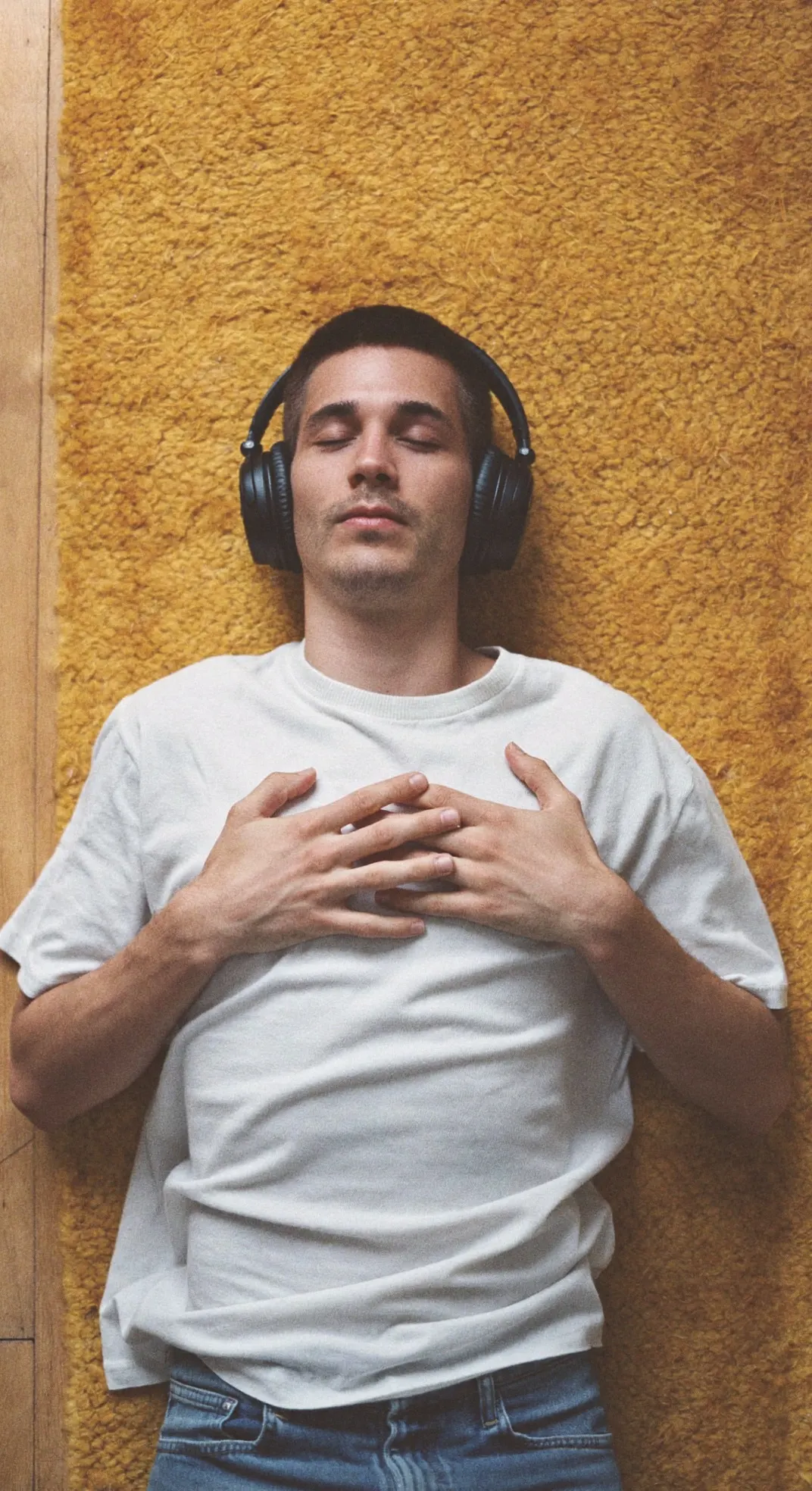
With two hands and one minute. Do it sitting or lying down, at a moment when nothing’s happening.
- Rest one hand flat on your upper chest and the other just above your belly button.
- Breathe normally for 5 breaths and just watch your hands. Don’t change anything yet.
- Notice which hand moves first, and which moves more.
- Check your shoulders in a mirror, or feel for them rising towards your ears.
If the lower hand leads and your shoulders stay put, you’re belly breathing. If the top hand does most of the moving, you’re breathing from your chest, as many people do when they’re busy, sitting a lot or a bit on edge.
Why do I breathe from my chest?
Mostly because of how the day goes. Stress speeds the breath and pulls it higher. Sitting slumped squashes the space under your ribs: in one study of 70 people, slumped sitting reduced lung capacity and airflow compared with sitting upright (Lin et al. 2006). Tight waistbands and holding your stomach in do the same. So can pain, or a habit left over from a stressful stretch of life.
When it stays high and quick for most of the day, it can feel like you never quite get a full breath. That has its own page: shallow breathing.
Is belly breathing the same as diaphragmatic breathing?
Yes, more or less. “Belly breathing” describes what you see, and “diaphragmatic breathing” names the muscle doing it. The air doesn’t go into your belly, of course: the diaphragm moves down, and your belly moves out of its way. A full breath also widens your lower ribs to the sides and back. The full technique is in diaphragmatic breathing, and the three-part breath builds on it, belly to ribs to chest.
Does chest breathing cause anxiety?
It’s more of a loop than a cause. Anxiety makes breathing quicker and higher, and quick, high breathing can make the body feel more on edge. Slowing the breath and moving it lower is one of the simplest ways to interrupt the loop. If your chest feels tight with worry, there’s a breath for that in tight chest anxiety.
What does the research say?
A systematic review found only three studies of diaphragmatic breathing on its own for stress, but all three found benefits: lower cortisol and breathing rate in one, lower blood pressure in another, less self-reported stress in the third (Hopper et al. 2019). In one of the better-known trials, with 40 office workers, those who had 20 coached sessions saw their cortisol fall, while the untrained group’s didn’t (Ma et al. 2017). The groups were small and weren’t truly randomised.
Breathing specialists also describe upper-chest breathing, when there’s no illness behind it, as a pattern that can leave people breathless, and one they help people retrain (Boulding et al. 2016).
So: a sensible habit with small but encouraging evidence.
How well each breath is studied
- 4-6 breathingWell studied
- Slow breathing (6-6)Some evidence
- Pursed-lip breathingSome evidence
Every study on this page (4)
- Lin et al., 2006: In 70 volunteers, slumped sitting significantly reduced lung capacity and expiratory flow compared with upright sitting.
- Hopper et al., 2019: A systematic review found three studies in which diaphragmatic breathing reduced physiological or self-reported stress in adults, with limitations in sample size and duration.
- Ma et al., 2017: In 40 IT workers, eight weeks of coached belly breathing lowered a stress hormone; gains in mood and focus were less clear.
- Boulding et al., 2016: A review classifies thoracic-dominant (upper-chest) breathing without disease as a dysfunctional breathing pattern that results in breathlessness.
How do I stop chest breathing?
Practise breathing lower when nothing is at stake, so it’s there when something is. Start lying down, where it’s easiest: with tones from  Breathform keeping time, both hands can stay where they are.
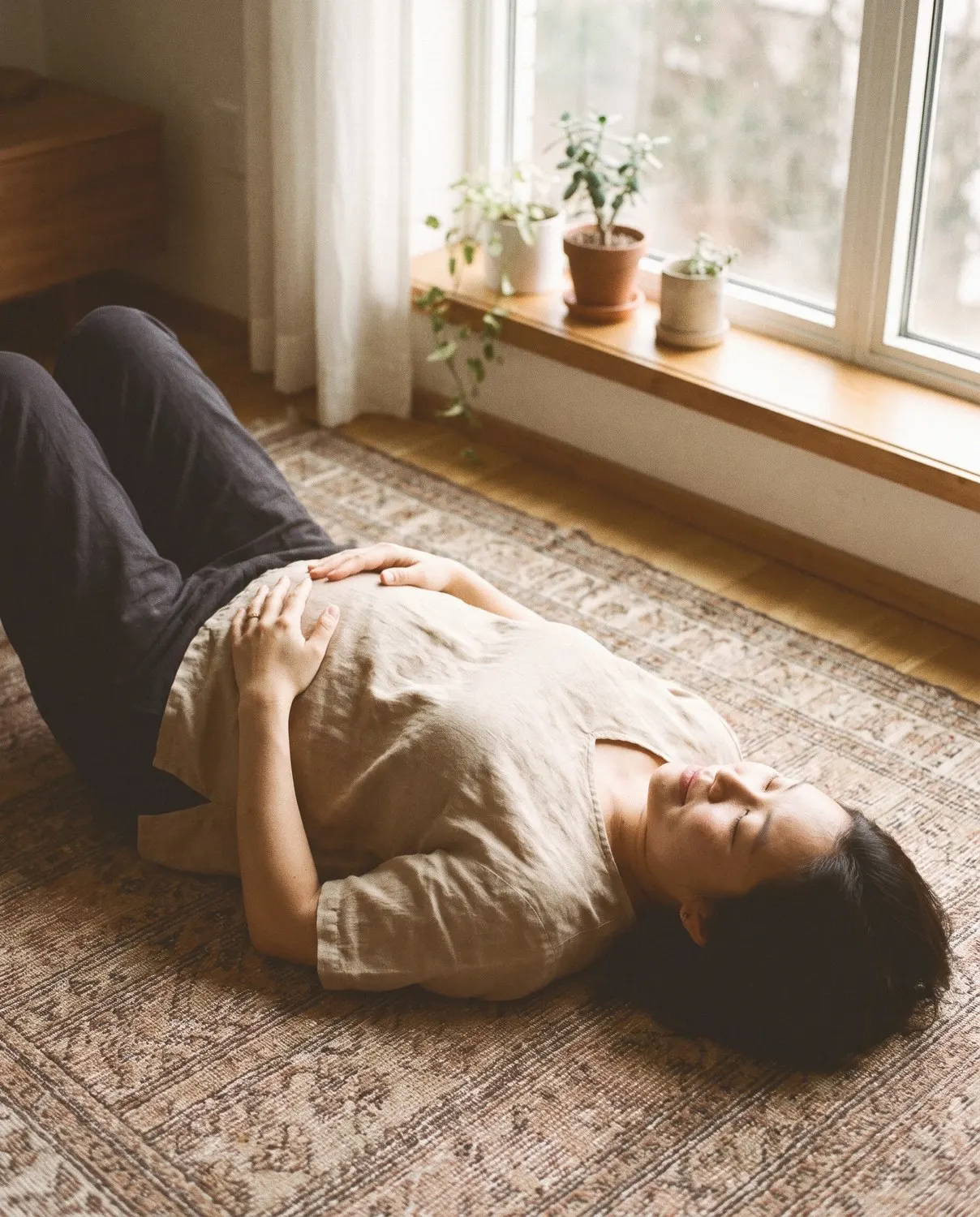
- Lie on your back with your knees bent, one hand on your belly and one on your chest.
- Breathe in through your nose for 4 seconds. Let the lower hand rise first; the top hand barely moves.
- Breathe out slowly for 6 seconds, through your nose or soft lips. Feel the lower hand sink.
- Keep it soft. If you feel light-headed, make the breaths smaller, not bigger.
- Practise for 5 minutes a day. After a week, try it sitting, then while you walk.
Once 4 in and 6 out comes easily, try slow breathing at 6 in and 6 out, for a slower, fuller breath. If even 4 feels long, pursed-lip breathing, 2 in and 4 out through soft lips, is the softest start.
Questions people ask
Should my chest move at all when I breathe?
A little, yes. A full, easy breath widens your lower ribs and lifts your chest slightly too. Belly breathing doesn’t mean a frozen chest. The thing to notice is the order and the effort: the belly and lower ribs move first, and the shoulders and neck stay quiet. If your shoulders rise towards your ears on every breath, that’s the habit to soften.
Is it bad to breathe from your chest?
Not when you need it. Running for a bus or climbing stairs, your chest and neck muscles help out, and that’s normal. As an everyday habit at rest, chest breathing tends to be quicker and smaller, and it can leave you feeling tired or short of breath. Breathing specialists list upper-chest breathing without an illness behind it as one of the patterns they help people change.
How long does it take to retrain your breathing?
There’s no set number, and it depends on how long the habit has been there. Some people notice an easier, lower breath within a few days of practising for 5 minutes a day, first lying down and then sitting. Making it automatic takes longer. Short, regular practice works better than one long session, and checking in with two hands now and then keeps you honest.
Practices in this guide
More comparisons
- 1 Best breathing techniques: one honest table
- 2 Box breathing vs 4-7-8: which to use when
- 3 Nose breathing vs mouth breathing: what the evidence says
- 4 Chest breathing vs belly breathing: where your breath goes You’re here
- 5 Is mouth taping safe, and does it work?
Read next
Technique · 7 min
Diaphragmatic breathing (belly breathing)Guide · 5 min
Shallow breathingLong read · 9 min
How to breathe properlyGuide · 5 min
Tight chest anxiety: a breath that loosens itTechnique · 5 min
Three-part breath (dirga pranayama)
More in Learn
Side by side · 6 min
Best breathing techniques: one honest tableQuestions · 5 min
Breathing exercises for beginnersQuestions · 5 min
Why does deep breathing make me dizzy?Questions · 6 min
What is breathwork?Side by side · 5 min
Box breathing vs 4-7-8: which to use whenSide by side · 6 min
Nose breathing vs mouth breathing: what the evidence saysSide by side · 5 min
Is mouth taping safe, and does it work?Research · 10 min
Slow breathing benefits: what it does to your body
Breathe gently, never strain, and stop if you feel dizzy, light-headed or short of breath.