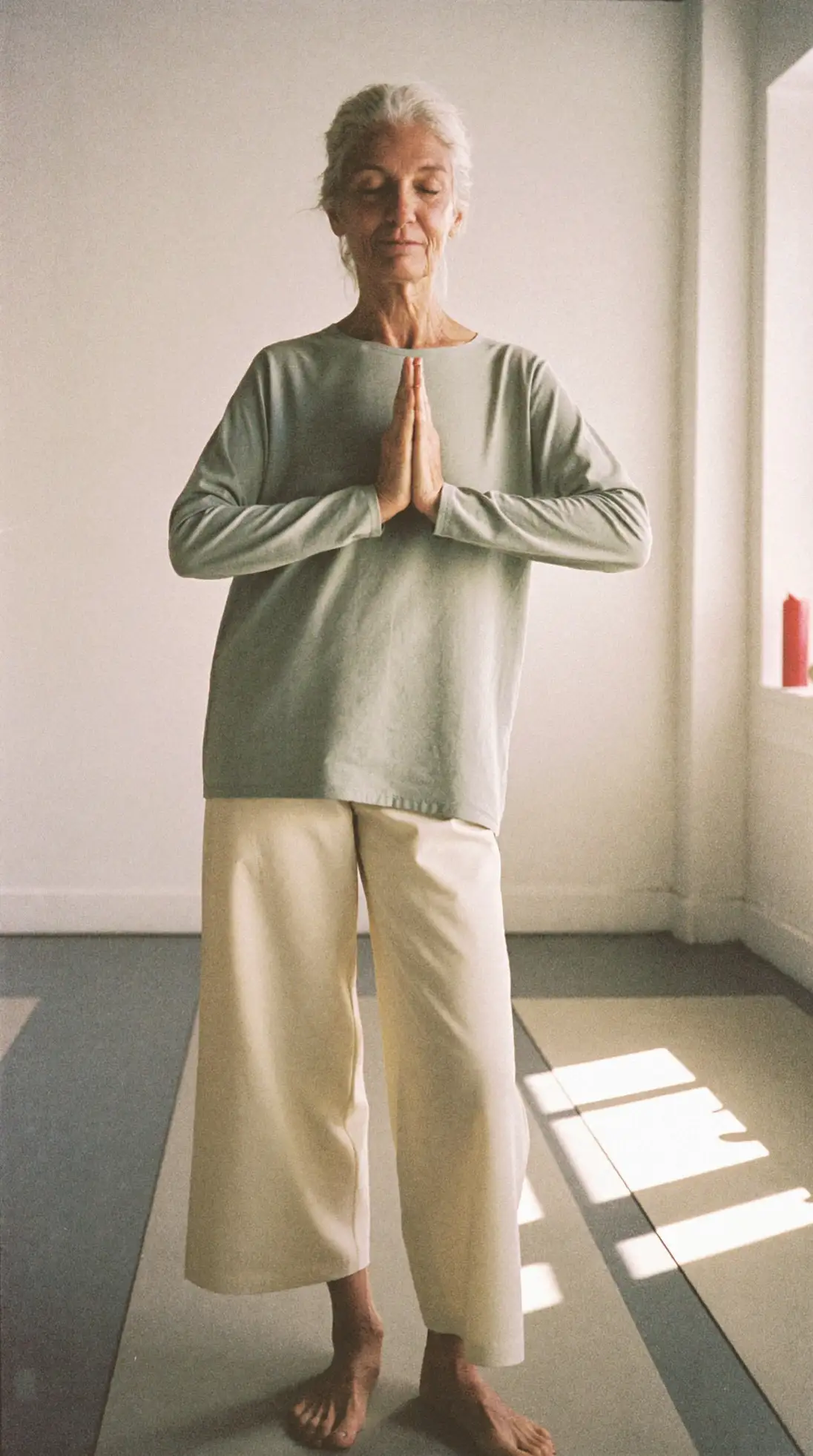
Start here
Humming bee breath, for 2 minutes
Long readTechniques9 min
Pranayama: yoga breathing for beginners
Pranayama is the breathing side of yoga: slow, deliberate breaths, some with a sound, some through one nostril at a time. You don’t need a mat, a class or any beliefs to start. Begin with the gentlest of all: a soft hum on every out-breath.
What is pranayama?
Pranayama is the practice of shaping the breath on purpose: slowing it, lengthening it, sending it through one nostril or adding a soft sound. The word comes from Sanskrit: prāṇa, breath or life force, and āyāma, extension or control. The Sanskrit names you’ll meet, from ujjayi to nadi shodhana, are in the breathing glossary. In the Yoga Sutras of Patanjali, an old text that sets out yoga’s eight limbs, pranayama is the fourth, after the postures and before the limbs of concentration and meditation.
Traditional texts talk about prana as an energy that moves through channels in the body. That’s a spiritual idea, and you don’t need it to practise. What you can feel is simpler: slow breathing changes your pace, your heart rhythm and how settled you feel. That’s what this guide sticks to.
Most pranayamas are gentle. A few are forceful and fast, and those are better learned in person. We teach the gentle ones here, each with a player, and describe the rest.
Which pranayama is best for beginners?
Start with any of these six. None has a long hold, all can be done sitting in a chair, and each plays right here.
Want the calmest place to start? Bhramari, the humming bee breath.
A low hum on every out-breath: it lengthens the breath by itself and gives your mind a sound to rest on.
- Sit comfortably. Breathe in through your nose for 4 seconds.
- Close your lips and breathe out for 6 seconds with a soft, low hum.
- Feel the buzz in your face and chest. Some people rest their index fingers on their ears.
- Two to five minutes is plenty.
Humming breaths are linked to calmer heart rhythms in small studies; a review of the early bhramari research rated its quality very low (Kuppusamy et al. 2018).
Full guide: humming bee breath
Want something steadying? Nadi shodhana, alternate nostril breathing.
One nostril at a time, switching sides: a slow, even rhythm with something for your hands to do.
- Rest your right thumb by your right nostril and your ring finger by your left.
- Close the right side and breathe in through the left for 4 seconds.
- Close the left, open the right and breathe out for 4. Breathe in on the same side.
- Keep alternating for 2 to 5 minutes. Light touch, never pinching.
In a small lab study, alternate nostril breathing and plain paced breathing at the same slow rate both raised heart rate variability, pointing to the pace (Ghiya & Lee 2012).
Full guide: alternate nostril breathing
Want an even rhythm you can hear? Ujjayi, the ocean breath.
A gentle narrowing at the back of the throat turns each breath into a soft sound like the sea.
- Breathe out through an open mouth with a slow “haaa”, as if fogging a mirror.
- Close your mouth and keep that soft narrowing as you breathe out through your nose.
- Keep the same sound on the way in. In for 5, out for 5.
- Two to five minutes, so quiet only you can hear it.
In 17 beginners, slow breathing with ujjayi did slightly less for blood pressure control than plain slow breathing, and took more effort (Mason et al. 2013).
Full guide: ujjayi breathing
Want a fuller breath? Dirga, the three-part breath.
Fill from the bottom up: belly, ribs, chest. Often the first pranayama a teacher introduces.
- Lie down or sit tall, one hand on your belly, one on your chest.
- Breathe in: belly first, then ribs, then a small lift in your upper chest.
- Breathe out slowly, letting chest, ribs and belly soften.
- Six to ten rounds, then breathe normally.
Not tested on its own; its slow pace sits in the well-studied range.
Full guide: three-part breath
Hot, or fuming? Sheetali, the cooling breath.
Breathe in over a curled tongue and out through your nose. The air feels cool on your tongue.
- Curl your tongue into a tube, tip just past your lips. Can’t curl it? Breathe in through your teeth (sheetkari).
- Breathe in through the tube for 4 seconds.
- Close your mouth, pause for 2, then breathe out through your nose for 6.
- Eight to ten rounds.
Traditional; any cooling effect on the body is untested.
Full guide: cooling breath
Want the simplest of all? Sama vritti, equal breathing.
Breathe in and out for the same count. That’s it.
- Breathe in through your nose for 4 seconds.
- Breathe out through your nose for 4.
- When it feels easy, try 5 and 5.
- Two to five minutes.
Studied as slow breathing rather than by its yoga name.
Full guide: equal breathing
What are the types of pranayama?
There are dozens, and lists of “the 8 types” or “the 15 types” vary from school to school. The Hatha Yoga Pradipika, a 15th-century manual, describes eight classic breaths, including ujjayi, sheetali, sheetkari, bhastrika and bhramari. Here are the ones you’ll meet most, gentle first:
| Pranayama | What the name means | What you do |
|---|---|---|
| Bhramari | Bee | Hum on the out-breath |
| Nadi shodhana | Channel cleaning | Breathe through one nostril at a time |
| Ujjayi | Victorious | A soft ocean sound at the back of the throat |
| Dirga | Long | Fill belly, ribs, then chest |
| Sheetali | Cooling | Breathe in over a curled tongue |
| Sheetkari | (its hissing sound) | Breathe in through your teeth |
| Sama vritti | Equal movement | The same count in and out |
| Kapalabhati | Skull shining | Short, sharp out-breaths, many in a row |
| Bhastrika | Bellows | Fast, forceful breaths in and out |
What is kapalabhati?
Kapalabhati is the most forceful of the common pranayamas: short, sharp breaths out, pumped by the belly, dozens in a row, with the breath in left to happen by itself. Bhastrika, the bellows breath, is forceful both ways. Strictly, old texts list kapalabhati among yoga’s cleansing practices rather than its breaths, and it feels like it: it’s energising, noisy and hard work.
Many people do it without trouble. It can also leave you light-headed or tingly, and it’s a poor fit for a racing heart, high blood pressure or pregnancy. That’s why we describe it here rather than teach it: if you’d like to learn it, a teacher in the room can pace you and keep it short. The same family of fast breathing turns up in modern breathwork, and we map it, gentle to intense, in types of breathwork.
What are the benefits of pranayama?
The clearest results come from slow breathing. In 17 trials of people with raised blood pressure, slow breathing at 10 breaths a minute or fewer, pranayama trials included, was linked to an average fall of about 5.6 mmHg in systolic blood pressure after weeks of practice (Chaddha et al. 2019). Results varied a lot between studies.
For alternate nostril breathing, a review of 6 trials found larger drops in blood pressure than in control groups, but the trials disagreed so much that the authors urge caution (Nam et al. 2024). For bhramari, the early studies point to calmer heart rhythms, though none was randomised (Kuppusamy et al. 2018).
Part of the effect may simply be the pace. When people recited yoga mantras, their breathing slowed to almost exactly 6 breaths a minute, and their heart rhythms swung in step (Bernardi et al. 2001). Across studies, slow breathing is linked to feeling more relaxed and less anxious (Zaccaro et al. 2018).
So: gentle pranayama is a sensible, calming practice, and its best-supported effects come from breathing slowly. Claims that it cures illness or “balances energy” aren’t supported.
How well each breath is studied
- Humming bee breathSome evidence
- Alternate nostril breathingSome evidence
Every study on this page (7)
- Kuppusamy et al., 2018: Six small studies hint that humming bee breath (Bhramari) may calm the body, but their quality was very low.
- Ghiya & Lee, 2012: In 20 adults new to yoga breathing, alternate-nostril breathing affected heart rhythm much like plain slow breathing; the slow pace seemed key.
- Mason et al., 2013: In 17 yoga beginners, slow breathing at 6 breaths a minute raised baroreflex sensitivity with or without ujjayi on the out-breath (not clearly with ujjayi on both breaths); ujjayi gave a slightly smaller improvement, needed more effort and raised heart rate.
- Chaddha et al., 2019: Across 17 trials in people with high or borderline-high blood pressure, regular slow breathing modestly lowered blood pressure, though results varied.
- Nam et al., 2024: Alternate-nostril breathing was linked with lower blood pressure across six trials, but results varied so widely that the authors urge caution.
- Bernardi et al., 2001: Reciting the rosary or a yoga mantra slowed 23 healthy adults' breathing to about six a minute, with stronger, synchronised heart rhythms.
- Zaccaro et al., 2018: In 15 small studies of healthy people, slow breathing was linked with feeling more relaxed and alert, and less anxious.
Is pranayama the same as breathwork?
Pranayama is one of breathwork’s oldest roots. “Breathwork” is the modern umbrella for any practice that uses the breath on purpose, from a slow count to hours of fast breathing in a workshop. Gentle pranayama sits at the calm end. There’s more on the whole field in what is breathwork?
How long should you practise pranayama?
Five to ten minutes a day is a good habit, and two minutes is a fine start. The blood pressure trials used at least 5 minutes, three or more days a week, for a month or longer (Chaddha et al. 2019). Yes, you can do gentle pranayama every day: little and often works best, and  Breathform’s History shows your days in a row.
Routine · 10 minutes
A 10-minute morning pranayama
- Sit tall on a chair or a cushion, shoulders soft, eyes closed.
- 2 minutes of slow, full breaths: belly, ribs, chest, 6 seconds in and 6 out.
- 4 minutes of nadi shodhana, 4 seconds through each side.
- 4 minutes of bhramari: in for 4, hum for 6. Then sit for a moment and breathe normally.
Questions people ask
What is the best time of day for pranayama?
Whenever you’ll actually do it. Yoga tradition favours early morning, before breakfast, when it’s quiet and your stomach is empty. That’s a good habit if mornings suit you. The calming breaths, like bhramari and three-part breath, also work well in the evening. The livelier ones, like kapalabhati, are better kept away from bedtime.
Should I do pranayama before or after yoga poses?
Traditionally after, once your body is warm and settled. Many classes put a few minutes of pranayama at the end, before the final rest. Some teachers start with three-part breath to arrive, and keep ujjayi going through the poses. On its own, without any poses, pranayama is just as worthwhile: sitting in a chair is enough.
Can I do pranayama on a full stomach?
It’s more comfortable on an empty or light stomach, which is why yoga tradition suggests waiting a couple of hours after a big meal. The gentle breaths on this page are fine after a snack. The forceful ones, kapalabhati and bhastrika, pump the belly hard, so they’re the ones to keep well away from mealtimes.
Is pranayama the same as meditation?
They’re neighbours. In yoga’s traditional eight limbs, pranayama comes before the limbs about concentration and meditation, as a way of settling the body and mind first. In practice, a few minutes of slow breathing makes sitting quietly much easier. Mindful breathing sits in between: you watch the breath rather than shaping it.
How long does it take to feel the benefits?
Most people feel a little calmer after a few minutes of a slow breath like bhramari or nadi shodhana. Longer-term changes, such as slightly lower blood pressure in people whose blood pressure runs high, were seen in trials after weeks of regular practice, usually at least a few times a week. Think of it as a daily habit, like a walk, rather than a quick fix.
More in Techniques
- 1
Technique · 8 min
Box breathing (square breathing)Four equal sides: in, hold, out, rest.
- 2
Technique · 7 min
4-7-8 breathing (the relaxing breath)The classic for winding down, honestly explained.
- 3
Technique · 6 min
Coherent breathing (resonance breathing)An even rhythm, six breaths a minute, at the heart of the HRV research.
- 4
Technique · 6 min
Physiological sigh (cyclic sighing)Two breaths in, one long breath out: the sigh your body already knows.
- 5
Technique · 5 min
Triangle breathingThree even sides to steady your attention.
- 6
Technique · 5 min
4-6 breathing (a longer exhale)In for 4, out for 6: the longer half on the way out.
- 7
Technique · 6 min
Pursed-lip breathingBreathe out slowly through softly pursed lips, as if blowing on a candle.
- 8
Technique · 5 min
Grounding breathingFeel your feet, feel the floor, breathe.
Also filed under Techniques Best breathing techniques: one honest table · Lion’s breath · What is breathwork? · Box breathing vs 4-7-8: which to use when
Breathe gently, never strain, and stop if you feel dizzy, light-headed or short of breath.