Field guideTechnique6 min
Ujjayi breathing (ocean breath)
In 5 · out 5. Closest in the app: Coherent
Follow the tide: it rises as you breathe in and falls as you breathe out.
- Pattern
- In 5 · out 5
- Pace
- 6 breaths a minute
- Length
- 2 min · 12 rounds
- Evidence
- Early research or tradition
How do you do ujjayi breathing?
Sit tall with your shoulders soft, or lie down if you prefer. The trick is finding the throat sound with your mouth open first, then keeping it with your mouth closed.
- Breathe through your nose for a few easy breaths, mouth closed.
- Find the sound. Open your mouth and breathe out a slow “haaa”, as if fogging a mirror. Feel the back of your throat narrow slightly.
- Close your mouth and keep that slight narrowing as you breathe out through your nose. You’ll hear a soft rush, like a wave pulling back.
- Breathe in the same way for 5 seconds, then out for 5. The sound stays even both ways.
- Carry on for 2 to 5 minutes. Keep it quiet: only you should hear it. If your throat tightens or you feel light-headed, soften the narrowing and breathe normally for a moment.
Five in and five out is 6 breaths a minute. The sound does the counting for you: listen for a smooth wave in, a smooth wave out, and no gaps.
Why does ujjayi sound like the ocean?
Because you’re narrowing the gap the air passes through. Slightly closing the back of your throat (the glottis, where your vocal cords sit) makes the air rush a little, the way wind does through a half-open door. Through the nose, that rush comes out soft and breathy, like waves on a beach.
That sound is the point. It gives your attention something to rest on, and it tells you at once when the breath gets ragged or rushed. The name comes from the Sanskrit for “victorious”, which is why you’ll also see it called victorious breath.
What is ujjayi breath good for?
Ujjayi is a traditional yoga breath, and it has barely been studied on its own. In one lab study, 17 yoga beginners tried slow breathing at 6 breaths a minute with and without ujjayi. Plain slow breathing raised baroreflex sensitivity, the body’s quick, beat-by-beat way of steadying blood pressure. With ujjayi the gain was smaller (with the sound on both the in- and out-breath, it wasn’t clearly above resting levels), blood pressure didn’t fall and heart rate rose a little, which the authors put down to the extra effort (Mason et al. 2013). Plain, even slow breathing came out as the most effective and simplest.
Many people find ujjayi makes slow breathing easier to keep up, especially while they move. Slowing down to around 6 breaths a minute is what reliably raises heart rate variability, the small beat-to-beat changes that tend to grow when you’re at rest (Laborde et al. 2022).
So: a lovely way to pace a slow breath, with little research of its own. Keep it soft.
Every study on this page (2)
- Mason et al., 2013: In 17 yoga beginners, slow breathing at 6 breaths a minute raised baroreflex sensitivity with or without ujjayi on the out-breath (not clearly with ujjayi on both breaths); ujjayi gave a similar rise in oxygen saturation but a slightly smaller baroreflex improvement and no drop in blood pressure, needed more effort and raised heart rate; equal slow breathing without ujjayi was the most effective and simple.
- Laborde et al., 2022: Across 223 studies, slow breathing raised heart-rhythm signs of calm, during practice and after, though that alone doesn't prove a health benefit.
Is ujjayi breath heating or cooling?
Yoga traditions call it warming: ujjayi is the breath you do while working through the poses, and its opposite is the cooling breath, sheetali, drawn in over a curled tongue. Nobody has measured whether ujjayi changes your body temperature. What the one lab study did find is that it takes a little more effort than ordinary slow breathing and nudged heart rate up slightly. If you feel warmer, that effort is the likeliest reason.
Can you do ujjayi breathing outside yoga?
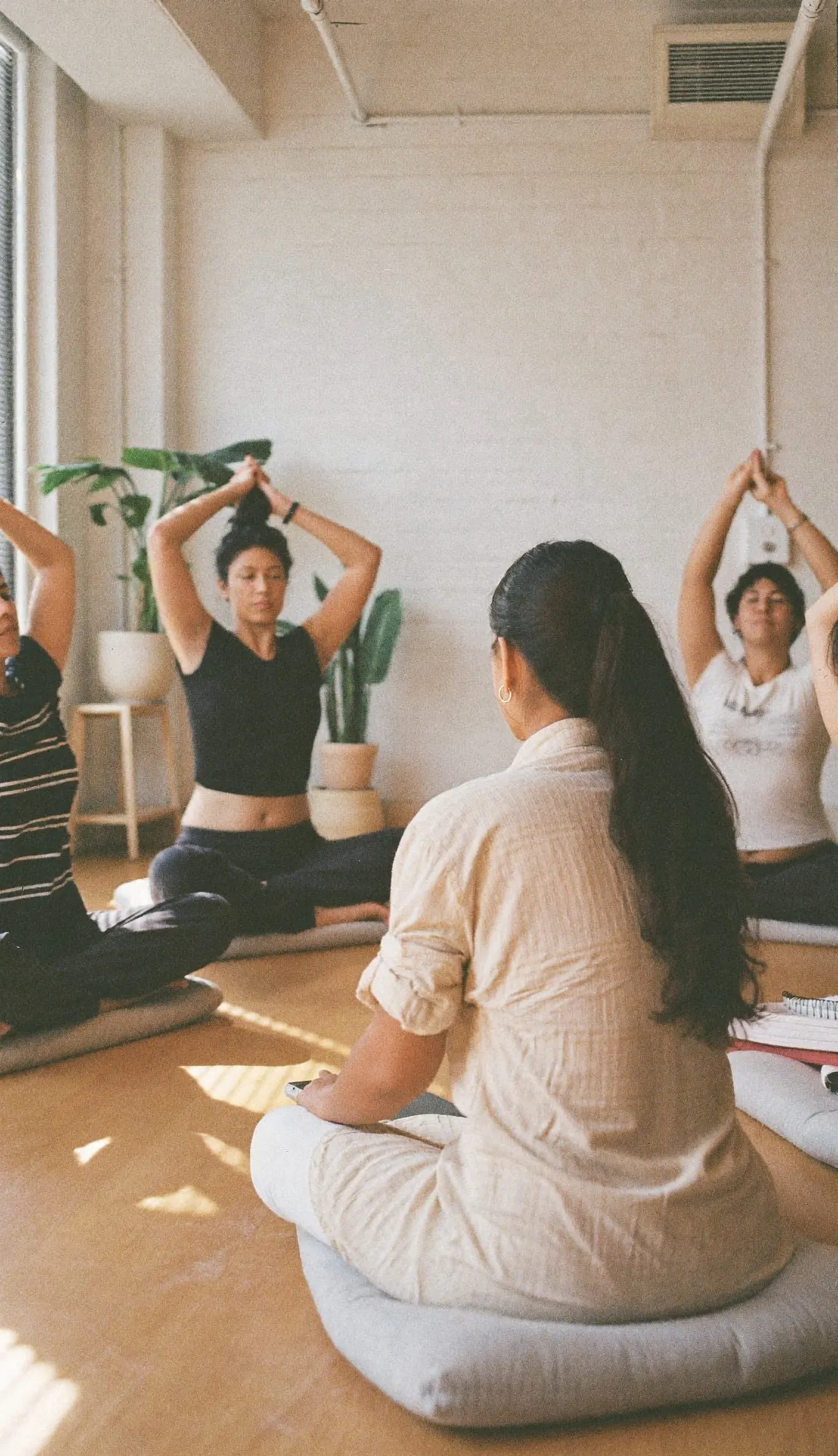
Yes. In class it’s the background rhythm of the poses, kept going from the first stretch to the last. Many teachers use it to set the pace of the movement: one movement on each breath in, one on each breath out.
Outside class, a very quiet ujjayi works anywhere you can breathe through your nose: on the train, at your desk, in the minute before a call. Make the sound so soft it’s more a feeling in your throat than a noise. If you’d like a slow, even breath without the throat work, coherent breathing is the same pace, just plain.
Ujjayi is one of the classic yoga breaths. There are more, each with a player, in pranayama for beginners.
Is ujjayi good before sleep?
It can be, if you keep it very soft. A whisper-quiet ujjayi lying in bed gives a busy mind something to follow. Let the out-breath grow a little longer than the in-breath, and let the sound fade as you settle.
If even a soft throat sound keeps you alert, drop it: in the lab study, plain slow breathing took less effort and did more for blood pressure. A plain slow breath is enough on its own:  Breathform’s Unwind, 4 in and 6 out, is free and can play on a dark screen. There are four bedtime breaths in breathing exercises for sleep.
Why does ujjayi feel hard?
- Your throat feels tight. You’re narrowing too much. Think of a soft “haaa”, not a squeeze. Less is more.
- It’s loud. Same fix: ease off until the sound is a whisper.
- You can only do it on the out-breath. Common at first. Keep it on the out-breath for a few days; the in-breath sound comes with practice.
- You feel light-headed. You’re probably breathing bigger as well as slower. Keep each breath small and smooth.
- Your nose is blocked. Leave ujjayi for another day and try three-part breath or a simple slow breath instead.
Questions people ask
Can ujjayi pranayama improve eyesight or thyroid problems?
There’s no good evidence that it can. You’ll see both claims on yoga sites, but no trial has shown ujjayi improving eyesight or thyroid function. Enjoy it for what it does well: it gives you an even, audible rhythm to follow, which makes a slow breath easier to keep. For anything medical, your doctor is the right first stop.
Why is it called Darth Vader breathing?
Because a loud ujjayi does sound a little like him. Some teachers use the nickname to help beginners find the throat sound quickly. The breath itself should be much softer than the film: more distant waves than mask and helmet. If someone across the room can hear you clearly, ease the narrowing in your throat and let the sound drop to a whisper.
Is ujjayi the same as humming bee breath?
They’re different breaths. Both make a sound, but in different places. Ujjayi is a soft, breathy rush at the back of the throat, on the way in and out, with no voice. Humming bee breath is a hum, made with your voice and lips closed, on the out-breath only. Both lengthen the breath and give you something to listen to.
Can I do ujjayi breathing through my mouth?
It’s traditionally done through the nose, with your mouth closed. Breathing out through an open mouth is a good way to learn the sound, and some teachers start that way. Once you’ve found the gentle narrowing in your throat, close your lips and keep it. If your nose is blocked, leave ujjayi for another day and simply breathe slowly.
Read next
Long read · 9 min
Pranayama: yoga breathing for beginnersThe gentle yoga breaths, each ready to play, and the intense ones explained.
Technique · 6 min
Coherent breathing (resonance breathing)An even rhythm, six breaths a minute, at the heart of the HRV research.
In 5 · out 5 · In the app: Coherent
Technique · 5 min
Cooling breath (sheetali)Breathe in over a curled tongue, out through the nose: a yoga breath for heat.
Technique · 5 min
Three-part breath (dirga pranayama)Fill from the belly, then the ribs, then the chest, and let it go.
Technique · 6 min
Humming bee breath (bhramari)A low hum on the out-breath, quiet enough for 3am.
In 4 · hum 6 · In the app: Hum
More in Techniques
Technique · 8 min
Box breathing (square breathing)Technique · 7 min
4-7-8 breathing (the relaxing breath)Technique · 6 min
Physiological sigh (cyclic sighing)Technique · 5 min
Triangle breathingTechnique · 5 min
4-6 breathing (a longer exhale)Technique · 6 min
Pursed-lip breathingTechnique · 6 min
Alternate nostril breathing (nadi shodhana)Technique · 5 min
Grounding breathing
Breathe gently, never strain, and stop if you feel dizzy, light-headed or short of breath.