KidsAges 4 and up (grown-ups too)4 min
Lion’s breath
Breathe in through your nose. Then open your mouth wide, stick your tongue out towards your chin and breathe out with a big, breathy “haaa”. Three lions, and most people are smiling.
How do you do lion’s breath?
Press Start above and breathe along: 3 seconds in, 3 seconds of “haaa”, three times.
- Sit or kneel, hands on your knees, fingers spread wide like claws.
- Breathe in through your nose for 3 seconds.
- Open wide. Mouth as big as it goes, tongue stretched out towards your chin, eyes looking up.
- Breathe out for 3 seconds with a big, breathy “haaa” from the back of your throat.
- Relax your face and take one ordinary breath. Do 3 lions, then a few slow, quiet breaths.
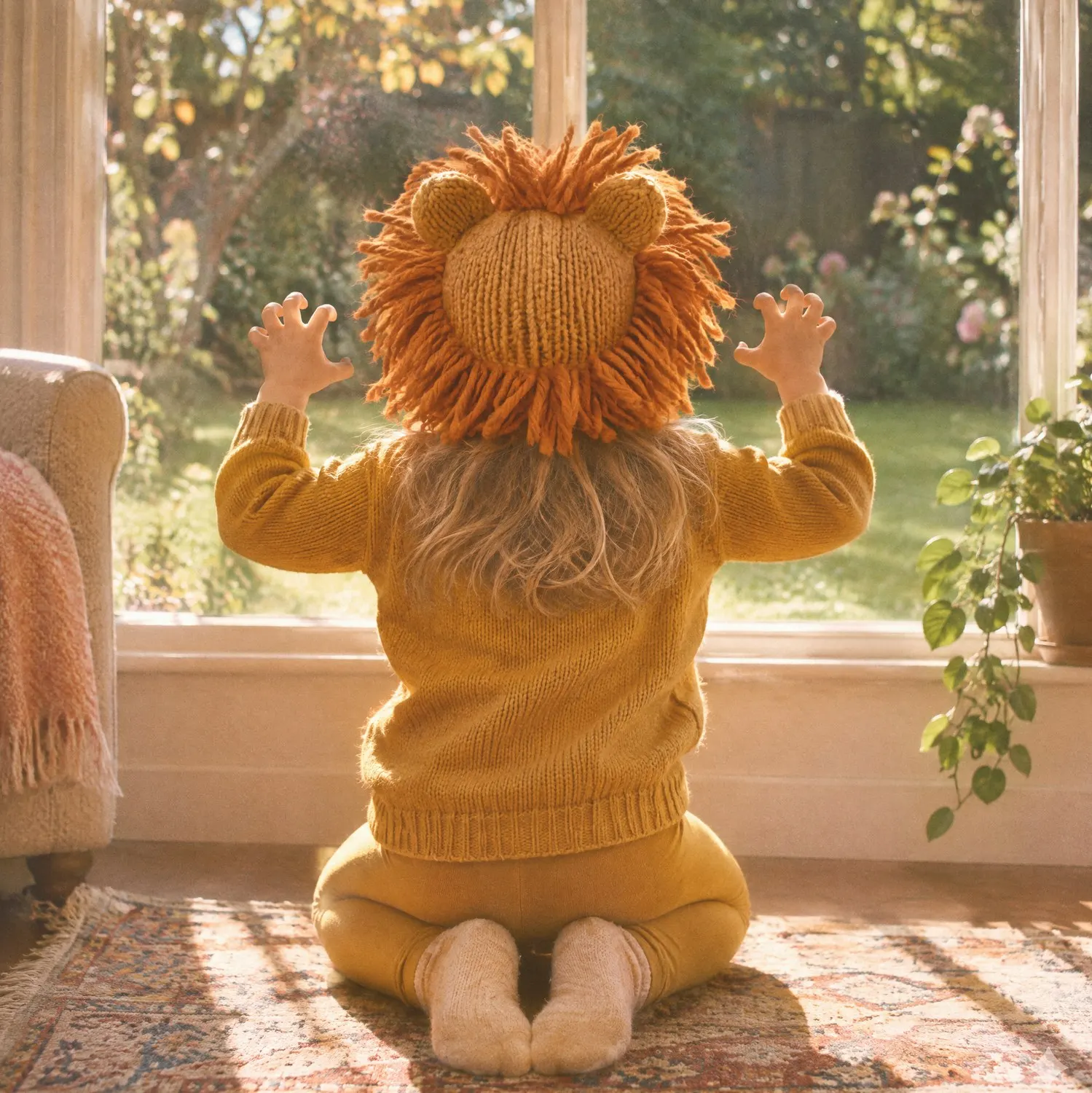
Why do you stick your tongue out?
Partly to stretch the face. The jaw, tongue and the muscles round the eyes are the parts that clench when you’re cross or concentrating hard, and a lion face stretches all of them at once. Partly because it’s silly. Pulling a face on purpose is hard to do while staying grumpy. And a wide-open mouth lets the breath out go long and easy, with nothing in the way.
Is lion’s breath good for kids?
Yes, from about 4. It’s one of the few breaths where being loud and silly is allowed, which makes it a good way in for children who don’t want to “calm down”. Follow it with a slower breath, so the energy has somewhere to settle.
For a classroom, a library or a little brother asleep next door, try the quiet lion: the same wide face, then a long, silent “haaa”, as if misting a cold window.
Lion’s breath is one of a family of playful breaths: see animal breaths for kids, or the full set in breathing exercises for kids.
Can lion’s breath help with anger?
It gives anger somewhere to go. The big breath out, the face pulled on purpose and the noise all let a child, or an adult, show the feeling without hurting anyone. Then the slower breaths afterwards do the calming. Nobody has studied lion’s breath and anger directly, so think of it as a release valve rather than a fix. For slower breaths when you’re cross, see breathing exercises for anger, or let  Breathform time a few for you.
Where does lion’s breath come from?
It comes from yoga, where simhasana (simha is Sanskrit for lion, asana for pose) is a seated pose: kneeling, ankles crossed underneath, hands on the knees, mouth wide and tongue out, with a strong breath out. Some teachers add a gaze up towards the eyebrows. It’s one of many breathing practices in the yoga tradition: there’s more in pranayama.
Lion’s breath itself has barely been studied. Claims you’ll see about the throat, the voice or confidence come from tradition, not trials.
So: a traditional, playful breath for letting go, with no research of its own.
Questions people ask
Do you have to make a noise?
The “haaa” is breathy, more like a sigh with your mouth wide than a real roar. Children usually want to make it loud, and at home that’s fine. In a classroom or a library, the silent version works just as well: same wide mouth, same tongue, same long breath out, no sound. The face does most of the work.
How many times should you do lion’s breath?
Three is plenty for children, and three to five for adults. Take an ordinary breath between each one. Lion’s breath is a big breath out, so doing lots in a row can make you feel light-headed: if that happens, stop and breathe normally for a moment. Finish with a few slow, quiet breaths.
Can adults do lion’s breath?
Yes. It’s a yoga breath first, and many adults use it to loosen a tight jaw or shake off a tense day. The traditional version is kneeling, ankles crossed underneath you, hands pressing into your knees. Sitting on a chair works just as well, and it’s easier on the knees.
Is lion’s breath OK in class?
Yes, in its quiet form. Ask everyone to make the biggest lion face they can with no sound at all, then a slow, silent “haaa”, like breathing on a cold window to mist it. It keeps the fun and the stretch without the noise. More ideas for teachers are in breathing exercises for the classroom.
Read next
Kids · 4 min
Animal breaths for kidsKids · 8 min
Breathing exercises for kidsGuide · 5 min
Breathing exercises for angerLong read · 9 min
Pranayama: yoga breathing for beginnersKids · 5 min
Breathing exercises for the classroom
More in Kids
Kids · 4 min
Rainbow breathingKids · 4 min
Star breathingKids · 4 min
Balloon breathingKids · 4 min
Smell the flower, blow out the candle (hot chocolate breathing)Kids · 3 min
Lazy 8 breathing (figure 8 breathing)Kids · 4 min
Box breathing for kidsKids · 4 min
Breathing exercises for kids to sleepKids · 4 min
Five-finger breathing (hand breathing)
Breathe gently, never strain, and stop if you feel dizzy, light-headed or short of breath.