GuideSleep6 min
How to fall asleep with anxiety
Anxiety at night has a way of filling the body: a quick heart, a tight chest, a breath that never feels quite full. You don’t have to talk yourself calm. Slow the out-breath, keep it easy, and let the body go first.
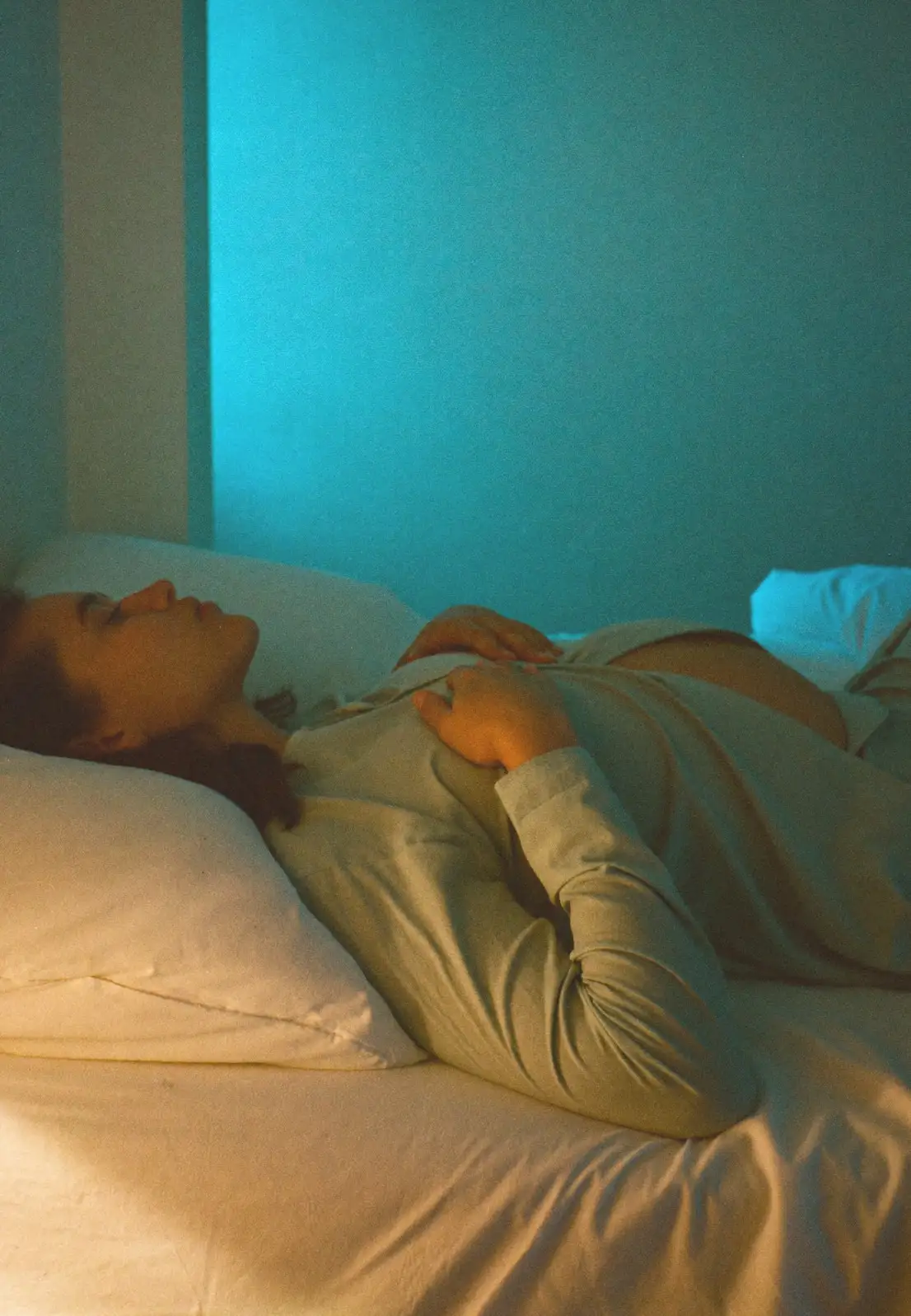
Why is anxiety worse at night?
Because there’s nothing else to listen to. In the day, work, people and noise keep worry in the background. In bed, it has your full attention, and the body joins in: the heart picks up, the breath goes quick and high, and you start to notice both.
Then a second worry arrives: worry about not sleeping. In one influential model of insomnia, this is a big part of what keeps it going. Fretting about sleep and about tomorrow raises arousal, which keeps you awake, which gives you more to fret about (Harvey 2002). The way out is to stop trying to sleep and start doing something small and calming instead.
How to fall asleep with anxiety: where do you start?
Start with the body. A long out-breath is the gentlest lever you have: your heart slows slightly every time you breathe out, so giving the out-breath more time gives the slowing side more time too. Leave holds out for now. When you’re anxious, holding your breath can feel like not getting enough air.
- Lie on your back with one hand on your belly and one on your chest. Let your shoulders sink.
- Breathe in through your nose for 4 seconds, into the hand on your belly. The chest hand stays fairly still.
- Breathe out slowly for 6 seconds, through your nose or softly parted lips, as if you’re letting the air fall out.
- Keep it small. Slower, not bigger: a big breath can make you light-headed. If 6 feels long, use 3 in and 5 out.
- Carry on for 5 to 10 minutes, or until you lose count. Losing count is a good sign.
This is 4-6 breathing, about 6 breaths a minute. More on it in 4-6 breathing.
Why do you feel short of breath when you lie down with anxiety?
Anxiety changes how you breathe. It tends to go quicker and higher in the chest, with more sighs and gulps, and that pattern can leave you feeling you can’t get a full breath even though you’re getting plenty of air. Lying still in the dark, with nothing else to notice, you feel it more.
The fix is counterintuitive: breathe less, not more. Slow, low, small breaths with a longer out-breath can ease that “can’t fill up” feeling within a few minutes. There’s more on it in air hunger anxiety. If breathlessness is new to you, or comes with chest pain, get it checked rather than breathing through it.
Routine · 30 minutes
A wind-down routine for anxious nights
- Half an hour before bed, write tomorrow’s list. Five minutes, as specific as you can. In one sleep-lab study, people who did this fell asleep faster than those who wrote about the day just gone (Scullin et al. 2018).
- Lights low, screens away. Charge the phone out of reach, or face-down at least.
- In bed, 4-6 breathing for 5 to 10 minutes, hand on your belly.
- Then let the breath go. Feel the weight of your body on the mattress, from your heels up to your head.
- If a worry surfaces, name it (“that’s the meeting again”) and come back to the out-breath.
Should you get up if you can’t sleep?
Yes, if you’ve been lying awake long enough that it’s turning into a struggle. Get up, keep the lights low and do something quiet somewhere else, then go back to bed when you feel sleepy. Sleep specialists call this stimulus control, and it’s one of the treatments they suggest for long-term insomnia (Edinger et al. 2021). There’s more on that moment in waking up at 3am.
Does slow breathing really help anxiety at night?
For anxiety, there’s more research. A review of 40 trials found breathing-focused treatments reduced anxiety more than control conditions, with smaller gains against other active treatments. But 35 of the 40 trials were at high risk of bias (Leyro et al. 2021). Even one 5-minute session of slow breathing with a longer out-breath was followed by lower anxiety in a small study, though it had no comparison group (Magnon et al. 2021).
For sleep, it’s earlier. In a 2026 review of 9 studies, slow breathing before bed improved how well people said they slept, while sleep-lab measures were inconclusive (Eide et al. 2026). In a small study, people with insomnia fell asleep sooner after 20 minutes of it (Tsai et al. 2015).
So: it tends to calm the body and may help sleep come sooner. It won’t switch anxiety off.
How well each breath is studied
- 4-6 breathingWell studied
- 4-7-8 breathingEarly research or tradition
- Coherent breathingWell studied
Every study on this page (7)
- Harvey, 2002: A cognitive model of insomnia proposing that worry about sleep and its daytime consequences triggers arousal and distress, which in turn keeps people awake.
- Scullin et al., 2018: In a sleep-lab study of 57 healthy young adults, those who spent 5 minutes writing a to-do list before bed fell asleep faster than those who wrote about tasks they had already completed.
- Edinger et al., 2021: The American Academy of Sleep Medicine guideline suggests stimulus control and relaxation therapy as single-component treatments for chronic insomnia in adults (conditional recommendations), and recommends multicomponent CBT for insomnia.
- Leyro et al., 2021: Across 40 trials with 3,047 people, breathing-based therapies eased anxiety more than comparison groups, but most trials had design flaws.
- Magnon et al., 2021: In 47 younger and older adults, anxiety was lower after one five-minute slow-breathing session, though the study had no comparison group.
- Eide et al., 2026: Across nine studies, slow breathing before bed improved how well people felt they slept, but sleep-lab and tracker results were inconclusive.
- Tsai et al., 2015: In a small sleep-lab study, people reporting insomnia fell asleep sooner and woke less after 20 minutes of slow breathing before bed.
What else helps anxiety at bedtime?
Practise the slow out-breath on easy evenings too, so it’s familiar on the anxious ones:  Breathform marks each day you do in History.
When the worry is mostly words, try racing thoughts at night: a humming breath and a word game for a busy head. For anxiety in the daytime too, breathing exercises for anxiety has breaths for every moment. And for nights that aren’t anxious, just restless, there are four more breaths in breathing exercises for sleep.
Questions people ask
Can anxiety keep you awake all night?
It can feel that way, and some nights are genuinely short. Many people sleep more than they think on anxious nights: lying awake is easy to remember, dozing isn’t. One bad night is uncomfortable but not dangerous, and the next night usually comes easier.
What is the 3-3-3 rule for anxiety?
It’s a quick grounding trick: name 3 things you can see, 3 things you can hear, and move 3 parts of your body. In bed, a gentle version works: notice the weight of the duvet, the sound of the room and your feet against the sheet, then go back to the slow out-breath. It brings your attention out of the worry and into the room.
Is it OK to fall asleep with music or a podcast when I’m anxious?
Yes, if it soothes you. Choose something slow and familiar rather than something gripping, keep the volume low and set a sleep timer so it stops once you’re asleep. A guided breath works the same way: it gives your attention something steady to follow while your body settles.
Should I take something to help me sleep?
That’s one to talk through with a GP or pharmacist, especially if you’re on other medicines. The breath and routine on this page fit alongside whatever else you use. For anxiety that disturbs sleep for weeks, CBT for insomnia is the usual first step, and it works on the worry about sleep as well.
Practices in this guide
Read next
Long read · 9 min
Breathing exercises for sleepGuide · 5 min
Racing thoughts at nightLong read · 10 min
Breathing exercises for anxietyTechnique · 5 min
4-6 breathing (a longer exhale)In the moment · 5 min
Waking up at 3am? A breath for getting back to sleep
More in Sleep
Technique · 5 min
The military sleep method
Breathe gently, never strain, and stop if you feel dizzy, light-headed or short of breath.