GuideBody5 min
Breathing exercises for pain and headaches
When something hurts, your body braces: jaw tight, shoulders up, breath held. A slow, soft out-breath is the opposite of bracing. It won’t make pain vanish, but it can loosen how hard it grips you.
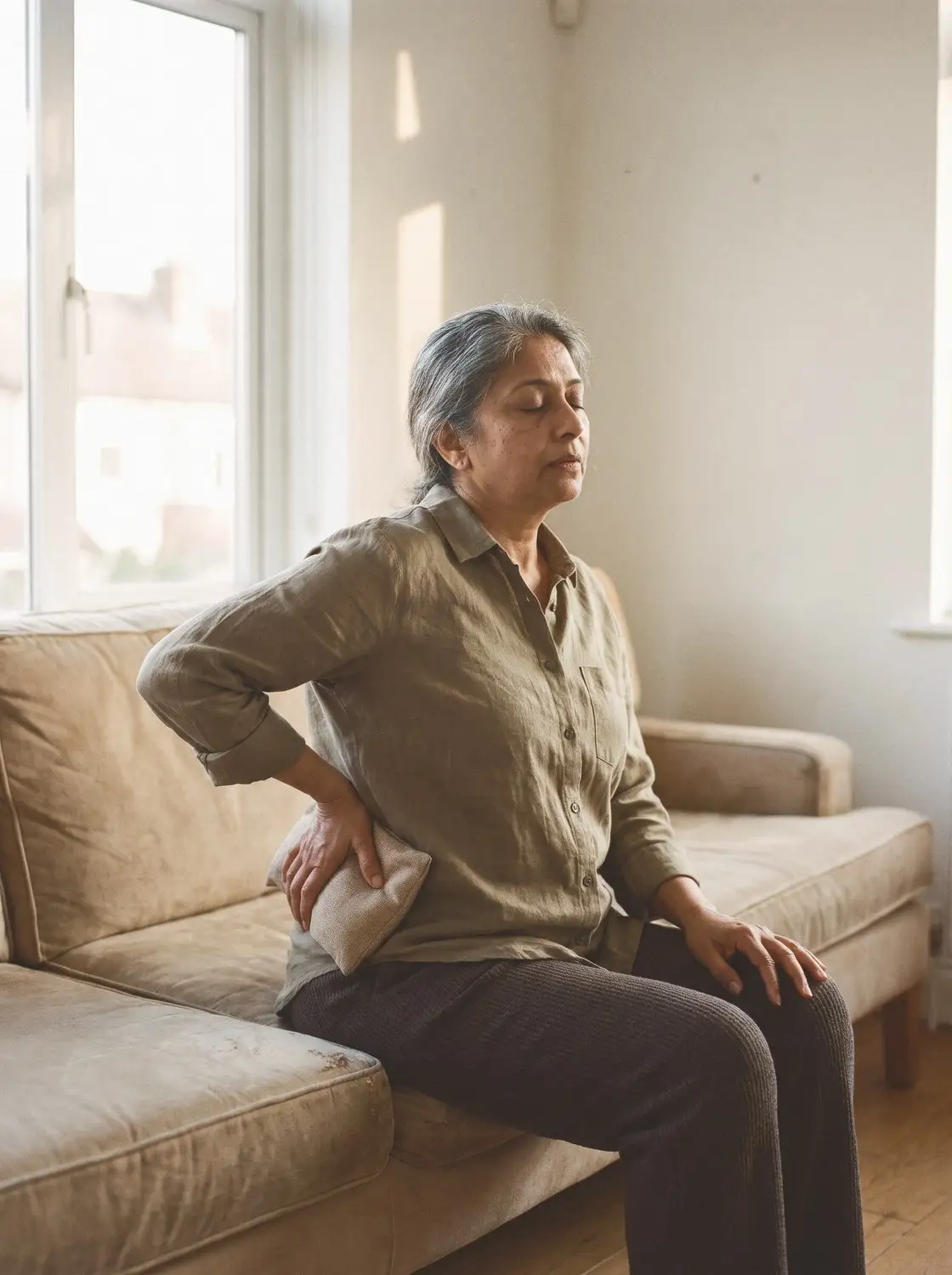
Can breathing help with pain?
It can take the edge off, especially for short-lived pain. A review of 7 randomised trials in people with short-term clinical pain found that slow, deep breathing was linked to lower pain scores, with the biggest effect in burn care. The certainty was very low, though, because the trials were small and varied (Joseph et al. 2022).
Breathing doesn’t block pain signals the way a painkiller does. It seems to change how your body and mind respond to them: less bracing, less alarm, a little more room around the hurt.
Why do we hold our breath when we’re in pain?
Because pain puts your body on alert. It tends to make your breathing quicker and bigger (Jafari et al. 2017), and many people also brace: they tense their stomach, clench their jaw and stop breathing for a moment, the way you might before a jab. It’s a protective reflex.
The trouble is that holding your breath tends to go with tensing up. Breathing out slowly does the opposite. That’s why midwives often coach a long out-breath through contractions, and why breathing techniques for labour are built around it.
Breathing exercises for pain: how to do them
- Get as comfortable as the pain allows: lying on your side, propped on pillows or in child’s pose. Support whatever hurts.
- Breathe in gently through your nose for 4 seconds. Let your belly soften and rise.
- Breathe out slowly for 6 seconds, through softly parted lips. Imagine the breath leaving through the sore place.
- On each out-breath, let one thing go: your jaw, your shoulders, your hands, your stomach.
- Carry on for 5 to 10 minutes. If you feel light-headed, make the breaths smaller. Slower helps; bigger doesn’t.
If counting feels like one job too many, let  Breathform keep time with a soft tone, so your attention can stay on letting go.
For a sharp moment, like a cramp, a needle or a sudden twinge, don’t hold it. Breathe out through it. A physiological sigh helps you let go: two breaths in through the nose, then a long, slow breath out.
How does slow breathing reduce pain?
In one experiment, 52 women had short bursts of heat applied to the skin while breathing either at their normal pace or at half that pace. When they breathed slowly, the same heat felt less intense and less unpleasant, especially at moderate levels. The effect was less reliable in women with fibromyalgia (Zautra et al. 2010).
Relaxing seems to matter, not just the slow pace. In a study of 16 adults, slow deep breathing done in a relaxed way raised pain thresholds, but the same breathing done while concentrating hard on a feedback task didn’t (Busch et al. 2012).
So: slow, relaxed breathing can soften how pain feels in the moment. It’s early, small-scale evidence, and nobody yet knows exactly how it works.
How well each breath is studied
- 4-6 breathingWell studied
- Physiological sighSome evidence
Every study on this page (5)
- Joseph et al., 2022: Systematic review and meta-analysis of 7 randomised trials: slow deep breathing was associated with lower acute clinical pain scores than control, with high heterogeneity (larger effects in burn pain) and very low certainty of evidence.
- Jafari et al., 2017: Systematic review of 31 publications on pain and respiration: pain increases breathing flow, frequency and volume, and paced slow breathing was associated with pain reduction in some studies, though the physiological mechanism is unclear.
- Zautra et al., 2010: In 52 women (27 with fibromyalgia, 25 healthy), breathing at half their normal rate reduced ratings of pain intensity and unpleasantness for heat pain, especially moderate pain; the effect was less reliable in fibromyalgia.
- Busch et al., 2012: In 16 healthy adults, deep slow breathing done in a relaxed way raised heat and cold pain thresholds and lowered sympathetic activity, while the same breathing done with effortful attention did not.
- Chen et al., 2026: Systematic review and meta-analysis of 17 randomised trials in chronic non-specific low back pain: breathing exercises may benefit pain and function, but heterogeneity was high and the certainty of evidence low to very low.
What breathing exercise helps headaches?
For tension headaches, the kind that feels like a tight band, the slow out-breath above is a good start, with a little extra attention on your jaw, forehead and shoulders. Many people hold tension there without noticing. Lie down or sit back with your head supported, and on each out-breath let your teeth part and your shoulders drop.
Big, fast breaths can make a headache feel worse, because over-breathing can bring on light-headedness of its own. Keep it slow and small. A sudden, severe headache, or one with a fever, a stiff neck, weakness or changes in your vision, needs a doctor rather than a breathing exercise.
Can breathing help a migraine?
There’s little good research on breathing for migraine itself. Some people find that slow, quiet breathing in a dark room helps them cope with the pain and the nausea that can come with it. If that’s you, try the 4-6 breath lying down with your eyes closed. If it makes things worse, stop. There’s a gentle rhythm for queasiness in breathing exercises for nausea.
Does breathing help back pain?
It may help you move and rest more easily. A 2026 review of 17 trials found that breathing exercises may ease long-term low back pain, but rated the evidence low to very low certainty (Chen et al. 2026). Lying on your back with your knees bent and breathing low into your belly can ease the bracing that often comes with a sore back. Diaphragmatic breathing shows you how to breathe low. For the bigger picture of calming a body that’s on alert, see how to calm your nervous system.
Questions people ask
How long should I breathe slowly for pain?
Start with 5 minutes and see how you feel. For a short, sharp moment, like a cramp or an injection, a few long out-breaths through the moment itself is plenty. For a longer ache, 10 to 15 minutes lying or sitting comfortably is a good session, once or twice a day. Stop whenever it stops helping.
Can breathing help chronic pain?
It can be one useful part of the picture. Most of the research is on short-lived pain, in the lab or in hospital, and people with long-term pain may need more guidance to benefit, according to one study of fibromyalgia. Pain clinics often teach slow breathing alongside movement, pacing and other support, so it’s worth asking your care team about.
Should I breathe through my nose or mouth when I’m in pain?
Whichever lets you keep the out-breath long and soft. Many people find breathing in through the nose and out through softly parted lips easiest, because it’s hard to rush an out-breath through lips. In a hard moment, a quiet “ffff” or “haaa” on the way out can help you keep the breath going rather than holding it.
Practices in this guide
Read next
Guide · 5 min
How to lower heart rate quicklyLong read · 10 min
How to calm your nervous systemGuide · 6 min
Breathing techniques for labourTechnique · 6 min
Coherent breathing (resonance breathing)Technique · 7 min
Diaphragmatic breathing (belly breathing)
More in Body
Guide · 5 min
Tight chest anxiety: a breath that loosens itGuide · 5 min
Air hunger anxiety: when you can’t get a full breathGuide · 6 min
Vagus nerve reset: what breathing can (and can’t) doGuide · 5 min
How to improve HRV with breathingQuestions · 6 min
What is HRV, and what’s a good HRV?Guide · 6 min
Breathing exercises to lower blood pressureResearch · 6 min
How to activate your parasympathetic nervous systemGuide · 4 min
Breathing exercises for nausea
Breathe gently, never strain, and stop if you feel dizzy, light-headed or short of breath.